Stocks
What Is a Blue-Chip Stock?
Quick answer
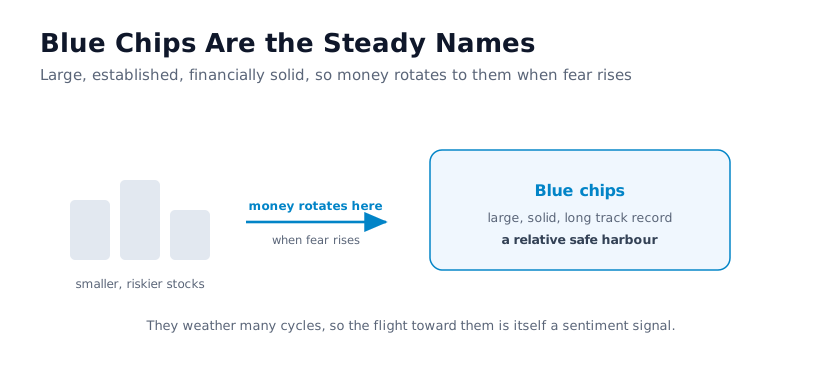
A blue-chip stock is a share in a large, well-established, financially solid company with a long track record, think the household names that have weathered many cycles. They are defined by size, financial strength, market leadership and often a reliable dividend. They tend to be steadier than smaller, riskier stocks, which is why investors often rotate toward them as a relative safe harbour when the mood turns fearful, though no stock is ever truly safe. This is education, not financial advice.
CFGI data
In a fearful market, money tends to rotate toward steady blue chips and away from risk, the same flight to safety CFGI reads as a signal. The Stock Fear and Greed Index scores that mood from 0 to 100, updated daily since 2021.
Source: CFGI methodology and dataset, 2021 to June 2026.
Key takeaways
- Blue chips are large, established, financially solid companies.
- They are defined by size, strength, leadership and often a dividend.
- They trade stability for less explosive growth.
- They are relatively steady, but never truly risk-free.
- Money often rotates toward them when fear rises.
What Is a Blue-Chip Stock?
The term comes from the highest-value chip in poker. A blue-chip stock is a share in a big, dependable company: a market leader with a long history, steady profits and, often, a reliable dividend. These are the names most people have heard of, the kind that have survived recessions and kept going. They are typically the largest members of major indices, the established giants rather than the up-and-comers.
What Makes a Stock a Blue Chip
There is no official checklist, but blue chips share a recognisable profile.
- Size: a large market capitalisation, usually one of the biggest companies in its market.
- Track record: a long history of operating, and surviving, through multiple economic cycles.
- Financial strength: solid balance sheets, dependable profits and manageable debt.
- Market leadership: a dominant, well-known position in its industry.
- Reliable dividends: many, though not all, pay a steady and often growing dividend.
Put together, these traits describe a mature, financially sturdy market leader, the kind of company investors trust to still be standing decades from now.
The Blue-Chip Trade-Off
Blue chips offer stability in exchange for excitement. They will not usually deliver the explosive gains of a small, speculative stock, a giant company simply cannot double in size as easily as a tiny one, but they are also far less likely to collapse. That makes them the classic "sleep well at night" holding: a core position you can own without watching it daily. For many investors, blue chips form the steady foundation of a portfolio, providing dependable, often dividend-paying ballast, while racier growth or speculative names, if held at all, sit around the edges. The trade-off is deliberate: you give up some upside for a lot less drama.
That ballast role is why blue chips tend to be most appreciated in bad times rather than good. During a roaring bull market, they often look dull next to soaring speculative names, and impatient investors are tempted to abandon them for something racier, frequently right before a downturn rewards the steadier choice. The discipline of holding quality through the boom, so it is there to cushion the bust, is one of the quieter virtues of a blue-chip core, and one the most exciting markets make hardest to keep.
Are Blue Chips Actually Safe?
Here an honest caution is essential: "blue chip" describes a reputation, not a guarantee. These companies are relatively stable, not risk-free, and they can and do fall in downturns, just usually less violently than smaller, speculative stocks. History is littered with former blue chips, household names once considered untouchable, that were disrupted, mismanaged or wiped out entirely. A dominant position today is no promise of survival tomorrow. So while blue chips are a sensible anchor for many portfolios, treating any single one as completely safe is a mistake, which is exactly why diversification matters even among the bluest of blue chips.
Reputation, Not a Guarantee
Yesterday’s untouchable blue chips have gone bankrupt before. "Blue chip" lowers risk; it does not remove it. No single stock is truly safe.
Blue Chips, Value and Defensives
Blue chips overlap heavily with two related ideas. Many are value stocks, trading on solid present-day fundamentals rather than distant promise, and many are defensive stocks, in industries like consumer staples and utilities whose demand holds up in any economy. The common thread is steadiness: established earnings, real dividends, and businesses that do not depend on perfect conditions to survive. This is why, when markets get nervous, money tends to flow toward this whole cluster, a "flight to quality" in which investors swap speculative bets for the dependable giants they trust to weather a storm.
How Blue Chips Fit Sentiment
Blue chips are the equity market’s defensive corner. When the crowd turns fearful and sells riskier, growth-focused stocks, money often rotates toward blue chips, part of the broader flight to safety. A market where defensives hold up while growth falls is usually a market growing cautious, even if the headline index looks calm. CFGI reads that risk-versus-safety rotation into the Stock Fear and Greed Index, so the quiet shift toward blue chips that marks a nervous market shows up in the score before it is obvious in the headlines.
Frequently asked questions
What makes a stock a blue chip?
Size, stability, a long track record, financial strength and market leadership. Blue chips are established giants, often paying steady dividends, that have weathered many market cycles, named after the highest-value chip in poker.
Are blue-chip stocks safe?
They are relatively stable, not risk-free. They can still fall in a downturn, just usually less violently than smaller, speculative stocks, and even former blue chips have gone bankrupt. "Blue chip" lowers risk but does not remove it.
What is the trade-off with blue chips?
Stability for less explosive growth. A giant company rarely doubles quickly, but it is also far less likely to collapse, making blue chips a steady "sleep well at night" core holding rather than a high-upside speculation.
Why do blue chips do well when fear rises?
Because investors rotate toward stability in a risk-off mood, a "flight to quality". As money leaves riskier stocks, defensive blue chips often hold up better, which a Fear and Greed Index reads as part of a cautious market. This is education, not financial advice.
CFGI.io, Market sentiment research
The CFGI research team builds and maintains the CFGI Fear and Greed Index: a 0 to 100 sentiment score from 10 sub-indicators across hundreds of crypto assets and the equity market, refreshed every 15 minutes. We have tracked market emotion through multiple full crypto and equity cycles.
Think we missed something?
Spotted a gap, disagree with a take, or think we should cover a new topic? Message us and we'll act on your input.
Message us on TelegramKeep reading
This article is educational and is not financial advice. Crypto and equities are volatile and you can lose money. See our disclaimer.