Markets
What Is Money?
Quick answer
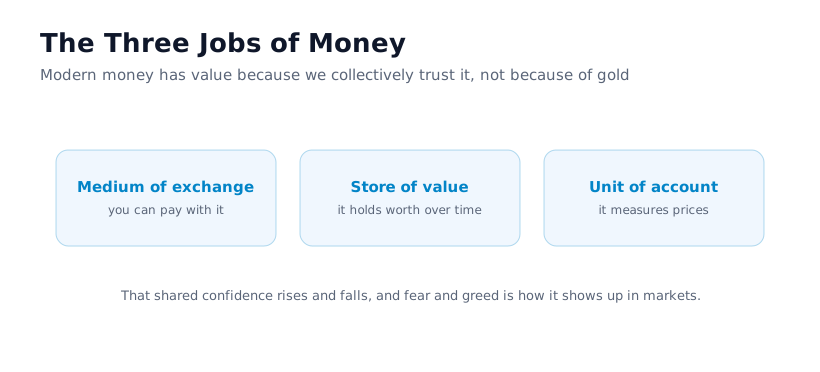
Money is anything widely accepted as payment. It does three jobs: a medium of exchange, a store of value and a unit of account. Modern money is "fiat", not backed by gold; its value rests on collective confidence that everyone else will accept it too. From shells to gold to paper to crypto, money has grown steadily more abstract and more trust-based. When that confidence moves, you see it as fear and greed. This is education, not financial advice.
CFGI data
If money is collective confidence, the Terra Luna collapse is what its failure looks like. CFGI scored crypto at a low of 17 on 12 May 2022 as a stablecoin lost its dollar peg and confidence drained away. That 0 to 100 fear and greed reading has tracked the mood since March 2022.
Source: CFGI dataset, March 2022 to June 2026.
Key takeaways
- Money is a medium of exchange, a store of value and a unit of account.
- It has evolved from shells and gold to paper and now digital numbers.
- Modern money has value because people collectively believe it does.
- That shared confidence rises and falls, and shows up as fear and greed.
- CFGI measures that confidence as a 0 to 100 score across crypto and equities.
What Is Money, Really?
Money is anything a society widely accepts in exchange for goods, services or debts. It does not have to be coins or notes. It has been shells, cattle, salt, gold, paper and now numbers in a database. What matters is acceptance, not the material: a thing becomes money the moment enough people will reliably take it in trade, and stops being money the moment they will not. This is the first and most surprising truth about money, that it is defined by a social agreement rather than by any physical property of the object itself.
What Does Money Actually Do?
Economists give money three jobs:
| Function | What it means |
|---|---|
| Medium of exchange | You can swap it for anything, so you avoid bartering |
| Store of value | It holds worth over time, so you can save it for later |
| Unit of account | It is the common ruler that prices everything else |
The three functions of money.
The first job is the one that makes economies possible: without money, you would need a "double coincidence of wants", finding someone who has what you want and wants what you have, to trade at all. Money solves that, and the other two jobs follow.
A Short History of Money
Money has evolved through recognisable stages, each more abstract than the last. It began with barter, which is clumsy, and gave way to "commodity money", real things with inherent value used as a medium of exchange, like gold, silver, salt or shells. Next came "representative money", paper notes that were claims on a commodity, the classic example being banknotes once redeemable for gold. The modern stage is "fiat money": currency that is not backed by any commodity at all, but is declared legal tender by a government and accepted purely on trust. Crypto represents a possible next step, "digital money" whose scarcity and rules are enforced by code and a network rather than a state. The throughline of this whole history is a steady march from the tangible to the abstract, from money you could bite to test, toward money that is, in the end, pure shared belief, which is exactly why confidence matters so much.
Why Is Money Based On Belief?
Most modern money is fiat: it is not backed by gold or anything physical. A banknote is worth something only because everyone agrees it is, and trusts that the next person will accept it too. That shared trust is the whole foundation, a ten-dollar bill is just a piece of paper, valuable solely because of a vast, unspoken collective agreement that it is. Crypto takes the idea further: a coin has value because a network of people collectively decides it does, with no government decree at all. In both cases, value is confidence. This is not a flaw or a trick; it is simply what money is, and recognising it is the key to understanding why the value of money, and of everything priced in it, can shift so dramatically on changes in belief. To learn how that plays out across assets, see what financial markets are.
Value Is Collective Confidence
Fiat money has no commodity backing; a banknote is worth something only because everyone agrees and trusts others will accept it too. Money is, at bottom, a shared belief, which is why confidence is everything.
What Happens When Confidence Moves?
If value is confidence, then fear and greed is confidence in motion. When trust surges, prices run on greed. When it cracks, fear takes over and prices fall faster than any fundamental justifies. The most dramatic illustrations are moments when confidence in a form of money collapses outright: the Terra/Luna disaster of May 2022, when a stablecoin designed to always be worth a dollar suddenly lost its peg and spiralled to near zero, was precisely a catastrophic failure of collective confidence, and CFGI scored crypto at a low of 17 as the fear rippled outward. That is why measuring sentiment is really measuring belief. The Fear and Greed Index turns that belief into a number from 0 to 100, so you can watch collective confidence rise and fall in real time.
Frequently asked questions
What is money?
Anything a society widely accepts in exchange for goods, services or debts. It need not be coins or notes, it has been shells, gold, paper and now digital numbers. What makes something money is acceptance, a social agreement, not its physical material.
What are the three functions of money?
A medium of exchange (you can swap it for anything, avoiding barter), a store of value (it holds worth over time) and a unit of account (it is the common measure that prices everything else).
What gives money its value?
Collective confidence. Fiat money is not backed by gold; it is worth something because people accept it and trust that others will too. Crypto goes further, with value resting on a network’s shared belief. When that confidence moves, markets move with it.
Is cryptocurrency money?
Some of it functions as money, and stablecoins are designed to. Like all money, crypto has value because a network of people collectively believe it does, the next stage in money’s march from the tangible to the abstract. This is education, not financial advice.
CFGI.io, Market sentiment research
The CFGI research team builds and maintains the CFGI Fear and Greed Index: a 0 to 100 sentiment score from 10 sub-indicators across hundreds of crypto assets and the equity market, refreshed every 15 minutes. We have tracked market emotion through multiple full crypto and equity cycles.
Think we missed something?
Spotted a gap, disagree with a take, or think we should cover a new topic? Message us and we'll act on your input.
Message us on TelegramKeep reading
This article is educational and is not financial advice. Crypto and equities are volatile and you can lose money. See our disclaimer.