Stocks
What Is a Stock?
Quick answer
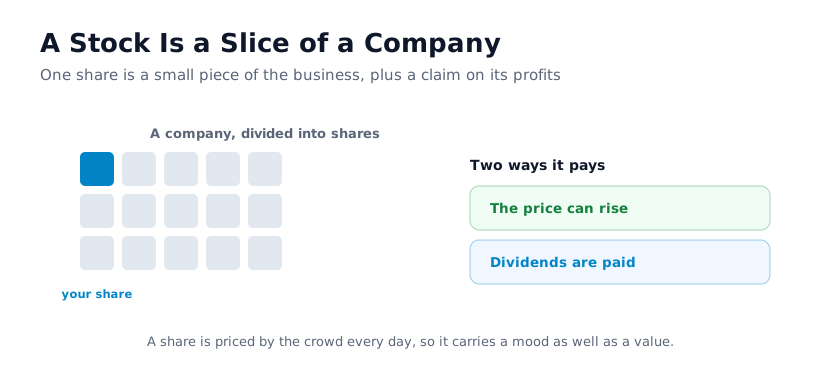
A stock, also called a share, is a unit of ownership in a company. Buy one and you own a small slice of the business, including a claim on its future profits. Stocks make money two ways: the price can rise (capital gains), and many pay dividends. They offer higher long-run returns than cash or bonds but carry more risk. Because a share is priced by the crowd every day, it carries a mood as well as a value. This is education, not financial advice.
CFGI data
Stocks reach greed too, and CFGI puts a number on it. The Stock Fear and Greed Index climbed to a high of 83 on 19 December 2023, the most confident the equity crowd has been on record, on a 0 to 100 scale spanning major indices and the most-traded stocks, updated daily since 2021.
Source: CFGI dataset, 2021 to June 2026.
Key takeaways
- A stock is a unit of ownership in a company.
- Companies issue stock to raise money without taking on debt.
- Stocks make money through price gains and dividends.
- They offer higher long-run returns than cash, with more risk.
- A share is priced by the crowd, so it carries a mood.
What Is a Stock?
A stock is a small piece of ownership in a company. Companies divide themselves into shares and sell them to raise money; when you buy a share, you become a part-owner, however small. That ownership comes with a claim on the company’s future profits and, often, a vote on big decisions. Shares trade on a stock exchange, where their price changes continuously as buyers and sellers meet. Owning a share is not like lending money or holding a token, it makes you a genuine, if tiny, owner of a real business, with a stake in its success or failure.
Why Companies Issue Stock
From the company’s side, selling stock is a way to raise money to grow, build factories, hire staff, fund research, without borrowing it and taking on debt. In exchange for that capital, the company gives up a slice of its ownership to the new shareholders. A private company first sells shares to the public through an initial public offering, or IPO, which is the "primary market" where the company itself receives the money. After that, those shares change hands between investors on the exchange, the "secondary market", where the company is no longer directly involved; it is investors trading ownership among themselves. This distinction matters: when you buy Apple stock today, your money goes to the previous shareholder, not to Apple. The price simply reflects what investors will currently pay for a piece of the company.
How Do Stocks Make Money?
- Capital gains: the share price rises and you sell for more than you paid.
- Dividends: many companies pay out a slice of profits to shareholders. See dividends.
Over the long run, share prices tend to track a company’s earnings, as a business grows more valuable, so does a claim on it. Over the short run, though, they track how the crowd feels about those earnings, which is why prices swing far more than the underlying businesses do. A great company can see its stock fall in a panic, and a mediocre one can soar on hype, because in the short term, mood, not maths, sets the price.
Stocks, Risk and Reward
Stocks sit at the higher-risk, higher-reward end of the traditional investing spectrum. Historically, over long periods, they have delivered better returns than safer assets like bonds or cash, a premium investors earn for taking on more risk. But that risk is real: share prices can fall sharply, a company can perform badly, and in the worst case, if a company goes bankrupt, its stock can become worthless. Unlike a bond, a stock makes no promise to pay you back. This is why diversification, owning many stocks rather than betting everything on one, and a long time horizon matter so much: spreading risk and giving the market years to recover from downturns are how investors try to capture the long-run reward of stocks while surviving their short-run volatility. The trade-off, more growth potential in exchange for more uncertainty, is the essence of equity investing.
Higher Reward, Real Risk
Stocks have historically out-returned cash and bonds over the long run, the reward for taking more risk. But that risk is genuine: prices can fall hard, and a failed company’s stock can go to zero.
Why Does a Stock Have a Mood?
Because its price is set by people, not a formula. The same company can see its stock rise on optimism and fall on fear with no change to the business itself, a fact that makes no sense if a price were pure maths, but perfect sense once you see that a price is the crowd’s shifting opinion. That gap between value and mood is investor sentiment, and it is what CFGI measures. The equity crowd has its own character, quick to panic but slow to celebrate, with the score reaching a confident high of 83 in its greediest moment. CFGI scores stocks individually on the Stock Fear and Greed Index, so you can read a single share’s mood, not just the market’s, separating how a stock feels from what it is fundamentally worth.
Frequently asked questions
What is a stock?
A unit of ownership in a company, also called a share. Buy one and you own a small slice of the business, with a claim on its future profits and often a vote. Shares trade on an exchange, where their price changes continuously.
Why do companies issue stock?
To raise money to grow without taking on debt, giving up a slice of ownership in exchange. A company first sells shares in an IPO (the primary market); after that, investors trade them among themselves on the exchange (the secondary market).
How do you make money from stocks?
Two ways: the share price rising (capital gains), and dividends, the share of profits some companies pay out. Over the long run prices track earnings; over the short run they track sentiment. Both carry risk.
Are stocks risky?
Yes. They offer higher long-run returns than cash or bonds, but prices can fall sharply and a bankrupt company’s stock can go to zero. Diversification and a long time horizon are how investors manage that risk. This is education, not financial advice.
CFGI.io, Market sentiment research
The CFGI research team builds and maintains the CFGI Fear and Greed Index: a 0 to 100 sentiment score from 10 sub-indicators across hundreds of crypto assets and the equity market, refreshed every 15 minutes. We have tracked market emotion through multiple full crypto and equity cycles.
Think we missed something?
Spotted a gap, disagree with a take, or think we should cover a new topic? Message us and we'll act on your input.
Message us on TelegramKeep reading
This article is educational and is not financial advice. Crypto and equities are volatile and you can lose money. See our disclaimer.