Stocks
What Is the Stock Fear and Greed Index?
Quick answer
The Stock Fear and Greed Index is a single score, from 0 to 100, that captures how fearful or greedy stock investors are right now. 0 is extreme fear, 100 is extreme greed. It is built from measurable signals like volatility, market breadth and safe-haven demand, so you can read the mood of the equity market at a glance. Contrarians watch its extremes, because the crowd is most one-sided, and most often wrong, when fear or greed is at its peak. This is education, not financial advice.
CFGI data
CFGI scores stock market sentiment from 0 to 100, updated daily since 2021, across major indices and the most-traded stocks. The equity crowd has spanned the full scale, from an extreme-fear 3 on 8 April 2025 to a high of 83 on 19 December 2023, fear arriving fast while euphoria stays scarce.
Source: CFGI dataset, 2021 to June 2026.
Key takeaways
- A 0 to 100 score of the stock market mood: 0 fear, 100 greed.
- Built from signals like volatility, breadth and safe-haven demand.
- The signal lives at the extremes; the middle is noise.
- Contrarians use it as context and a check on their own emotion.
- CFGI scores stocks individually, not just one market number.
What Is the Stock Fear and Greed Index?
It is the equity version of a Fear and Greed Index: one number, from 0 to 100, telling you how fearful or greedy stock investors are. Rather than reading dozens of charts, you get the market’s mood at a glance. The CNN Fear and Greed Index popularised the format, and the idea rests on a simple truth: the stock market is driven, especially in the short run, as much by collective emotion as by fundamentals, so measuring that emotion is genuinely useful.
How Do You Read the Score?
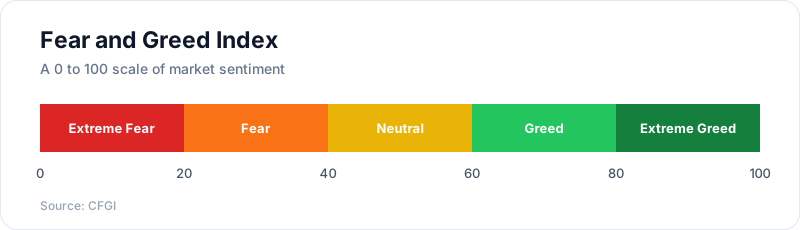
The scale splits into five zones, from Extreme Fear under 20 to Extreme Greed at 80 and above, with Neutral around 50. But the most important thing to understand is that the index is not equally informative across its range. The signal concentrates at the two extremes, where the crowd is most one-sided, and fades to noise in the neutral middle. So reading the score well means paying close attention when it reaches an extreme and largely ignoring it when it sits around 50. In CFGI’s equity history the score has run the full width, from a panicked 3 to a confident 83.
What Does It Measure?
Equity sentiment is read from market behaviour, not opinion. The index blends signals such as price momentum, volatility and the VIX, market breadth (how many stocks are participating), safe-haven demand (money favouring stocks or fleeing to bonds), and options positioning. Each captures a different facet of fear and greed, and because they are concrete and measurable, the result is an honest, repeatable read of how the crowd is positioned rather than how it claims to feel. CFGI combines these into one daily score, daily rather than the 15 minutes used for crypto, because stock exchanges trade on set hours and close overnight.
The Contrarian Use
The reason to watch the index is the contrarian insight that the crowd tends to be most wrong at its emotional extremes. When everyone is greedy and fully invested, there are few buyers left to push prices higher; when everyone is fearful and has sold, there are few sellers left to drive them lower. This is the logic behind "be fearful when others are greedy, and greedy when others are fearful". So an Extreme Fear reading historically clusters nearer market lows and an Extreme Greed reading nearer tops, though neither times the turn precisely. Just as valuable is the personal use: the index is a check on your own emotions, because you are part of the crowd it measures, and seeing the gauge at an extreme is a prompt to slow down rather than act on feeling.
A Mirror As Much As a Window
The Stock Fear and Greed Index shows the crowd’s mood, but it also reflects your own. When it screams an extreme, that is the cue for independent thinking, not for joining the herd.
What Makes CFGI Different?
The big difference is breadth. CFGI scores stocks individually, not just the market as a whole, and reads equities and crypto on the same 0 to 100 scale. So it can show the equity crowd cautious while crypto runs hot, or one stock fearful while another is greedy, distinctions a single market-wide number simply erases. It also scores the major indices and the most-traded stocks separately, so you can drill from the overall mood down to the names driving it. That per-asset, cross-market granularity turns "how does the market feel?" into the far more useful "how does each part of the market feel, and how do they compare?" Read it live on the Stock Fear and Greed Index.
How to Use It
Used well, the index is context, not a trigger. Weight the extremes over the noisy middle, read the direction the score is travelling as well as its level, and confirm any action with the trend, valuations and your own plan rather than acting on the number alone. Remember its honest limit: it reads the present mood accurately but forecasts the next move poorly, agreeing with the same day far more than the next. So it is best used to gauge how stretched the crowd has become and to keep your own emotions in check, not to time the market. As one input among several, a clean read of equity sentiment, it consistently adds value; as a standalone buy or sell signal, it disappoints, like any honest measure of mood.
Frequently asked questions
What is the Stock Fear and Greed Index?
A single score from 0 to 100 that captures how fearful or greedy stock investors are right now, where 0 is extreme fear and 100 is extreme greed. It is built from measurable signals like volatility, breadth and safe-haven demand.
How is the Stock Fear and Greed Index calculated?
CFGI combines measurable equity signals, including price momentum, volatility and the VIX, market breadth, safe-haven demand and options positioning, into one 0 to 100 score, updated daily across indices and leading stocks.
How do you read the score?
By its zone, from Extreme Fear under 20 to Extreme Greed at 80 and above, but mainly by weighting the extremes, where the crowd is most one-sided, over the neutral middle, which is mostly noise. The direction it is moving matters too.
What makes CFGI different from other Fear and Greed indexes?
CFGI scores stocks individually, not just one market number, and reads equities and crypto on the same scale, so it can show one stock fearful while another is greedy, or stocks cautious while crypto runs hot, distinctions a single gauge erases. This is education, not financial advice.
CFGI.io, Market sentiment research
The CFGI research team builds and maintains the CFGI Fear and Greed Index: a 0 to 100 sentiment score from 10 sub-indicators across hundreds of crypto assets and the equity market, refreshed every 15 minutes. We have tracked market emotion through multiple full crypto and equity cycles.
Think we missed something?
Spotted a gap, disagree with a take, or think we should cover a new topic? Message us and we'll act on your input.
Message us on TelegramKeep reading
This article is educational and is not financial advice. Crypto and equities are volatile and you can lose money. See our disclaimer.