Stocks
What Is a Dividend?
Quick answer
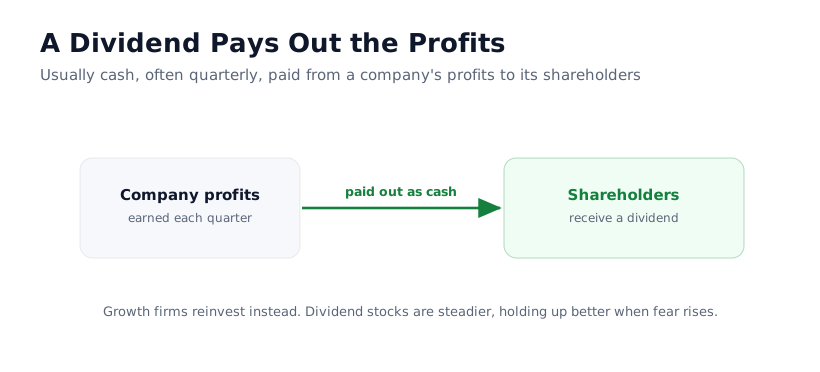
A dividend is a share of a company’s profits paid out to its shareholders, usually as cash, often every quarter. Not all companies pay them: younger, growth-focused firms tend to reinvest instead. A dividend is measured as a yield, the annual payout divided by the share price, and reinvested dividends compound into a large share of long-run stock returns. Dividend-paying stocks are often seen as steadier and more defensive, which is why they can hold up better when the mood turns fearful. This is education, not financial advice.
CFGI data
Defensive, dividend-paying stocks often hold up when fear rises, the same flight to safety CFGI reads as a signal. Its Stock Fear and Greed Index scores that mood from 0 to 100, updated daily since 2021, so the rotation between risk and safety is visible.
Source: CFGI methodology and dataset, 2021 to June 2026.
Key takeaways
- A dividend is a share of profits paid to shareholders, usually quarterly.
- The key dates are the ex-dividend, record and payment dates.
- Yield is the annual dividend divided by the price.
- Reinvested dividends compound into much of long-run returns.
- Dividend stocks are often seen as steadier and defensive.
What Is a Dividend?
When a company makes a profit, it can either reinvest it in the business or hand some back to shareholders. That payout is a dividend. Mature, profitable companies, think large consumer or utility firms, often pay regular dividends, while fast-growing companies usually keep every penny to fuel growth. A dividend is a genuine return on owning a stock that does not depend on the share price rising at all, which is a meaningful part of its appeal.
How Dividends Work: The Key Dates
A company’s board "declares" a dividend, then a sequence of dates determines who gets paid. The one that trips people up is the ex-dividend date: you must own the shares before it to receive the upcoming payment.
| Date | What it means |
|---|---|
| Declaration date | The board announces the dividend |
| Ex-dividend date | Buy before this day to receive it |
| Record date | The company checks who owns the shares |
| Payment date | The cash actually arrives |
The dividend timeline.
On the ex-dividend date, the share price typically drops by roughly the dividend amount, because new buyers no longer receive that payment, so the dividend is not "free money".
Yield and Payout Ratio
Two numbers describe a dividend. The "dividend yield" is the annual dividend divided by the share price, so a stock paying 2 dollars a year at a 50 dollar price yields 4%. The "payout ratio" is the share of earnings paid out as dividends, and it measures sustainability: a company paying out 40% of profits has plenty of room, while one paying out 90% or more has little cushion if earnings dip. A very high yield can be a warning rather than a gift, it often means the price has fallen because the market expects the dividend to be cut, the so-called "yield trap".
A High Yield Can Be a Warning
An unusually high dividend yield often reflects a falling share price, not generosity. Check the payout ratio: if the company cannot afford the dividend, a cut may be coming.
Why Dividends Matter: Total Return and Compounding
Your real return from a stock is its "total return": price gains plus dividends. Over long periods, reinvested dividends have historically contributed a remarkably large share of the stock market’s total return, because each payment buys more shares, which then pay their own dividends, a compounding snowball. A steady, growing dividend also says something reassuring about a company: the famous "dividend aristocrats" have raised their payouts for 25 years or more, a track record only durable businesses can sustain. Conversely, a dividend cut is a serious red flag, since boards are deeply reluctant to make them and usually only do so under real pressure.
Dividends Versus Buybacks
Dividends are one of two main ways companies return cash; the other is a share buyback. The differences matter. A dividend returns cash to every shareholder and is taxed when you receive it; a buyback returns cash only to those who sell and defers tax until you do, while lifting earnings per share by shrinking the share count. Over the past decade, buybacks have actually eclipsed dividends as the favoured method in the US, which is part of why the broad market’s dividend yield has slipped below 2%, down from a historical 3% to 6%. Notably, companies that do both have tended to outperform those that only pay dividends.
How Dividends Connect to Sentiment
Dividend-paying stocks are often defensive: their steady income makes them less reliant on optimism, so they tend to hold up better when the crowd turns fearful and sells riskier, growth-focused names. A rotation into defensive dividend stocks is part of the broader flight to safety that marks a fearful market. CFGI reads that risk-versus-safety rotation into the Stock Fear and Greed Index, so when money moves toward steady income and away from speculative growth, the gauge tends to register the cooling mood.
Frequently asked questions
Do all stocks pay dividends?
No. Mature, profitable companies often do, while growth companies usually reinvest their profits instead. A stock with no dividend can still be a good investment through price gains.
What is the ex-dividend date?
The cut-off to qualify for the next dividend: you must own the shares before the ex-dividend date to receive the payment. On that date, the price typically drops by roughly the dividend amount.
What is a dividend yield?
The annual dividend divided by the share price, expressed as a percentage. A very high yield can be a warning, often signalling a falling price and a possible dividend cut, so check the payout ratio for sustainability.
Why are dividend stocks called defensive?
Because their steady income makes them less dependent on optimism, so they often hold up better in fearful markets. Money tends to rotate toward them in a risk-off mood. This is education, not financial advice.
CFGI.io, Market sentiment research
The CFGI research team builds and maintains the CFGI Fear and Greed Index: a 0 to 100 sentiment score from 10 sub-indicators across hundreds of crypto assets and the equity market, refreshed every 15 minutes. We have tracked market emotion through multiple full crypto and equity cycles.
Think we missed something?
Spotted a gap, disagree with a take, or think we should cover a new topic? Message us and we'll act on your input.
Message us on TelegramKeep reading
This article is educational and is not financial advice. Crypto and equities are volatile and you can lose money. See our disclaimer.