Stocks
What Does the Stock Fear and Greed Index Measure?
Quick answer
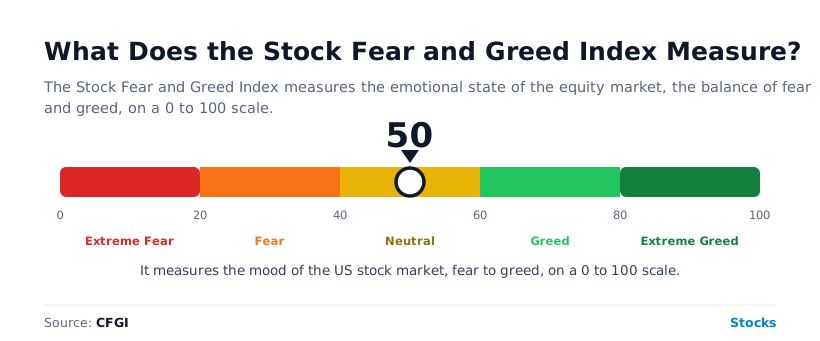
The Stock Fear and Greed Index measures the emotional state of the equity market: the balance between fear and greed among investors, expressed as a single number from 0 to 100. It does not measure value, earnings or what stocks are worth. It measures mood, how confident or fearful the crowd is right now, by blending indicators of momentum, volatility, breadth and demand for safety. Mood and value are two separate questions, and the index answers only the first. This is education, not financial advice.
CFGI data
CFGI measures emotion, not value. Its equity score blends 10 indicator groups into one 0 to 100 read of fear versus greed, scored daily since 2021. The 3 on 8 April 2025 and 83 on 19 December 2023 measured how fearful and how greedy the crowd was, not what stocks were worth.
Source: CFGI dataset, 2021 to June 2026.
Key takeaways
- It measures the equity market’s emotional state.
- It captures the balance of fear and greed, 0 to 100.
- It blends momentum, volatility, breadth and safe-haven demand.
- It does not measure value, earnings or fair price.
- Mood and value are separate questions; it answers only mood.
Mood, Not Value
It is easy to assume a Fear and Greed Index measures whether stocks are cheap or expensive. It does not. It measures emotion, how fearful or greedy investors are, which is a different thing entirely. A market can be expensive and greedy, or cheap and fearful; the index reports the mood, and leaves the question of value to you. It does this by synthesising several signals, momentum, volatility, market breadth, demand for safety, into one number, so the reading reflects the whole emotional picture rather than any single gauge.
What Exactly It Captures
The index measures mood by reading what investors actually do, not what they say. It folds together several behavioural signals, each a different facet of fear and greed: price momentum (is the market trending up or down relative to its averages?), volatility (how nervous are options markets?), market breadth (how many stocks are participating?), safe-haven demand (is money favouring stocks or fleeing to bonds?), and options positioning. Because each of these is concrete and measurable, the resulting score is an honest, repeatable read of how the crowd is positioned, rather than a survey of opinions, which is precisely what lets it sometimes contradict the prevailing headlines.
What It Does Not Measure
Being clear about the boundaries keeps you from misusing it. The index does not measure valuation, whether stocks are cheap or dear, nor earnings, growth or any fundamental. It does not measure the health of the economy directly, nor the quality of any individual company. And it does not forecast: it reads the present mood, not the next move. It is a measure of one dimension only, the crowd’s emotional state, and trying to read value, fundamentals or a prediction out of it is asking it to do jobs it was never built for. Knowing what it leaves out is as important as knowing what it captures.
One Dimension, Measured Well
The index measures emotion, and only emotion. It says nothing about value, fundamentals or the future, which is why it works best alongside those things, not instead of them.
Mood and Value: Two Separate Questions
The most useful way to hold this is that investing involves two distinct questions, and the index answers only one. "How does the crowd feel?" is the mood question, which the Fear and Greed Index measures. "What is it actually worth?" is the value question, which fundamental analysis answers. The two combine into a richer picture: a market that is cheap and fearful may be an opportunity, while one that is expensive and greedy may be a risk, and the most interesting situations are where mood and value disagree. Reading the index without the value question, or the value question without the mood, leaves you with half the picture. Measuring emotion is valuable precisely because it is the half that fundamentals ignore.
This is also why the index pairs so naturally with valuation tools. A measure like the price-to-earnings ratio tells you how richly stocks are priced; the Fear and Greed Index tells you how the crowd feels about that price. Together they can show, for instance, that a market is both expensively valued and euphorically greedy, a combination far more telling than either signal alone. The index never tries to answer the value question, but by answering the mood question cleanly, it makes whatever valuation work you do more useful, not less.
Why Measuring Mood Is Useful
Mood matters because it drives behaviour, and behaviour drives prices in the short run. Knowing the crowd is in Extreme Fear or Extreme Greed is useful context for your own decisions, and a check on your own emotions, since you are part of the crowd it measures. The Stock Fear and Greed Index measures that mood so you can read it at a glance, turning a vague sense of "the market feels nervous" into a concrete number you can compare against history and weigh alongside the fundamentals. It is one clean reading of the emotional half of investing.
Frequently asked questions
What does the Stock Fear and Greed Index measure?
The emotional state of the equity market, the balance of fear and greed among investors, on a 0 to 100 scale, by blending behavioural signals like momentum, volatility, breadth and safe-haven demand. It measures mood, not value.
Does it measure whether stocks are cheap or expensive?
No. It measures emotion, not valuation. A market can be expensive and greedy or cheap and fearful; the index reports the mood and leaves the value question to fundamental analysis.
What does it not measure?
Valuation, earnings, fundamentals, the economy directly, or the future. It reads one dimension, the crowd’s present emotional state, so it works best alongside fundamentals rather than instead of them.
Why is measuring mood useful?
Because mood drives behaviour and behaviour drives short-run prices. A reading of Extreme Fear or Extreme Greed is useful context and a check on your own emotions, capturing the emotional half of investing that fundamentals ignore. This is education, not financial advice.
CFGI.io, Market sentiment research
The CFGI research team builds and maintains the CFGI Fear and Greed Index: a 0 to 100 sentiment score from 10 sub-indicators across hundreds of crypto assets and the equity market, refreshed every 15 minutes. We have tracked market emotion through multiple full crypto and equity cycles.
Think we missed something?
Spotted a gap, disagree with a take, or think we should cover a new topic? Message us and we'll act on your input.
Message us on TelegramKeep reading
This article is educational and is not financial advice. Crypto and equities are volatile and you can lose money. See our disclaimer.