Stocks
What Is a Growth Stock?
Quick answer
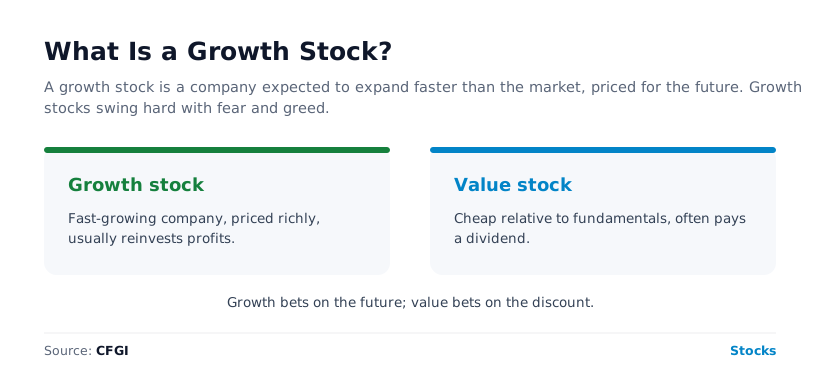
A growth stock is a company investors expect to grow revenue and earnings much faster than average, often reinvesting profits rather than paying dividends. Because their value rests on future promise, growth stocks carry high valuations, typically a high price-to-earnings ratio, and are especially sensitive to sentiment and interest rates: they soar in greed and fall hardest in fear, when investors discount distant earnings. They are the mirror of value stocks, which trade on present fundamentals. This is education, not financial advice.
CFGI data
Growth stocks amplify the mood. Their future-heavy valuations stretch most in greed and compress most in fear, so when CFGI swings, like the equity score hitting an extreme-fear 3 on 8 April 2025, growth names tend to move further than the market in both directions on the 0 to 100 scale.
Source: CFGI dataset, 2021 to June 2026.
Key takeaways
- A growth stock is expected to expand faster than the market.
- Its value rests on future earnings, so the P/E is high.
- It usually reinvests profits rather than paying dividends.
- Distant earnings make it sensitive to rates and sentiment.
- It swings hardest in both fear and greed.
Priced for the Future
Growth stocks are companies, often in technology or fast-moving sectors, whose appeal is what they might become, not what they earn today. Investors accept a high P/E ratio because they expect rapid expansion. Profits, when they come, are usually reinvested to fuel more growth rather than returned as dividends. The trade-off is sensitivity: when a valuation rests on earnings years away, anything that changes the outlook, or just the mood, moves the price sharply. Growth stocks are the opposite of value stocks, which trade on present fundamentals.
What Makes a Stock a Growth Stock
Growth stocks have a clear profile, easiest to see against their value opposites.
| Trait | Growth stock | Value stock |
|---|---|---|
| P/E ratio | High (often 30+) | Low (often near 10) |
| Dividend | Usually reinvests | Often pays one |
| Priced on | Future promise | Present fundamentals |
| Typical sector | Tech, disruptors | Banks, energy, utilities |
Growth versus value, at a glance.
The defining trait is rapidly rising revenue and earnings, fast enough that investors will pay a premium today for a much larger company tomorrow.
Why Valuations Are So High
A growth stock’s high price is not necessarily irrational, it reflects expected future earnings pulled into the present. If a company is doubling its sales every couple of years, today’s price-to-earnings ratio looks expensive but tomorrow’s may not, because the earnings are racing to catch up with the price. The danger is that this only works if the growth actually arrives. A growth stock is "priced for perfection": when a fast-growing company keeps delivering, the high multiple is justified, but any stumble, a single disappointing quarter or a cut to guidance, can trigger a brutal repricing, because so much optimism was already in the price.
Why Growth Swings Hardest
There is a deeper reason growth stocks are so volatile, borrowed from bond maths: they are "long duration" assets. Most of their value comes from earnings expected far in the future, and the further away a payoff is, the more its present value shifts when conditions change. Rising interest rates make those distant earnings worth less today, hitting growth stocks harder than value. The same is true of mood: when fear takes hold and investors discount the future steeply, growth names fall fastest; when greed returns and the future feels bright again, they rebound the most. This sensitivity is exactly why growth stocks lead in good times and lag in bad ones.
Leveraged to the Future
Because their worth sits years out, growth stocks magnify whatever the market feels about the future. Higher rates or rising fear compress them most; optimism inflates them most.
The Long Record, and the Recent Lead
Style leadership runs in long cycles. Over the very long run, value has historically edged growth, by about 4.4% a year in the US since 1927, but the past decade flipped the script: a handful of giant technology growth companies dominated the market and left value far behind. Neither style wins forever, which is why their relative performance is best thought of as cyclical rather than settled. Buffett’s own view is that the distinction is somewhat artificial, since "growth is always a component in the calculation of value". For most investors, the lesson is to hold both, capturing growth’s upside while value cushions the inevitable rotations.
Growth Stocks and Sentiment
Because their worth is future-weighted, growth stocks are leveraged to fear and greed. In greed, investors happily pay up for promise and growth names stretch to rich valuations; in fear, they discount the future hard and growth falls fastest, which is why deep-fear episodes like CFGI’s equity score hitting 3 in April 2025 tend to hurt growth most. A Stock Fear and Greed Index is useful context for how exposed the market is: when sentiment is euphoric and growth multiples are stretched, the downside if the mood turns is greatest precisely where the optimism is thickest.
Frequently asked questions
What is a growth stock?
A company expected to grow revenue and earnings much faster than average. Its value rests on future promise, so it carries a high P/E and usually reinvests profits rather than paying dividends.
Why are growth stocks volatile?
Because most of their value comes from earnings years away. As "long duration" assets, they are highly sensitive to interest rates and sentiment, so small changes in the outlook or mood move the price sharply.
Why do growth stocks have high P/E ratios?
Because the price reflects expected future earnings, not just current ones. If rapid growth arrives, the high multiple is justified, but the stock is "priced for perfection" and a single stumble can trigger a sharp fall.
Growth stocks or value stocks?
Neither is better in all conditions. Growth has led the past decade, but value edged it over the long run since 1927, and leadership rotates in cycles. Many investors hold both. This is education, not financial advice.
CFGI.io, Market sentiment research
The CFGI research team builds and maintains the CFGI Fear and Greed Index: a 0 to 100 sentiment score from 10 sub-indicators across hundreds of crypto assets and the equity market, refreshed every 15 minutes. We have tracked market emotion through multiple full crypto and equity cycles.
Think we missed something?
Spotted a gap, disagree with a take, or think we should cover a new topic? Message us and we'll act on your input.
Message us on TelegramKeep reading
This article is educational and is not financial advice. Crypto and equities are volatile and you can lose money. See our disclaimer.