Stocks
What Is a Defensive Stock?
Quick answer
A defensive stock is one that tends to hold its value when the economy weakens, because it sells things people need regardless of conditions: electricity, food, household basics, healthcare. Utilities and consumer staples are the classic examples. Because demand for essentials is steady, defensives are less volatile, pay reliable dividends, and tend to hold up best, or fall least, when fear takes hold of the market. The trade-off is that they rarely deliver the explosive gains of racier stocks when times are good. This is education, not financial advice.
CFGI data
Defensives are where money shelters in fear. When CFGI plunges toward equity lows like the 3 on 8 April 2025 on its 0 to 100 scale, defensive sectors typically hold up better than the market, while in greed they tend to lag. The sentiment reading helps frame which side, defensive or aggressive, is in favour.
Source: CFGI dataset, 2021 to June 2026.
Key takeaways
- A defensive stock sells essentials and holds up in downturns.
- Utilities, consumer staples and healthcare are the classic sectors.
- They have low beta, low volatility and reliable dividends.
- They underperform in bull markets, the price of their stability.
- Defensive leadership over cyclicals is a sign of rising caution.
Selling What People Always Need
People keep the lights on, buy groceries and fill prescriptions whether the economy is booming or shrinking. Companies that sell those essentials, utilities, consumer staples and much of healthcare, have steadier revenues than most, which makes their shares more stable through the cycle. That stability is the whole point, and the whole trade-off: defensive stocks rarely deliver the explosive gains of cyclicals or growth stocks in good times, but they tend to cushion a portfolio when conditions turn.
What Makes a Stock Defensive
A handful of traits define the type. Demand for the product is non-discretionary, people cannot easily cut it even when money is tight, so revenues and earnings stay consistent across the cycle. That consistency shows up as a low beta, usually below one, meaning the stock swings less than the market and falls less when the market drops. And defensives are typically reliable dividend payers, returning steady cash to shareholders rather than ploughing everything into risky growth. Together these make defensive stocks the financial equivalent of a sturdy, unexciting car: not thrilling, but dependable when the road gets rough.
The Defensive Sectors
- Utilities. Electricity, gas and water, demand barely changes with the economy, the most defensive sector of all.
- Consumer staples. Food, drink, household and personal-care basics that people buy in any climate.
- Healthcare. Medicine and care driven by need and demographics, not discretionary spending.
- Real estate (in part). Some property income is steady, though it is more rate-sensitive than the others.
The Trade-Off: Defence Costs Growth
There is no free lunch. The same steadiness that protects defensives in a downturn holds them back in a boom. When the economy is expanding and risk appetite is high, investors chase the bigger gains on offer from cyclicals and growth names, and defensive stocks, with their modest, predictable earnings, get left behind. So a defensive stock can underperform for years in a strong bull market and still be doing exactly its job. The key is to judge it on relative resilience, how well it holds value when markets fall, rather than on raw upside when they soar.
Absolute Versus Relative
Defensives are not about beating the market in good times; they are about losing less in bad ones. Measured against a crash rather than a boom, their value becomes obvious.
Defensive Versus Cyclical: The Rotation
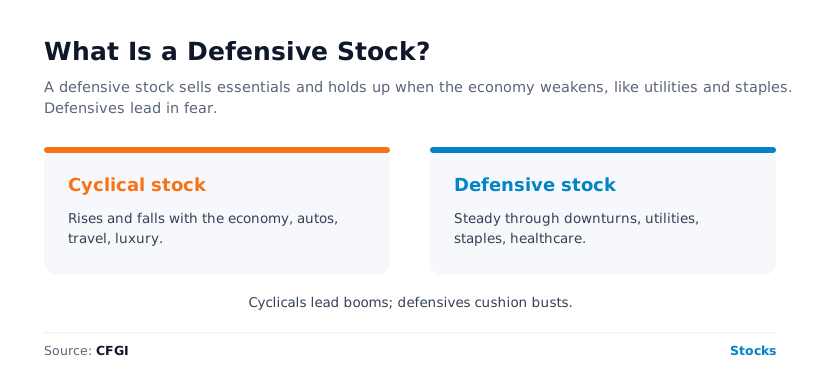
Defensives are best understood next to their opposite, cyclical stocks, which thrive when the economy is strong and fall hard when it weakens, names in consumer discretionary, mining, energy and the like. Because the two behave so differently, the balance between them is itself a market signal. When cyclicals are leading defensives, it usually reflects optimism and positioning for growth, and has historically coincided with healthy markets. When money rotates into defensives and they start to lead, it often signals rising caution and the expectation of weaker conditions ahead. Watching that rotation can tell you where the market thinks the cycle is heading.
The Proof: The Dotcom Crash
History shows defensives earning their name precisely when it matters. During the dotcom crash of the early 2000s, the broad S&P 500 fell roughly 49% from its peak, a brutal bear market. Over that same stretch, defensive sectors did the opposite of collapse: consumer staples delivered double-digit annualised returns and utilities produced strong positive total returns while the market was bleeding. Investors who held steady, dividend-paying essentials were largely shielded from the carnage in technology. It is the clearest illustration of why the boring, defensive part of a portfolio is the part you are most grateful for in a storm.
Defensives and Sentiment
Defensives are where money tends to shelter when the crowd turns fearful. As a Stock Fear and Greed Index falls toward fear on its 0 to 100 scale, defensive sectors often hold up better than the market; as greed returns and risk appetite rises, they tend to lag the racier names. That makes the rotation into and out of defensives a real-money echo of the same mood the gauge measures. Reading the two together, where money is sheltering and where sentiment sits, gives a clearer sense of whether the market is leaning brave or cautious.
Frequently asked questions
What is a defensive stock?
A stock that holds its value when the economy weakens because it sells essentials people need regardless of conditions, such as utilities, consumer staples and healthcare. They are stable, low-volatility and usually pay reliable dividends.
Why are defensive stocks less volatile?
Because demand for essentials stays steady through the cycle, their revenues and earnings are consistent, which gives them a low beta and steadier share prices than the broader market.
Do defensive stocks underperform in bull markets?
Generally yes. Their steadiness holds them back when risk appetite is high and investors chase the bigger gains of cyclicals and growth stocks. That underperformance in booms is the price of their resilience in busts.
Do defensives do well in fear?
They tend to hold up better than the market when fear takes hold and lag when greed returns. A rotation into defensives is a sign of rising caution. This is education, not financial advice.
CFGI.io, Market sentiment research
The CFGI research team builds and maintains the CFGI Fear and Greed Index: a 0 to 100 sentiment score from 10 sub-indicators across hundreds of crypto assets and the equity market, refreshed every 15 minutes. We have tracked market emotion through multiple full crypto and equity cycles.
Think we missed something?
Spotted a gap, disagree with a take, or think we should cover a new topic? Message us and we'll act on your input.
Message us on TelegramKeep reading
This article is educational and is not financial advice. Crypto and equities are volatile and you can lose money. See our disclaimer.