Stocks
What Is a Value Stock?
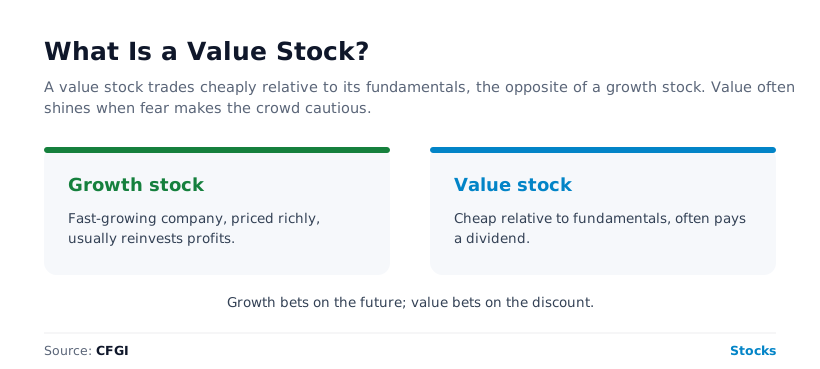
Quick answer
A value stock trades at a low price relative to its fundamentals, such as earnings, assets or dividends, often because it is overlooked, out of favour or in a slower industry. Value investors buy these in the belief the market is underpricing them, and that the gap between price and worth will eventually close. Typically these stocks have a low price-to-earnings ratio and pay a dividend. Value tends to hold up better than growth when the crowd is fearful and wary of paying for future promise. This is education, not financial advice.
CFGI data
Value and growth take turns with the mood. When CFGI sits in fear and investors distrust lofty future earnings, cheaper value names often hold up better; in greed, expensive growth tends to lead. The 0 to 100 sentiment reading is useful context for which style the market favours.
Source: CFGI dataset, 2021 to June 2026.
Key takeaways
- A value stock trades cheaply relative to its fundamentals.
- It typically has a low P/E ratio and pays a dividend.
- Value investors bet the market is underpricing it.
- The risk is a "value trap": cheap because it deserves to be.
- Value often holds up better in fearful markets.
Buying Below the Crowd’s Price
Value investing, associated with Benjamin Graham and Warren Buffett, looks for companies trading below what their fundamentals suggest they are worth. That might be a low P/E ratio, a solid dividend, or assets the market is ignoring. The bet is that the gap between price and worth eventually closes. Value stocks are the mirror of growth stocks: where growth is priced for the future, value is priced for the present, which tends to make it steadier, if less exciting.
What Makes a Stock a Value Stock
Value stocks share a recognisable fingerprint, captured most simply against their growth opposites.
| Trait | Value stock | Growth stock |
|---|---|---|
| P/E ratio | Low (often near 10) | High (often 30+) |
| Dividend | Often pays one | Usually reinvests |
| Priced on | Present fundamentals | Future promise |
| Typical sector | Banks, energy, utilities | Tech, disruptors |
Value versus growth, at a glance.
A value stock is usually a mature, established business in a slower-growing industry, cheap enough that it pays you to wait, and overlooked by a crowd chasing flashier names.
The Philosophy: Price Versus Worth
At its heart, value investing rests on a single distinction: price is what you pay, worth (or "intrinsic value") is what you get. Value investors try to estimate a company’s real worth from its earnings, assets and cash flow, then buy only when the market price sits comfortably below that estimate, a cushion Graham called the "margin of safety". The idea is to buy a dollar for fifty cents and wait for the market to recognise the mismatch. While you wait, a healthy value stock often pays a dividend, so you are paid to be patient, which is part of value investing’s enduring appeal.
The Value Trap
The central risk in value investing is the "value trap": a stock that looks cheap but is cheap for a good reason, because the business is genuinely declining. A low P/E on a company losing customers, saddled with debt, or facing obsolescence is not a bargain at all, it is a fair price for a shrinking future, and it can keep getting cheaper. The hard skill of value investing is telling a temporarily out-of-favour but sound company from a permanently broken one. Cheapness alone is not the signal; cheapness relative to a durable, underappreciated business is.
Cheap Is Not the Same As Undervalued
A falling price only makes a stock a bargain if the business is sound. A genuinely declining company can stay "cheap" all the way down. The art is separating the two.
The Long Record, and the Recent Lag
Over the very long run, value has a strong pedigree: studies find that since 1927, value stocks outperformed growth by roughly 4.4% a year in the US. But that edge is not constant. Over the past decade, a handful of giant technology growth stocks led the market and value lagged badly, a reminder that the two styles trade leadership in long cycles. Even Buffett, value’s most famous practitioner, insists the line between them is artificial, noting that "growth is always a component in the calculation of value". The practical takeaway is that most investors benefit from owning both styles rather than betting everything on one.
Value and Sentiment
Style leadership rotates with mood. In greed, investors chase growth and happily pay up for promise; in fear, they often retreat to cheaper, fundamentally grounded value names that offer dividends and present-day earnings rather than distant hopes. A Stock Fear and Greed Index helps frame which environment the market is in, and therefore which style the crowd is likely favouring. It will not tell you a value stock is cheap, that takes fundamental analysis, but it can tell you whether the broader mood is the kind that tends to reward patience over promise.
Frequently asked questions
What is a value stock?
A stock trading cheaply relative to its fundamentals, such as earnings or assets, often because it is overlooked or in a slower industry. It typically has a low P/E ratio and pays a dividend, and value investors bet the market is underpricing it.
How is a value stock different from a growth stock?
A value stock is priced for the present and its fundamentals, with a low P/E and often a dividend; a growth stock is priced for future expansion, with a high P/E and usually no dividend. Value tends to be steadier, growth more volatile.
What is a value trap?
A stock that looks cheap but is cheap for a good reason, because the underlying business is genuinely declining. It can keep getting cheaper, so the skill is telling a sound, out-of-favour company from a broken one.
Does value do better in fear?
Often. When the crowd is fearful and wary of paying for future promise, cheaper value names with real earnings and dividends tend to hold up better than expensive growth. But leadership rotates in long cycles. This is education, not financial advice.
CFGI.io, Market sentiment research
The CFGI research team builds and maintains the CFGI Fear and Greed Index: a 0 to 100 sentiment score from 10 sub-indicators across hundreds of crypto assets and the equity market, refreshed every 15 minutes. We have tracked market emotion through multiple full crypto and equity cycles.
Think we missed something?
Spotted a gap, disagree with a take, or think we should cover a new topic? Message us and we'll act on your input.
Message us on TelegramKeep reading
This article is educational and is not financial advice. Crypto and equities are volatile and you can lose money. See our disclaimer.