Stocks
What Is Market Capitalisation?
Quick answer
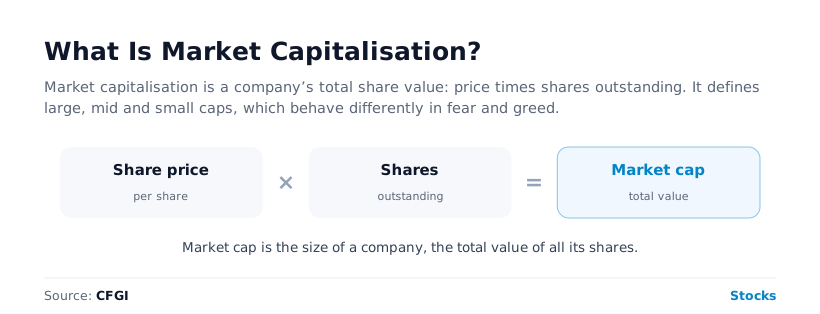
Market capitalisation, or market cap, is the total value of a company’s shares: its share price multiplied by the number of shares outstanding. It is the standard measure of a company’s size, splitting the market into mega, large, mid, small and micro caps. The big thing people get wrong is assuming a high share price means a big company; it does not, because size is price times share count, not price alone. Size also shapes sentiment: smaller companies tend to swing harder through fear and greed than large, established ones. This is education, not financial advice.
CFGI data
Size shapes how sentiment hits. Smaller caps move more violently through fear and greed than large caps, which is why a market-wide score and the experience of a single small stock can differ. CFGI scores assets individually on a 0 to 100 scale, daily for equities since 2021, so the read reflects each one, not just the giants.
Source: CFGI dataset, 2021 to June 2026.
Key takeaways
- Market cap is share price multiplied by shares outstanding.
- It is the standard measure of company size, not the share price.
- Caps run from micro to mega, each with a different character.
- Enterprise value adds debt and subtracts cash for a fuller size.
- Smaller caps tend to swing harder in fear and greed.
Measuring Company Size
A company trading at 50 dollars a share with 2 billion shares has a market cap of 100 billion dollars. That single number ranks companies by size far better than share price alone, and it splits the market into recognisable tiers.
| Category | Rough range | Character |
|---|---|---|
| Mega cap | Over 200bn | The giants, most stable |
| Large cap | 10bn to 200bn | Established, steadier |
| Mid cap | 2bn to 10bn | Growth with more risk |
| Small cap | 250m to 2bn | Volatile, sentiment-sensitive |
| Micro cap | Under 250m | Tiny, thinly traded, risky |
Rough market-cap categories.
Price Is Not Size: The Big Misconception
Here is the most common mistake in all of investing: assuming a high share price means a big, expensive company and a low one means a small, cheap company. It is simply false. There is no direct link between share price and market cap, because cap is price multiplied by share count. A stock at 600,000 dollars a share with very few shares can be smaller than a stock at 5 dollars a share with billions of them. The share price on its own tells you almost nothing about a company’s size or value; only the market cap does. Internalising that single fact clears up an enormous amount of confusion, and it is the same lesson behind why a coin’s unit price says nothing without its supply.
The Rule
Never judge a company’s size or a stock’s "cheapness" by its share price. Always look at the market cap, price times shares, and, for value, what you get for that cap.
What the Size Categories Mean
The tiers are more than labels; they describe character. Mega and large caps are the household-name giants, established, profitable and relatively stable, the steady core of most portfolios and indices. Mid caps offer more growth potential with more risk. Small and micro caps are where the biggest gains, and the biggest losses, live: they are younger, less proven, more thinly traded, and far more sensitive to the economy and to mood. In general, the smaller the cap, the higher the potential reward and the higher the risk, which is why size is one of the first things investors check.
Market Cap Versus Enterprise Value
Market cap measures only one part of a company: the value of its equity, its shares. It ignores debt entirely. A fuller measure of a company’s true size is "enterprise value", which takes the market cap, adds the company’s debt, and subtracts its cash. Think of it as the price you would really pay to buy the whole business: you would inherit its debts and pocket its cash. Two companies can have the same market cap but very different enterprise values if one is loaded with debt and the other sits on a pile of cash, which is why analysts often prefer enterprise value when comparing companies or judging a takeover.
Float: Not All Shares Trade
There is one more wrinkle. Not every share a company has issued is actually available to trade; founders, insiders and large long-term holders lock a lot of stock away. The portion that is freely tradeable is called the "float". Free-float market cap counts only those tradeable shares, and it is the version used to weight most major indices, because it reflects what the public can really buy and sell. A small float matters in practice: a company with few tradeable shares can be far more volatile, since it takes less buying or selling to move the price.
Why Size Shapes Behaviour
Size strongly influences how a stock behaves, especially through the market cycle. Large caps are liquid and resilient, the names investors hide in when they are nervous. Small caps, with thinner trading and more economic sensitivity, amplify the market’s moves, which is exactly the higher "beta" that the Russell 2000 small-cap index is known for. So when fear grips the market, money flees to the safety of large, established names and small caps fall hardest; when greed returns and risk appetite rises, those same small caps can lead the charge.
Market Cap and Sentiment
Because size shapes sensitivity, the same wave of fear or greed lands very differently on a mega cap than on a micro cap. A Stock Fear and Greed Index reads the market’s mood on a 0 to 100 scale, but the experience of that mood depends on what you hold: the small, volatile names move much harder than the giants. That is why CFGI scores stocks individually rather than only as a single market number, so a reading can reflect the violent swing of a small cap or the steadiness of a giant, not just the blended average of the two.
Frequently asked questions
What is market capitalisation?
A company’s total share value: share price multiplied by shares outstanding. It is the standard measure of company size, splitting the market into mega, large, mid, small and micro caps.
Does a high share price mean a big company?
No. There is no direct link between share price and market cap, because cap is price times share count. A high-priced stock can be small and a low-priced one can be enormous. Always judge size by market cap, not price.
What is the difference between market cap and enterprise value?
Market cap measures only equity, the value of the shares. Enterprise value adds the company’s debt and subtracts its cash, giving a fuller picture of what it would really cost to buy the whole business.
Do small caps move more in fear and greed?
Generally yes. With thinner trading and more economic sensitivity, small caps amplify the market’s moves: in fear, investors flee to large, liquid names and small caps fall harder; in greed, small caps can rise faster. This is education, not financial advice.
CFGI.io, Market sentiment research
The CFGI research team builds and maintains the CFGI Fear and Greed Index: a 0 to 100 sentiment score from 10 sub-indicators across hundreds of crypto assets and the equity market, refreshed every 15 minutes. We have tracked market emotion through multiple full crypto and equity cycles.
Think we missed something?
Spotted a gap, disagree with a take, or think we should cover a new topic? Message us and we'll act on your input.
Message us on TelegramKeep reading
This article is educational and is not financial advice. Crypto and equities are volatile and you can lose money. See our disclaimer.