Markets
What Are Safe-Haven Assets?
Quick answer
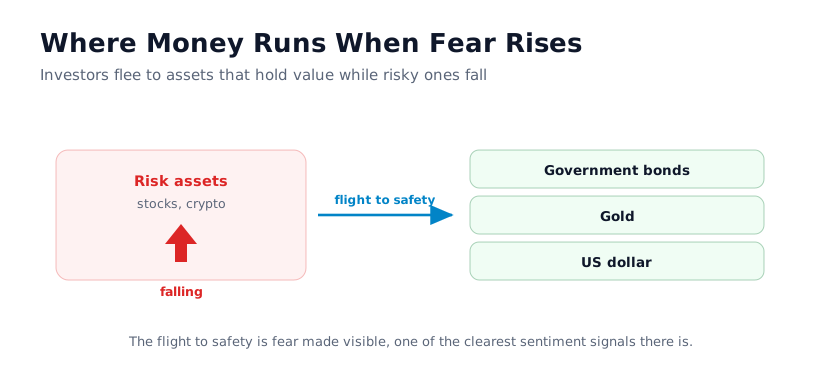
Safe-haven assets are things investors flee to when they are afraid: government bonds, gold, and stable currencies like the US dollar and Japanese yen. They tend to hold or gain value while riskier assets fall, thanks to deep liquidity, trust and low correlation to risk. The rush into them, the flight to safety, is one of the clearest sentiment signals there is, because it is fear made visible. This is education, not financial advice.
CFGI data
Safe-haven demand is a core fear signal, and CFGI reads the rotation toward safety as one of its inputs. When risk appetite drains, money leaves crypto and equities for bonds, gold and cash, and the 0 to 100 fear and greed score leans hard toward fear. CFGI has tracked both markets since March 2022.
Source: CFGI dataset, March 2022 to June 2026.
Key takeaways
- Safe havens are assets money flees to in fear: bonds, gold, the US dollar.
- They are trusted, liquid and lowly correlated to risky assets.
- The flight to safety is fear made visible.
- Crypto is generally a risk asset, not a safe haven.
- Safe-haven demand is one of the clearest sentiment signals.
What Are Safe-Haven Assets?
A safe haven is an asset expected to hold or increase its value during turmoil, when riskier assets are falling. The classics are government bonds from stable countries, gold and other precious metals, and reserve currencies like the US dollar and the Japanese yen. They share a quality: they are trusted to be there when little else is, even though they pay little or nothing. A safe haven is not where you go to get rich; it is where you go to not lose, a place to preserve capital and wait out the storm until risk appetite returns.
What Makes an Asset a Safe Haven?
Not just any "safe" asset becomes a haven in a crisis; the classics share a specific set of qualities. They are deeply liquid, so you can move large amounts into them quickly and reliably exactly when everyone wants to, a market that seizes up under stress is no haven. They have a low or even negative correlation with risky assets, meaning they tend to hold steady or rise when stocks and crypto fall, which is the whole point. They carry a deep, long-standing perception of stability and trust: US government bonds are backed by the world’s largest economy, and gold has been a store of value for thousands of years. And in gold’s case, scarcity and the absence of any counterparty (it is no one’s liability) add to the appeal. What unites them is not high return, indeed they often yield very little, but reliability under stress: the confidence that, when everything else is falling apart, they will still be standing and still be worth something.
What Is the Flight to Safety?
When fear takes over, investors sell risky assets and pile into safe havens all at once. This is the flight to safety. Bonds and gold rise, the dollar strengthens, and risky assets like stocks and crypto fall together. It is one of the most reliable signatures of a fearful market, a visible, market-wide rotation from "things that grow" to "things that endure". The reverse, money leaving safe havens for risk, is the signature of returning greed and risk-on appetite. Watching this rotation, what is rising and what is falling in tandem, is one of the clearest ways to read whether fear or greed is currently in charge across the whole financial system.
Is Crypto a Safe Haven?
This is one of the most debated questions in crypto, and the honest answer, so far, is no. Although Bitcoin is often promoted as "digital gold" and a hedge against the traditional system, in practice it has behaved as a risk asset, not a safe haven. In moments of genuine panic, Bitcoin and crypto have tended to fall hard alongside stocks, not rise like gold, as money flees risk entirely rather than rotating into crypto. The March 2020 Covid crash and the 2022 downturn both saw crypto sell off sharply in line with risk assets. The bull case argues that this could change as Bitcoin matures, that its fixed supply and independence from any government give it real long-term safe-haven properties, and over very long horizons it may yet earn that status. But for now, treating crypto as a place to hide from fear is a mistake: it sits at the far, risk-on end of the spectrum, and in a true flight to safety, money flees crypto rather than toward it.
Crypto Is Risk-On, Not a Haven
Despite the "digital gold" narrative, crypto has behaved as a risk asset, falling with stocks in panics rather than rising like gold. In a flight to safety, money flees crypto, not toward it.
Why Is Safe-Haven Demand a Sentiment Signal?
Because it measures fear directly. You do not have to guess whether the crowd is scared; you can watch where the money goes. A rush into bonds and gold is fear in action, an objective, visible footprint of a fearful market that needs no interpretation. CFGI reads safe-haven demand as one of the signals behind its Fear and Greed Index, which is one reason the equity score is so attuned to fear: the stock crowd flees to safety fast, even as it withholds euphoria. By folding the rotation between risk and safety into the score, the index captures not just how prices are moving but where frightened money is actually going, which is one of the most reliable tells that fear has taken hold. See it on the Stock Fear and Greed Index.
Frequently asked questions
What are the main safe-haven assets?
Government bonds from stable countries, gold and other precious metals, and reserve currencies such as the US dollar and the Japanese yen. They tend to hold or gain value when riskier assets fall.
What makes an asset a safe haven?
Deep liquidity (you can move into it reliably under stress), low or negative correlation to risky assets, a deep perception of stability and trust, and, for gold, scarcity and no counterparty. The defining trait is reliability under stress, not high return.
Is crypto a safe haven?
Generally no. Despite the "digital gold" narrative, crypto has behaved as a risk asset, falling with stocks in panics (as in 2020 and 2022) rather than rising like gold. In a true flight to safety, money flees crypto rather than toward it.
Why does safe-haven demand signal fear?
Because money only rushes into safe havens when investors are afraid of risk, so it is fear made visible. CFGI reads that demand as one of the signals behind its score, especially in equities. This is education, not financial advice.
CFGI.io, Market sentiment research
The CFGI research team builds and maintains the CFGI Fear and Greed Index: a 0 to 100 sentiment score from 10 sub-indicators across hundreds of crypto assets and the equity market, refreshed every 15 minutes. We have tracked market emotion through multiple full crypto and equity cycles.
Think we missed something?
Spotted a gap, disagree with a take, or think we should cover a new topic? Message us and we'll act on your input.
Message us on TelegramKeep reading
This article is educational and is not financial advice. Crypto and equities are volatile and you can lose money. See our disclaimer.