Markets
What Is Volatility?
Quick answer
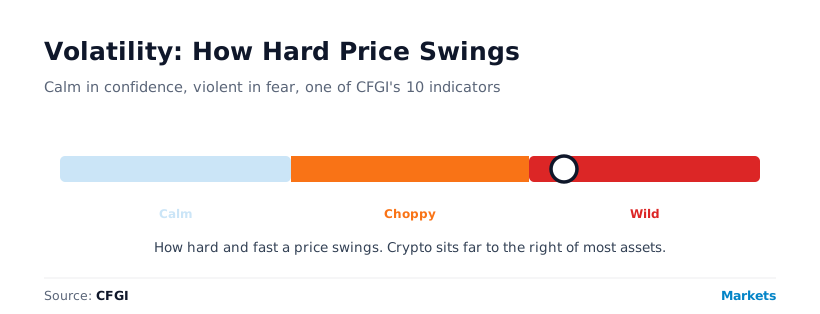
Volatility is how much and how fast a price moves. High volatility means big, rapid swings; low volatility means calm, steady prices. It is measured statistically as the standard deviation of returns, and it varies hugely across assets, from near-zero for cash to extreme for memecoins. It spikes in fear and eases in confidence, which is why it is one of the core signals behind any sentiment reading. This is education, not financial advice.
CFGI data
Volatility is one of the 10 indicators behind every CFGI Fear and Greed score, a 0 to 100 reading across hundreds of assets refreshed every 15 minutes since March 2022. Because sharp swings cluster with fear, rising volatility pulls the score lower, so the calm-versus-panic state of the market is built into the number.
Source: CFGI methodology and dataset, March 2022 to June 2026.
Key takeaways
- Volatility is how much and how fast a price moves.
- It is measured as the standard deviation of returns.
- It varies hugely across assets, from cash to memecoins.
- It spikes in fear and eases in confidence.
- It is one of the 10 indicators behind the CFGI score.
What Is Volatility?
Volatility measures the size and speed of price moves, not their direction. A market that drifts 1% a week is low-volatility; one that swings 10% in a day is high-volatility. It is, in effect, a measure of nervousness: calm markets move little, anxious markets lurch. In stocks, expected volatility is tracked by the VIX, often called the fear gauge. Crypto, being younger and thinner, is far more volatile than equities, which is partly why crypto is so volatile. The key thing to hold onto is that volatility is about magnitude, not direction: a price can be highly volatile whether it is rising or falling.
How Volatility Is Measured
Formally, volatility is measured as the statistical "standard deviation" of an asset’s returns, a number that captures how widely its price tends to scatter around its average. The wider the scatter, the higher the volatility. It usually comes in two flavours that answer different questions. "Realised" or historical volatility looks backward, measuring how much the price actually moved over a past period. "Implied" volatility looks forward, derived from options prices, it reflects how much movement the market expects in future, and it is what the famous VIX index captures for US stocks. Volatility is typically "annualised" so different assets can be compared on the same footing: an asset with 20% annualised volatility is far steadier than one with 80%. You do not need the maths to use the idea, but knowing that volatility is a precise, measurable quantity, not just a vague sense of "choppiness", is what lets it serve as a hard input into a sentiment model.
Volatility Across Asset Classes
One of the most useful things about volatility is that it lets you rank assets by how wild they are. There is a clear spectrum. Cash is essentially zero-volatility, its value barely moves day to day. Government bonds are low. Large, established blue-chip stocks are moderate. Small-cap stocks are higher. Major cryptocurrencies like Bitcoin are higher still, often several times more volatile than stocks. And speculative memecoins sit at the extreme end, capable of doubling or halving in a day. This ranking is not random: volatility tends to rise as an asset gets smaller, younger, less liquid and less anchored by fundamentals, all the qualities that let emotion move a price more freely. Understanding where an asset sits on this spectrum is essential to sizing a position sensibly, a 10% move means something very different for a blue-chip stock than for a memecoin, and treating them the same is a common and costly mistake.
A Spectrum of Wildness
Cash near zero, bonds low, blue-chips moderate, crypto high, memecoins extreme. Volatility rises as assets get smaller, younger and less anchored, so the same percentage move means very different things.
Why Does Volatility Track Fear?
Because fear is fast and greed is slow. Markets tend to rise gently and fall violently: a calm uptrend can take months, while a panic can wipe out weeks of gains in hours, the old line that markets "take the stairs up and the elevator down". So a spike in volatility usually means fear has taken over, while a long stretch of low volatility signals calm, even complacent, confidence. There is a subtle warning in that last point: unusually low volatility, far from being purely reassuring, can mark a complacent market quietly building up fragility beneath the surface, the proverbial "calm before the storm". This tight link between sharp movement and fear is exactly why volatility is such a valuable ingredient in a sentiment gauge.
Volatility Is Not Direction
A volatile market is not necessarily a falling one, but big, fast moves are far more common in fear than in steady greed, which is why high volatility leans fearful.
How Does CFGI Use Volatility?
Volatility is one of the 10 indicators behind the Fear and Greed Index. When swings get sharp, that pulls the score toward fear; when the market settles, it eases toward calm. It works alongside liquidity and volume, so the score reflects how the market is moving, not just where it is. This is part of why a sentiment index is more than a price chart in disguise: by reading volatility, it captures the emotional texture of a move, distinguishing a calm, orderly drift from a frightened, lurching one even when the price change is similar. A market that is falling smoothly and one that is crashing in violent spasms are in very different emotional states, and folding volatility into the score is one of the ways the index tells them apart.
Frequently asked questions
What is volatility?
How much and how fast a price moves, measuring the size and speed of swings rather than their direction. A market drifting 1% a week is low-volatility; one swinging 10% a day is high-volatility. It is, in effect, a measure of how nervous a market is.
How is volatility measured?
As the standard deviation of an asset’s returns, often annualised so assets can be compared. Realised (historical) volatility looks backward at actual past moves; implied volatility, like the VIX, is derived from options prices and looks forward at expected future moves.
Is high volatility good or bad?
Neither on its own; it is risk in both directions. It means bigger, faster moves, which raises both opportunity and the chance of loss. It is why position size and a clear head matter, especially in higher-volatility assets like crypto.
Why does CFGI use volatility?
Because sharp swings cluster with fear. Volatility is one of the 10 indicators behind the score, so rising volatility pulls the reading toward fear, helping the index distinguish a calm drift from a frightened, lurching move. This is education, not financial advice.
CFGI.io, Market sentiment research
The CFGI research team builds and maintains the CFGI Fear and Greed Index: a 0 to 100 sentiment score from 10 sub-indicators across hundreds of crypto assets and the equity market, refreshed every 15 minutes. We have tracked market emotion through multiple full crypto and equity cycles.
Think we missed something?
Spotted a gap, disagree with a take, or think we should cover a new topic? Message us and we'll act on your input.
Message us on TelegramKeep reading
This article is educational and is not financial advice. Crypto and equities are volatile and you can lose money. See our disclaimer.