Crypto
What Does Extreme Greed Mean On the Fear and Greed Index?
Quick answer
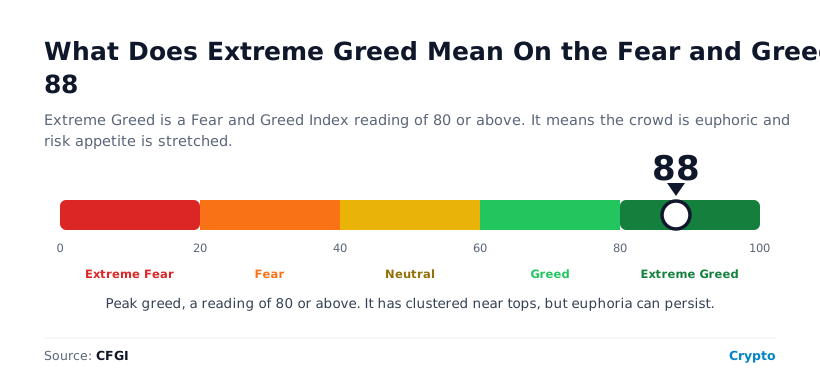
Extreme Greed is a Fear and Greed Index reading of 80 or above, the top zone of the 0 to 100 scale. It means investors are euphoric and chasing risk, and positioning is crowded. Because the crowd is most one-sided at this point, extremes of greed have clustered near market tops, but greed can persist in a strong run, so it flags rising risk rather than a guaranteed top. Most investors use it as a prompt to manage risk, not as a sell signal. This is education, not financial advice.
CFGI data
Extreme Greed is rarer than Extreme Fear in CFGI data since March 2022, euphoria stays scarce while fear arrives fast. The stock score reached a high of 83 on 19 December 2023, near the top of its range, the kind of reading that flags risk building rather than a precise top.
Source: CFGI dataset, March 2022 to June 2026.
Key takeaways
- Extreme Greed is any reading of 80 or above on the 0 to 100 scale.
- It means the crowd is euphoric and positioning is crowded.
- It has clustered near tops, but does not guarantee one.
- Greed persists longer than fear, so selling it is unreliable.
- It is best read as rising risk, a prompt to manage exposure.
What Extreme Greed Tells You
On the Fear and Greed Index, a reading of 80 or above is Extreme Greed. The signals the index reads all point to optimism: strong momentum, rising volume, bullish social activity. The risk is that almost everyone is already positioned for more upside, so the marginal buyer, the next person needed to push prices higher, is scarce. Many investors use it as a prompt to manage risk, trimming or rebalancing, rather than as a sell signal, because greed can stay high while a strong trend continues.
Why Contrarians Watch It
Extreme Greed is the greed-side version of the contrarian advice to "be fearful when others are greedy". The logic is that when optimism is universal and everyone is already invested, there is little buying power left to drive prices higher, and the market becomes vulnerable to any disappointment. Historically, deep-greed readings have clustered nearer market tops than bottoms. CFGI’s own record offers a vivid marker: the stock score reached 83 in December 2023, about as greedy as the equity crowd got. But, crucially, reaching greed is not the same as marking the exact top, and the contrarian who watches Extreme Greed does so knowing it raises the odds of a pullback, not that it guarantees one is imminent.
What Extreme Greed Does Not Mean
It is just as important to know what the reading does not promise. Extreme Greed is not a guaranteed top and not an automatic sell signal. There is a real asymmetry between the two extremes: fear is sharp and self-exhausting, but greed can build and persist for months, even years, during a powerful bull market. So selling at the first Extreme Greed reading and waiting on the sidelines has a poor record, it can leave you missing some of the largest gains as the rally keeps climbing. CFGI’s data underlines the limit: even an 83 did not mark a definitive top. Extreme Greed is a reason to pay attention and check your risk, not a green light to dump everything.
Greed Is Stubborn
Unlike fear, which burns out fast, greed can persist for a long time. That is why Extreme Greed is better used to trim and de-risk than to call the exact top, which almost no one does.
Euphoria: Greed At Its Peak
The deepest Extreme Greed readings coincide with euphoria, the emotional peak of a bull market. In euphoria, caution evaporates, valuations are dismissed with "this time is different" stories, and FOMO-driven buying goes near-vertical. It is the final and most dangerous stage of greed, because by the time almost everyone is euphoric and fully invested, the conditions for a sharp reversal have quietly built up. This is why a sustained, pinned-at-the-top Extreme Greed reading, especially on an asset whose price is going parabolic, is treated as a warning of a possible bubble rather than a reason to join the party.
How to Use an Extreme Greed Reading
In practice, the disciplined response to Extreme Greed is to adjust risk rather than flip to cash. That usually means trimming a little, rebalancing back toward your targets, or taking some profits off positions that have run hard, while letting the rest continue to participate. It can mean tightening stops or simply checking that your exposure has not quietly ballooned. The point is to reduce risk and lock in some gains without betting that you can call the exact peak. Above all, when the gauge screams Extreme Greed and you feel most certain the rise will go on forever, that shared certainty is itself the signal to slow down, the opposite of what euphoria urges.
Where Extreme Greed Sits On the Scale
| Score | Zone |
|---|---|
| 0 to 19 | Extreme Fear |
| 20 to 39 | Fear |
| 40 to 59 | Neutral |
| 60 to 79 | Greed |
| 80 to 100 | Extreme Greed |
The five zones of the 0 to 100 scale.
Frequently asked questions
What number is Extreme Greed?
Any reading of 80 or above on the 0 to 100 Fear and Greed scale. 60 to 79 is Greed; 80 to 100 is Extreme Greed.
Is Extreme Greed a sell signal?
Not on its own. It flags that optimism is high and positioning crowded, which raises risk, but greed can persist in a strong run. Most investors treat it as a prompt to manage risk, trimming or rebalancing, rather than a sell trigger.
Why is selling greed harder than buying fear?
Because fear is sharp and self-exhausting while greed is slow and stubborn. Euphoria can build for months or years, so selling at the first Extreme Greed reading often means missing big gains. Greed signals call for trimming, not bailing.
Why is Extreme Greed rarer than Extreme Fear?
In CFGI data, euphoria tends to be brief while fear arrives fast and deep. Markets spend less time at the top of the scale than at the bottom. This is education, not financial advice.
CFGI.io, Market sentiment research
The CFGI research team builds and maintains the CFGI Fear and Greed Index: a 0 to 100 sentiment score from 10 sub-indicators across hundreds of crypto assets and the equity market, refreshed every 15 minutes. We have tracked market emotion through multiple full crypto and equity cycles.
Think we missed something?
Spotted a gap, disagree with a take, or think we should cover a new topic? Message us and we'll act on your input.
Message us on TelegramKeep reading
This article is educational and is not financial advice. Crypto and equities are volatile and you can lose money. See our disclaimer.