Stocks
What Affects the Stock Fear and Greed Index?
Quick answer
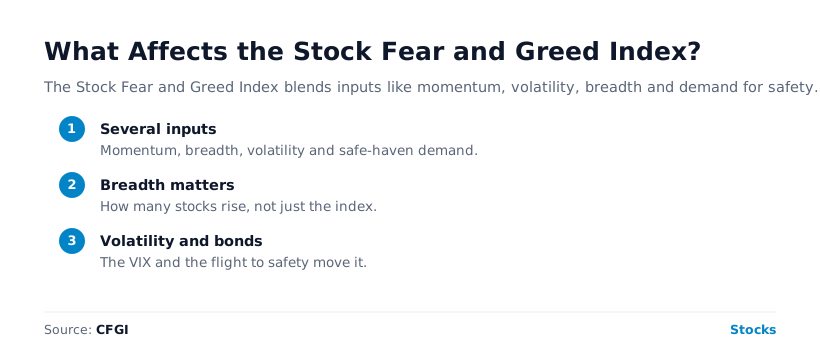
The Stock Fear and Greed Index moves because its underlying inputs move. It blends indicators of price momentum, volatility, market breadth, demand for safe havens versus risk, and options activity into one 0 to 100 score. Real-world events, an earnings season, a Fed decision, an economic shock, affect the index indirectly, by moving those signals. When they point to confidence the score rises toward greed; when they point to stress it falls toward fear. No single input dominates, which keeps the reading balanced. This is education, not financial advice.
CFGI data
CFGI builds the equity score from 10 indicator groups, so it reflects the whole picture, not one signal. That breadth is why the score is steadier than any single gauge, and why it took a broad, market-wide stress event to drive it all the way to an extreme-fear 3 on 8 April 2025 on its 0 to 100 scale.
Source: CFGI dataset, 2021 to June 2026.
Key takeaways
- The score moves because its underlying inputs move.
- Inputs include momentum, volatility, breadth and safe-haven demand.
- Real-world events affect it indirectly, by moving those signals.
- Market breadth is a key tell the headline index can hide.
- No single input or headline dominates the reading.
What Feeds the Score
A Fear and Greed Index is a synthesis, so what affects it is the basket of signals beneath it. Broadly, the equity score responds to several families of input working together.
| Input | Pushes toward greed when... |
|---|---|
| Price momentum | Prices rise above their averages |
| Volatility | Volatility is low and calm |
| Market breadth | Many stocks participate in the gains |
| Safe-haven demand | Money favours stocks over bonds |
| Options activity | Traders lean bullish, not hedged |
What pushes the stock score toward greed.
The Input Families, One by One
Each family reads a different facet of the equity crowd’s mood. Momentum asks whether prices are trending above or below their recent averages, strength reads as greed. Volatility measures how nervous options markets are, with calm signalling confidence and spikes signalling fear. Market breadth checks how many stocks are joining a move. Safe-haven demand compares the appetite for stocks against the pull toward bonds and other defensive assets. And options activity, like the balance of bullish calls against protective puts, shows whether traders are positioning for gains or bracing for losses. Together, ten such groups blend into one figure.
The Real-World Catalysts Behind It
News events do not feed the index directly; they move the underlying signals, which then move the score. A strong earnings season, an interest-rate cut, or a run of upbeat economic data tends to lift momentum and risk appetite while calming volatility, dragging the score toward greed. A hawkish central bank, a weak jobs report, a geopolitical shock or a sharp sell-off spikes volatility, breaks momentum and sends money fleeing to safe havens, pulling it toward fear. So when you ask "what moved the index today?", the honest answer is usually an event that moved its inputs, the gauge is the messenger, not the cause.
Market Breadth: The Hidden Tell
One input deserves special attention, because it captures something the headline index cannot: market breadth, how many stocks are actually participating in a move. An index can keep climbing while breadth quietly weakens, with just a few giant companies carrying it and most stocks already falling. That narrow, fragile kind of rally looks healthy on the surface but is built on thin ice. By folding breadth into the score, the gauge can lean toward caution even as the index sets new highs, which is exactly the sort of divergence a single price chart would miss. It is one of the clearest reasons a blended sentiment reading beats watching the index level alone.
Why the Blend Matters
Because the score blends many inputs, no single event automatically swings it. A scary headline that does not show up in momentum, volatility, breadth and demand will barely move the score. It takes broad, corroborated stress to drive a deep reading, which is what makes the index a balanced gauge rather than a knee-jerk one. That is also why a reading at an extreme carries weight: reaching it required many independent signals to agree, not a single dramatic moment.
The Practical Upshot
One frightening headline is not enough to move the gauge far. When the Stock Fear and Greed Index does hit an extreme, it is telling you the whole market, not just one news story, has turned.
What Does Not Move It
It is just as useful to know what the index ignores. Your personal opinion, a single headline in isolation, or a price move with no confirmation from volatility, breadth and positioning will not shift it meaningfully. It does not run on narrative or on any one commentator’s view of where the market "should" go. The score is a reflection of measured, collective behaviour across many channels, which means it can disagree with the loudest voices, and that disagreement is often exactly when it is most worth heeding.
Reading the Blend
The takeaway is that the Stock Fear and Greed Index is a weighted blend of measurable signals, moved by real events that ripple through those signals, and built to resist the noise of any single one. That is what lets one number stand in for the mood of a sprawling, complicated market. The live gauge below shows where equity sentiment sits today, and, because CFGI scores stocks individually too, you can drill from the market mood down to the leading names within it.
Frequently asked questions
What affects the Stock Fear and Greed Index?
Its underlying inputs: price momentum, volatility, market breadth, demand for safe havens versus risk, and options activity, among ten indicator groups. Real-world events move it by moving those signals.
Does one piece of news move the score?
Rarely on its own. Because the index blends many inputs, it takes broad stress, showing up across momentum, volatility, breadth and demand, to drive a deep reading.
Why is market breadth important?
Because it reveals how many stocks are really participating. An index can rise while breadth weakens and most stocks fall, a fragile, narrow rally. Folding breadth in lets the gauge flag caution that the headline index level hides.
Why does the blend matter?
It keeps the score balanced. No single signal or headline dominates, so the index is a steady gauge of overall mood rather than a knee-jerk reaction, and an extreme reading means many signals have agreed. This is education, not financial advice.
CFGI.io, Market sentiment research
The CFGI research team builds and maintains the CFGI Fear and Greed Index: a 0 to 100 sentiment score from 10 sub-indicators across hundreds of crypto assets and the equity market, refreshed every 15 minutes. We have tracked market emotion through multiple full crypto and equity cycles.
Think we missed something?
Spotted a gap, disagree with a take, or think we should cover a new topic? Message us and we'll act on your input.
Message us on TelegramKeep reading
This article is educational and is not financial advice. Crypto and equities are volatile and you can lose money. See our disclaimer.