Stocks
What Is Investor Sentiment?
Quick answer
Investor sentiment is the overall attitude of investors toward a market or asset at a given time, ranging from extreme fear to extreme greed. It often diverges from what the fundamentals alone would justify, which is why sentiment moves prices day to day even when nothing about the underlying companies has changed. The equity crowd has its own character: quick to panic but slow to turn euphoric. This is education, not financial advice.
CFGI data
Investor sentiment is measurable, and equities behave unlike crypto. CFGI data shows the stock crowd quick to panic but slow to cheer: on 5 February 2026 the stock market held at 35, ordinary fear, while crypto hit an all-time low of 12. The Stock Fear and Greed Index runs 0 to 100, daily since 2021.
Source: CFGI dataset, 2021 to June 2026.
Key takeaways
- Investor sentiment is the market mood, from extreme fear to extreme greed.
- It moves prices short term, often regardless of the fundamentals.
- It is measured through volatility, breadth and safe-haven demand.
- The equity crowd panics fast but withholds euphoria, unlike crypto.
- It is best read as context, not a signal.
What Is Investor Sentiment?
Investor sentiment is the collective mood of the market: how optimistic or pessimistic investors feel right now. It is the emotional layer that sits on top of the fundamentals, and over short horizons it often matters more than the fundamentals themselves. A great company can see its stock fall on sour sentiment, and a shaky one can rally on a hopeful mood. That gap between mood and fundamentals is exactly what sentiment measures, and it is the reason a stock’s price can swing far more dramatically, day to day, than anything happening inside the actual business would justify.
How Is Investor Sentiment Measured?
Sentiment is read from measurable market behaviour rather than opinion polls alone. The classic equity signals include:
- Volatility: the VIX, the market’s fear gauge, rises when investors are nervous.
- Market breadth: in greed most stocks rise together; in fear gains narrow to a few names.
- Safe-haven demand: money rotates into bonds and gold when fear takes over.
- Momentum: how far prices sit above or below their recent range.
The reason these behavioural signals are preferred to simply asking investors how they feel is that actions are more honest than words: what people do with their money reveals their true mood far more reliably than what they say in a survey. A Stock Fear and Greed Index folds these signals into one 0 to 100 score.
Why Sentiment Moves Stock Prices
The deeper reason sentiment moves stocks is that a share price is not a fixed fact but the crowd’s current opinion of a company’s worth, and opinions are emotional. The very same piece of news, an earnings report, an economic figure, can send a stock up or down depending on the mood it lands in: in an optimistic market it is greeted as good news, in a fearful one the identical report is read as a warning. Because investors are human and prone to herding, FOMO and panic, their collective mood pushes prices above or below fair value, sometimes far above or below, and it does so faster than the slow grind of fundamentals ever could. This is why, over days and weeks, sentiment is the dominant force on price. Only over years does the "weighing machine" of real earnings and value reassert itself; in the short run, it is the "voting machine" of investor mood that rules, which is precisely what makes measuring that mood so worthwhile.
How Does Stock Sentiment Differ From Crypto?
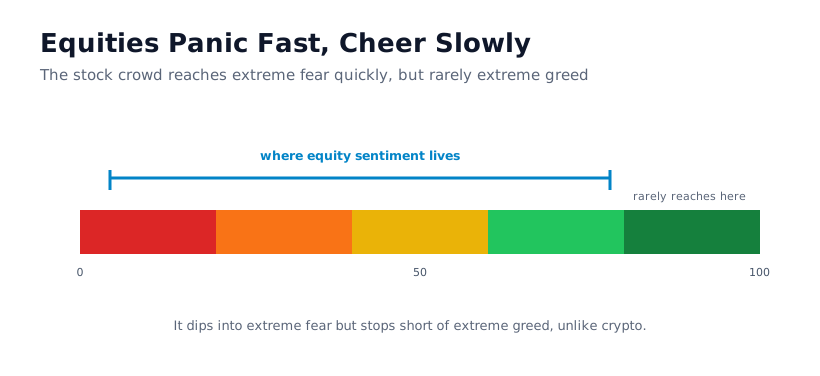
The two crowds are not the same. CFGI measures both the same way, and the contrast is clear: the equity crowd panics quickly but is slow to turn euphoric, while crypto swings to both extremes fast and trades 24/7. The reasons are structural. The stock market has a larger, more institutional investor base, closing bells that impose pauses, and real company earnings anchoring prices, all of which temper its swings. Crypto, by contrast, is younger, more retail-driven, always open and often without fundamental anchors, so its mood runs hotter in both directions. The result is a measurably different temperament: equities reach the depths of fear readily but rarely the heights of euphoria, while crypto regularly reaches both extremes.
A Measured Example
On 5 February 2026 the crypto market hit an all-time low of 12, Extreme Fear, while the stock index sat at 35, ordinary Fear. Same day, two very different moods.
How Do You Read Investor Sentiment?
You read it as context, not a signal to act. Extreme fear and extreme greed tell you the crowd is crowded on one side, which historically clusters near turning points, but they do not tell you what happens next, sentiment reads the present accurately and forecasts the future poorly. The most useful way to use it is at the extremes and as a check on yourself: a reading of Extreme Greed is a prompt to question your own optimism and manage risk, while Extreme Fear is a prompt to resist the urge to panic-sell with the crowd. Because the equity crowd reaches true Extreme Greed so rarely, a genuine one is worth heeding when it appears. Track it on the Stock Fear and Greed Index, and see the wider idea in what the Fear and Greed Index is.
Frequently asked questions
What is investor sentiment?
The overall attitude of investors toward a market or asset at a given time, from extreme fear to extreme greed. It is the emotional layer on top of the fundamentals, and over short horizons it often moves prices more than the fundamentals themselves.
How do you measure investor sentiment?
Through measurable market behaviour rather than opinion alone: volatility (the VIX), market breadth, safe-haven demand and momentum. Actions are more honest than words, and a Stock Fear and Greed Index combines these into a single 0 to 100 score.
How does stock sentiment differ from crypto?
The equity crowd panics fast but is slow to turn euphoric, thanks to a larger institutional base, closing bells and real earnings anchoring prices. Crypto, younger and retail-driven, swings to both extremes fast. On 5 Feb 2026 stocks sat at 35 while crypto hit 12.
Does investor sentiment predict the market?
No. Sentiment reads the present accurately but forecasts the next move poorly. It is best used as context: extremes flag a one-sided crowd and a prompt to check your own emotions, not a signal to act. This is education, not financial advice.
CFGI.io, Market sentiment research
The CFGI research team builds and maintains the CFGI Fear and Greed Index: a 0 to 100 sentiment score from 10 sub-indicators across hundreds of crypto assets and the equity market, refreshed every 15 minutes. We have tracked market emotion through multiple full crypto and equity cycles.
Think we missed something?
Spotted a gap, disagree with a take, or think we should cover a new topic? Message us and we'll act on your input.
Message us on TelegramKeep reading
This article is educational and is not financial advice. Crypto and equities are volatile and you can lose money. See our disclaimer.