Stocks
What Does the Stock Fear and Greed Index Tell You?
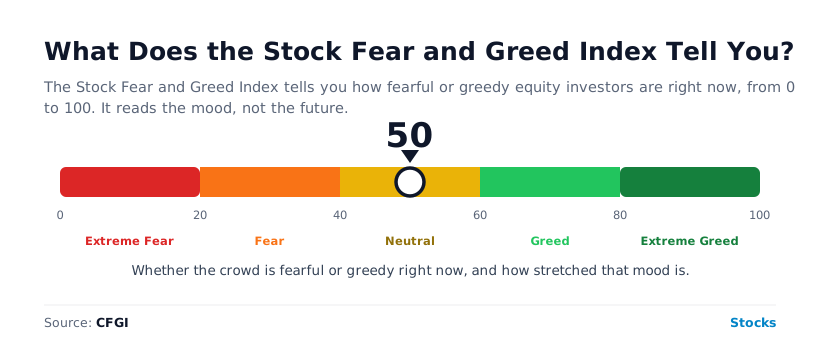
Quick answer
The Stock Fear and Greed Index tells you one thing well: how fearful or greedy equity investors are right now, on a 0 to 100 scale. It reads the present mood from market behaviour, not the future. A low reading means the crowd is risk-off and defensive; a high reading means it is confident and crowded. The signal is strongest at the extremes and weakest in the middle. It is a gauge of emotion, valuable as context and as a check on your own bias, not a forecast. This is education, not financial advice.
CFGI data
CFGI reads stock sentiment from measurable behaviour, volatility, breadth, safe-haven demand, into one daily 0 to 100 score since 2021. It tells you where the crowd stands, not where price goes: readings have run from an extreme-fear 3 on 8 April 2025 to a greedy 83 on 19 December 2023.
Source: CFGI dataset, 2021 to June 2026.
Key takeaways
- It tells you how fearful or greedy equity investors are now.
- It reads market behaviour, not stated opinion, so it is repeatable.
- The signal is strongest at the extremes, weakest in the middle.
- It is also a mirror: it tells you whether your mood matches the crowd.
- It is a gauge of emotion, not a forecast of price.
What It Tells You, and What It Does Not
The Stock Fear and Greed Index tells you the emotional temperature of the equity market: whether investors are protecting capital or chasing returns. It does this from measurable signals, so it is repeatable rather than opinion. What it does not tell you is where price goes next, because sentiment reads the present, not the future. Holding those two facts together, what it does say, and what it cannot, is the whole skill of using it.
What It Reads: Behaviour, Not Opinion
The index is built from what investors actually do, not what they say. It blends signals like price momentum, volatility, market breadth, safe-haven demand and options positioning into one number. That is a meaningful distinction: surveys can be vague or wishful, but money moving into bonds, options being bought for protection, or a rally narrowing to a handful of stocks are concrete, measurable actions. Because the index reads behaviour, its output is honest and repeatable, it reflects how the crowd is positioned, not how it claims to feel, which is exactly why it can sometimes contradict the prevailing headlines.
Reading the Scale
| Score | What the crowd is doing |
|---|---|
| 0 to 19 | Extreme Fear, protecting capital |
| 20 to 39 | Fear, cautious and defensive |
| 40 to 59 | Neutral, balanced |
| 60 to 79 | Greed, confident and buying |
| 80 to 100 | Extreme Greed, euphoric and crowded |
The five zones of the 0 to 100 scale.
In CFGI’s equity history, the score has swung from a deep 3 in April 2025 to 83 in December 2023, a wide range that captures both panic and confidence.
The Signal Is At the Extremes
The index is not equally informative across its range. A reading under 20 says the crowd is very fearful, which historically clusters near market lows; a reading over 80 says it is greedy and crowded, which raises the risk of a pullback. The neutral middle, around 50, says little, sentiment is balanced and offers no contrarian edge. So the right way to read it is to pay close attention when it reaches an extreme and to largely ignore it when it sits in the middle. The value is concentrated at the two ends, where the crowd is most one-sided and therefore most likely to be stretched.
Where to Look
Treat the extremes as the message and the middle as noise. The index earns its keep below 20 and above 80, not at 50.
What It Tells You About You
There is a second, more personal thing the index tells you: whether your own mood is in step with the crowd, or out of it. If you feel euphoric and the gauge reads Extreme Greed, you are feeling exactly what everyone else feels, which is precisely when independent thinking is most valuable. If you feel like panic-selling and the gauge reads Extreme Fear, the same applies. Used this way, the index is a mirror as much as a window: it holds your own emotions up against the market’s, and that comparison, more than any forecast, is what helps you avoid acting with the herd at the worst possible moment.
What It Does Not Tell You
Being clear about its limits keeps you from misusing it. The index does not tell you direction, it does not tell you when a turn will come, and it is not a buy or sell trigger. It reads the present mood, not the future, and its day-ahead forecasting power is little better than a coin flip. Sentiment can stay extreme for a long time while prices keep moving. So the honest framing is that the Stock Fear and Greed Index is one valuable input, a clean read on crowd emotion, to be weighed alongside trend, valuation and your own plan, never the single thing you act on.
Frequently asked questions
What does the Stock Fear and Greed Index tell you?
How fearful or greedy equity investors are right now, on a 0 to 100 scale, read from market behaviour like volatility, breadth and safe-haven demand. It is a gauge of current emotion, not a forecast of price.
Why does it read behaviour instead of opinion?
Because actions are concrete and measurable where stated opinions can be wishful. Money moving to safety, options bought for protection or a narrowing rally are real signals, which makes the index honest and repeatable.
What reading should I pay attention to?
The extremes: under 20 is Extreme Fear, which clusters near lows, and 80 or above is Extreme Greed, which raises risk. The neutral middle offers little information.
Can it tell me where the market is going?
No. It reads the present mood well but forecasts poorly, its day-ahead accuracy is close to a coin flip. Treat it as context, and as a mirror for your own bias, alongside other analysis. This is education, not financial advice.
CFGI.io, Market sentiment research
The CFGI research team builds and maintains the CFGI Fear and Greed Index: a 0 to 100 sentiment score from 10 sub-indicators across hundreds of crypto assets and the equity market, refreshed every 15 minutes. We have tracked market emotion through multiple full crypto and equity cycles.
Think we missed something?
Spotted a gap, disagree with a take, or think we should cover a new topic? Message us and we'll act on your input.
Message us on TelegramKeep reading
This article is educational and is not financial advice. Crypto and equities are volatile and you can lose money. See our disclaimer.