Stocks
What Is a P/E Ratio?
Quick answer
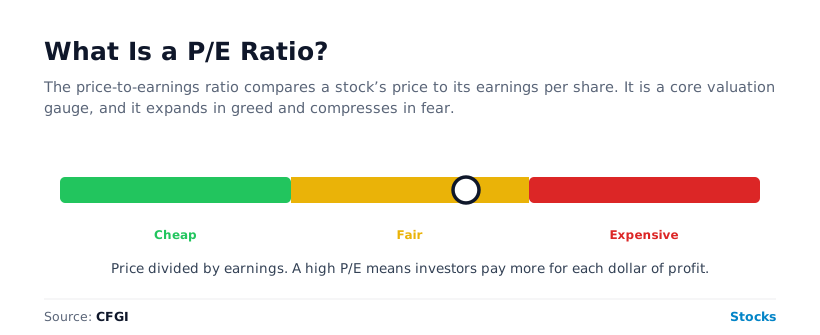
The price-to-earnings ratio, or P/E, divides a stock’s price by its earnings per share. It shows how much investors are paying for each dollar of profit, a quick gauge of how expensive a stock is. A high P/E means high expectations; a low one means caution or doubt. There is no universal "good" number, it depends on growth, the sector and the market, and crucially, P/E ratios expand when the crowd is greedy and contract when it is fearful, which links valuation to sentiment. This is education, not financial advice.
CFGI data
Valuation and sentiment move together. When CFGI sits in greed, investors pay up and P/E ratios stretch; when it falls toward the equity lows like the 3 on 8 April 2025, multiples compress as fear discounts the same earnings. The ratio is partly a price tag on optimism.
Source: CFGI dataset, 2021 to June 2026.
Key takeaways
- P/E divides share price by earnings per share.
- It shows how much investors pay per dollar of profit.
- Trailing P/E uses past earnings; forward P/E uses estimates.
- There is no universal "good" P/E; context decides.
- P/E ratios expand in greed and compress in fear.
A Price Tag On Earnings
If a stock trades at 100 dollars and earns 5 dollars per share, its P/E is 20: investors pay 20 dollars for each dollar of annual profit. Compared across companies and over time, the P/E is a fast, if rough, sense of how richly a stock is valued. A high P/E is not automatically bad, nor a low one good. A fast-growing company can justify a high multiple; a struggling one can look cheap for good reason. The ratio is a starting question, not an answer.
Trailing Versus Forward P/E
There are two flavours of P/E, and the difference matters. The "trailing" P/E uses earnings from the past twelve months, real, reported numbers, so it is factual but backward-looking. The "forward" P/E uses analysts’ estimates of earnings over the next twelve months, so it looks ahead but relies on forecasts that can be wrong. Because the stock market is fundamentally a discounting machine, it prices the future, not the past, many investors lean on the forward P/E as the more useful of the two. A stock can have a scary-looking trailing P/E and a reasonable forward one if its earnings are expected to grow quickly, which is exactly the case for many growth stocks.
What Is a "Good" P/E?
There is no single good number, only context. As a rough guide, a P/E above 30 is often called "high" and one below 15 "low", and the S&P 500 has averaged a forward P/E of roughly 19 over the past decade. But a number means little in isolation. The useful comparisons are three: against the company’s own history, against its sector peers, and against the broader market. A high P/E signals high expectations the company must then live up to, "priced for perfection", while a low P/E can mean a genuine bargain or a value trap, cheap because the business is in trouble. The figure is the start of the analysis, not its conclusion.
| P/E | Often means |
|---|---|
| Below 15 | Low: value, caution, or a struggling business |
| ~15 to 25 | Around typical market levels |
| Above 30 | High: strong growth hopes, or overvaluation |
Reading P/E levels, roughly.
The Limits of P/E
P/E is useful but blunt, and it breaks down in several cases. It is meaningless for a company with no profits, since you cannot divide by zero or negative earnings, which rules out many young, fast-growing firms. It ignores growth, so comparing a fast grower and a stagnant company on P/E alone is misleading (the "PEG" ratio tries to adjust for this). It ignores debt and the quality of earnings, which can be flattered by accounting choices or one-off items. And because it depends on earnings, a temporary profit spike or slump can distort it badly. None of this makes P/E useless, it is a great quick gauge, but it is one tool among many, best used alongside other measures rather than trusted on its own.
A Starting Question
P/E gives you a fast read on how richly a stock is priced, but it ignores growth, debt and earnings quality. Treat it as the opening of an analysis, never the verdict.
P/E and Sentiment
Valuations breathe with the mood. In greed, the crowd pays up and the same earnings command a higher price, lifting market-wide P/E ratios, "multiple expansion". In fear, multiples compress as investors discount the future and refuse to pay as much for each dollar of profit. That is why a Stock Fear and Greed Index and aggregate valuations often move together: a big chunk of what drives a high P/E is not the earnings at all, but how optimistic the crowd feels about them. Read that way, an unusually high market-wide P/E during Extreme Greed is partly a measure of euphoria, and a compressed one during Extreme Fear is partly a measure of panic.
Frequently asked questions
What is a P/E ratio?
The price-to-earnings ratio divides a stock’s price by its earnings per share, showing how much investors pay for each dollar of profit. A P/E of 20 means paying 20 dollars per dollar of annual earnings. It is a core valuation gauge.
What is the difference between trailing and forward P/E?
Trailing P/E uses real earnings from the past twelve months; forward P/E uses analysts’ estimates for the next twelve. Because the market prices the future, the forward P/E is often more useful, though it relies on forecasts that can be wrong.
What is a good P/E ratio?
There is no universal number. Above 30 is often "high", below 15 "low", and the S&P 500 has averaged a forward P/E around 19. What matters is context: comparing to the company’s history, its sector peers and the broader market.
How does sentiment affect P/E ratios?
P/E ratios expand when the crowd is greedy and pays up, and compress when fear discounts the same earnings. A big part of a high market-wide P/E is optimism, so valuation is partly a price tag on mood. This is education, not financial advice.
CFGI.io, Market sentiment research
The CFGI research team builds and maintains the CFGI Fear and Greed Index: a 0 to 100 sentiment score from 10 sub-indicators across hundreds of crypto assets and the equity market, refreshed every 15 minutes. We have tracked market emotion through multiple full crypto and equity cycles.
Think we missed something?
Spotted a gap, disagree with a take, or think we should cover a new topic? Message us and we'll act on your input.
Message us on TelegramKeep reading
This article is educational and is not financial advice. Crypto and equities are volatile and you can lose money. See our disclaimer.