Stocks
Does the Fear and Greed Index Work for Individual Stocks?
Quick answer
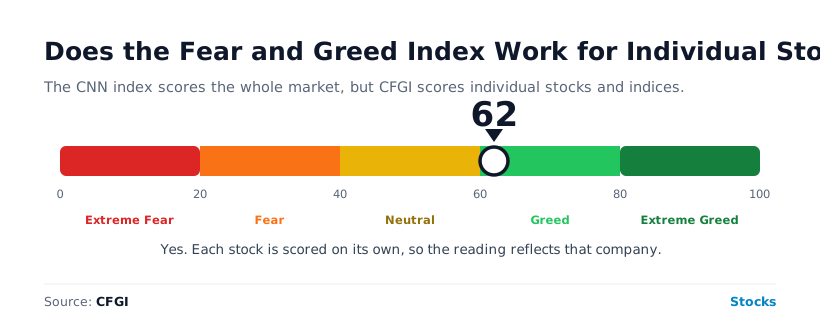
The original CNN index scores the whole US market as one number, so it does not work for individual stocks. CFGI does: it scores major indices and the most-traded names individually on the same 0 to 100 scale. A per-stock reading shows whether the fear or greed around a specific company matches the broader market or diverges from it, which a single market average can never reveal. This is education, not financial advice.
CFGI data
CFGI scores stocks individually, not just the market, which is what lets a single name read fearful while the index is calm, or the reverse. The same per-asset approach in crypto produced a 61-point gap between the most fearful and most greedy major coins on 23 May 2024, the kind of divergence a market-only gauge hides completely.
Source: CFGI dataset, 2021 to June 2026.
Key takeaways
- The CNN index is market-wide, so it cannot score individual stocks.
- CFGI scores major indices and leading stocks individually.
- A single stock can be fearful while the market is greedy, or the reverse.
- Stocks diverge on their own catalysts: earnings, guidance and news.
- A per-stock score uses the same 0 to 100 scale, applied to one name.
Market Gauge Versus Per-Stock Score
A market-wide Fear and Greed Index, like CNN’s, gives one number for the whole US market and cannot tell you anything about a single stock. CFGI scores names individually, so you can read the sentiment around a specific company the same way you read the market, on the same 0 to 100 scale where low is fear and high is greed. The market number answers "how does the crowd feel about stocks?"; a per-stock score answers the sharper question, "how does the crowd feel about this one?".
Why a Stock Diverges From the Market
Individual stocks are driven by catalysts the market as a whole never feels. A disappointing earnings report, a cut to guidance, a product recall, a lawsuit, a CEO departure or a sector rotation can send one company into deep fear while the broader market is calm or even greedy. The reverse happens too: a single name can be euphoric on a breakthrough while the market drifts sideways. A market average, by construction, blends all of this away, so it will tell you the crowd is "neutral" even on a day a stock you hold has just crashed 20% on its own news.
The Core Point
The market index tells you the weather over the whole market. It says nothing about the storm hitting one specific stock. For that, you need the stock’s own reading.
How a Per-Stock Score Is Built
CFGI builds a single stock’s score the same way it builds the market’s: by reading that stock’s own behaviour rather than asking anyone how they feel. It blends signals like price momentum, volatility, volume and demand into one 0 to 100 figure for the individual name. The result is a sentiment reading for the most-traded stocks that you can compare directly against the market and against each other, the equity equivalent of scoring each crypto coin on its own rather than lumping them into one number.
Reading the Scale
| Reading | Mood | What it often suggests |
|---|---|---|
| 0 to 19 | Extreme Fear | Panic in the name, possible value |
| 20 to 39 | Fear | Caution, weak confidence |
| 40 to 59 | Neutral | No strong lean |
| 60 to 79 | Greed | Optimism, rising demand |
| 80 to 100 | Extreme Greed | Euphoria, elevated pullback risk |
What the 0 to 100 bands broadly mean for a stock.
The bands mean the same thing for a single stock as for the market: the extremes carry the signal, and the most useful reading is often relative, how the stock’s score compares with the market’s.
What Per-Stock Sentiment Is Good For
The real value is divergence. When a stock’s score splits sharply from the market’s, that gap is information: it tells you the company is trading on its own story right now, not just riding the market tide. A name in Extreme Fear while the market sits in greed may be reacting to something specific worth investigating, and as a contrarian context tool, single-stock fear at an extreme has the same logic as market fear, it can flag a name where pessimism has run ahead of reality. As always, treat it as one input, not a buy or sell trigger.
Read the Stock, the Sector and the Market
The most complete read comes from layering the views together. The market score tells you the broad mood; a sector or peer comparison tells you whether a whole industry is in or out of favour; and the individual stock’s score tells you the company’s own story. When all three line up, fearful or greedy together, the signal is clearest. When they diverge, the gap is the interesting part, and it is exactly the nuance a single market-wide number can never give you. That layered, per-name view is the core difference between a market gauge and what CFGI does.
Read the Market, Then the Name
Frequently asked questions
Can you get a Fear and Greed score for a single stock?
With CFGI, yes. It scores major indices and the most-traded stocks individually on the 0 to 100 scale. The CNN index, by contrast, scores only the whole US market as one number.
Why does a per-stock score matter?
Because a single name can diverge from the market, fearful while the market is greedy, or the reverse, on its own catalysts like earnings, guidance or news. A market average hides that; a per-stock score shows it.
How is a single-stock score built?
From that stock’s own behaviour, price momentum, volatility, volume and demand, blended into one 0 to 100 figure, the same method used for the market but applied to one name.
Is the scale the same?
Yes. A stock score uses the same 0 to 100 Fear and Greed scale as the market, so below 20 is Extreme Fear and 80 or above is Extreme Greed. This is education, not financial advice.
CFGI.io, Market sentiment research
The CFGI research team builds and maintains the CFGI Fear and Greed Index: a 0 to 100 sentiment score from 10 sub-indicators across hundreds of crypto assets and the equity market, refreshed every 15 minutes. We have tracked market emotion through multiple full crypto and equity cycles.
Think we missed something?
Spotted a gap, disagree with a take, or think we should cover a new topic? Message us and we'll act on your input.
Message us on TelegramKeep reading
This article is educational and is not financial advice. Crypto and equities are volatile and you can lose money. See our disclaimer.