Stocks
What Are Company Earnings?
Quick answer
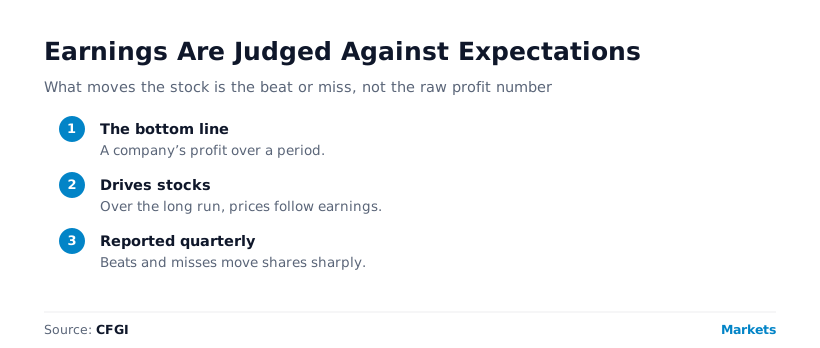
Company earnings are a company’s profits, reported every quarter in an earnings report alongside revenue and earnings per share. They are the fundamental that, over time, drives a stock’s value. But the market reaction to an earnings report is rarely about the raw number; it is about whether the result beat or missed expectations, which is why a profitable company can still see its stock fall. This is education, not financial advice.
CFGI data
Earnings move stocks through expectations, not just the numbers, which is why the same result can spark greed or fear. CFGI scores the equity mood those reports land in, from 0 to 100 on the Stock Fear and Greed Index, updated daily since 2021.
Source: CFGI dataset, 2021 to June 2026.
Key takeaways
- Earnings are a company’s profits, reported quarterly.
- A report shows revenue, net income and earnings per share.
- Over time, earnings drive a stock’s value.
- The market reacts to beats and misses versus expectations.
- A profitable company can still fall if it disappoints.
What Are Company Earnings?
Earnings are simply how much profit a company made, reported to investors each quarter in an earnings release. They are the clearest measure of whether a business is actually making money, and over the long run, a stock’s price tends to follow its earnings. A company that steadily grows its profits will, over time, see its share price grow with it; one whose earnings stagnate or shrink will struggle, however exciting its story. Earnings are the bedrock fundamental beneath all the noise.
What Is In an Earnings Report
Public companies are required to report their results to regulators and investors every quarter, in a document packed with figures. Three numbers matter most. "Revenue", or the "top line", is the total money the company brought in from sales. "Net income", or earnings, is the "bottom line", what is left as profit after all costs, taxes and expenses are subtracted. And "earnings per share" (EPS) divides that profit across the company’s shares. Alongside the raw numbers, companies usually provide "guidance", their own forecast for the quarters ahead, which the market often weighs even more heavily than the results just reported, because markets price the future, not the past. Most companies also hold an earnings call shortly after, where executives discuss the results and take questions, and the tone of that call can move the stock as much as the figures themselves.
Earnings Per Share: The Headline Number
The single most-watched figure in an earnings report is earnings per share, calculated by dividing net income by the number of shares outstanding. EPS matters because it expresses profit on a per-share basis, which makes it comparable across companies of wildly different sizes and lets you judge a stock against its price through the P/E ratio. It is the number analysts forecast and the one a result is judged "beat" or "miss" against. One quirk worth knowing: because EPS divides by the share count, a company can lift its EPS simply by reducing that count through share buybacks, boosting the per-share figure even if total profit is flat, which is why thoughtful investors look at both EPS and the underlying revenue and net income.
Why Does Earnings Season Move Markets?
Four times a year, companies report in a cluster known as earnings season, and stocks can swing hard on the results. It is a concentrated burst of new information, so it reprices expectations across the whole market in a few weeks. Individual stocks can gap violently the morning after they report, and big names, especially the mega-cap technology giants, can move entire indices on their own. Because so many results land at once, correlations rise and volatility climbs, making earnings season one of the most active and unpredictable stretches of the market calendar. It is, in effect, the market’s quarterly report card, marked all at once.
The Quarterly Report Card
Earnings season is when the market grades thousands of companies in a few weeks. Surprises, good and bad, reprice stocks fast, which is why volatility reliably rises during it.
Why Is It About Expectations, Not the Number?
Because the market has already priced in what it expects. What moves the stock is the surprise: a beat (better than expected) or a miss (worse). A company can report record profits and still fall if investors hoped for more, because the good news was already in the price, or because it missed the unofficial "whisper number" the market was quietly betting on. Equally, a struggling company can rally on losing less than feared. This is the gap between fact and mood that investor sentiment captures, and a core part of what moves stock prices. The bar is always the expectation, not the raw result, which is why understanding earnings means understanding what the market was expecting in the first place.
Frequently asked questions
What are company earnings?
A company’s profits, reported to investors every quarter in an earnings report alongside revenue and earnings per share. They are the clearest measure of whether a business is making money, and a stock’s price tends to follow its earnings over time.
What is in an earnings report?
The key figures are revenue (the top line, total sales), net income or earnings (the bottom line, profit after costs), and earnings per share (EPS). Companies also give "guidance", their forecast for coming quarters, which markets often weigh heavily.
What is earnings per share?
Net income divided by the number of shares outstanding, the most-watched figure in a report. It expresses profit per share, makes companies comparable, and is what results are judged "beat" or "miss" against. Buybacks can lift it by shrinking the share count.
Why did a stock fall after good earnings?
Because the market had already expected good news, so it was priced in, or the result missed the higher "whisper number". Stocks move on the surprise versus expectations, not the raw number, so a beat that is not big enough can still disappoint. This is education, not financial advice.
CFGI.io, Market sentiment research
The CFGI research team builds and maintains the CFGI Fear and Greed Index: a 0 to 100 sentiment score from 10 sub-indicators across hundreds of crypto assets and the equity market, refreshed every 15 minutes. We have tracked market emotion through multiple full crypto and equity cycles.
Think we missed something?
Spotted a gap, disagree with a take, or think we should cover a new topic? Message us and we'll act on your input.
Message us on TelegramKeep reading
This article is educational and is not financial advice. Crypto and equities are volatile and you can lose money. See our disclaimer.