Stocks
What Moves Stock Prices?
Quick answer
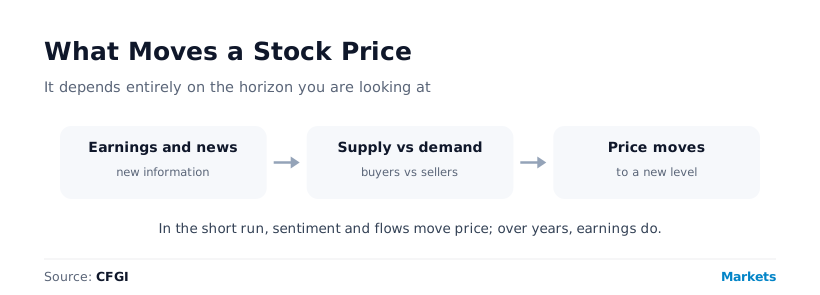
Over years, stock prices track fundamentals: earnings, growth and interest rates. Over days and weeks, they track supply and demand driven by sentiment, how the crowd feels about those fundamentals, and they move on surprises versus expectations rather than raw facts. That is why a strong company can fall on good news and a weak one can rally. The longer your horizon, the more fundamentals matter; the shorter it is, the more mood does. This is education, not financial advice.
CFGI data
Sentiment moves stock prices in the short run, and CFGI scores it live. The Stock Fear and Greed Index has hit an Extreme Fear low of 3 on 8 April 2025, the kind of crowd panic that moves prices well before the fundamentals catch up.
Source: CFGI dataset, stocks since 2021.
Key takeaways
- Long run: earnings, growth and interest rates.
- Short run: supply, demand and sentiment.
- Prices move on surprises versus expectations, not raw facts.
- A strong company can fall; a weak one can rally.
- The shorter the horizon, the more mood matters.
The Long Run: Fundamentals
Over years, a stock follows the business. Rising earnings, a growing economy and falling interest rates tend to lift prices; the reverse tends to weigh on them. This is the weighing machine: given enough time, real value wins out. A company that steadily grows its profits will, over the long run, see its share price grow with it, regardless of the noise along the way.
Interest rates deserve special mention, because they affect every stock at once. A share is ultimately worth the value of its future profits, and higher rates make those future profits worth less in today’s money, while also making safer alternatives like bonds more attractive. That is why a single decision by a central bank can move the entire market: it changes the yardstick against which all those future earnings are measured. Over the long run, then, the two great fundamental levers are how fast a company’s earnings grow and the level of interest rates used to value them.
The Short Run: Supply, Demand and Sentiment
Over days and weeks, the same stock can swing on mood alone. At the most basic level, price is set by supply and demand: if more people want to buy than sell, the price rises, and vice versa, and that balance is driven largely by sentiment. News lands differently depending on how the crowd feels; a good earnings report can be sold off, a bad one bought. Benjamin Graham’s line captures it: in the short run the market is a voting machine, and the votes are emotional. That gap between value and price is investor sentiment, and it is what drives most short-term moves.
The Specific Catalysts
On any given day, a stock moves on a recognisable set of catalysts. Earnings reports are the biggest, capable of repricing a stock in milliseconds when they beat or miss expectations. Analyst upgrades and downgrades shift demand. Decisions by the Federal Reserve on interest rates ripple through every valuation. Economic data, like inflation and jobs reports, moves the whole market at once. And company-specific news, a new product, a lawsuit, a merger, a scandal, hits individual names. Underneath all of these, the wider market’s mood acts as an amplifier: the same piece of news can spark a rally in a greedy market and a sell-off in a fearful one.
Why Expectations Beat Facts
The most confusing thing about short-term moves is that prices react to surprises relative to expectations, not to the raw facts. A company can post record profits and fall, because the market expected even more, and a struggling one can rally on losing less than feared. This is because the market is forward-looking and "prices in" what it already anticipates, so only the gap between reality and expectation moves the price. It is why "buy the rumour, sell the news" is a market saying: by the time good news is official, it is often already in the price, and the buyers who chased the rumour sell to the latecomers. Understanding that the bar is the expectation, not the fact, explains most of the otherwise baffling reactions to news.
The Bar Is the Expectation
Stocks move on the gap between reality and what was expected. "Good news" already priced in can send a stock down; "bad news" less bad than feared can send it up.
How Well Does Sentiment Explain Prices?
Well for today, poorly for tomorrow. CFGI data mirrors same-day market direction 79% of the time, but its agreement with the next day falls to 49%, close to a coin flip. So sentiment tells you where the crowd stands now, not where price goes next. The practical takeaway is to match your lens to your horizon: if you are investing for years, focus on the fundamentals that the weighing machine ultimately rewards, and treat the daily mood as noise; if you are trading over days, the sentiment and the expectations game matter far more than any long-run valuation. See the equity mood on the Stock Fear and Greed Index.
Frequently asked questions
What moves stock prices?
Over the long run, fundamentals: earnings, economic growth and interest rates. Over the short run, supply and demand driven by sentiment, plus specific catalysts like earnings, analyst changes, Fed decisions and economic data.
Why did a stock drop on good news?
Because the good news was already expected and priced in, or fell short of even higher expectations, or the mood was fearful. Short-term prices move on the gap between reality and expectation, not the raw fact, hence "buy the rumour, sell the news".
What are the main catalysts that move a stock?
Earnings beats or misses, analyst upgrades and downgrades, Fed interest-rate decisions, economic data like inflation and jobs reports, and company-specific news, all amplified by the wider market’s mood.
Can sentiment predict where a stock goes next?
No. CFGI data matches same-day direction 79% of the time but only 49% the next day. Sentiment reads the present; it does not forecast the next move. This is education, not financial advice.
CFGI.io, Market sentiment research
The CFGI research team builds and maintains the CFGI Fear and Greed Index: a 0 to 100 sentiment score from 10 sub-indicators across hundreds of crypto assets and the equity market, refreshed every 15 minutes. We have tracked market emotion through multiple full crypto and equity cycles.
Think we missed something?
Spotted a gap, disagree with a take, or think we should cover a new topic? Message us and we'll act on your input.
Message us on TelegramKeep reading
This article is educational and is not financial advice. Crypto and equities are volatile and you can lose money. See our disclaimer.