Stocks
Fear and Greed Index for Retirement Investing
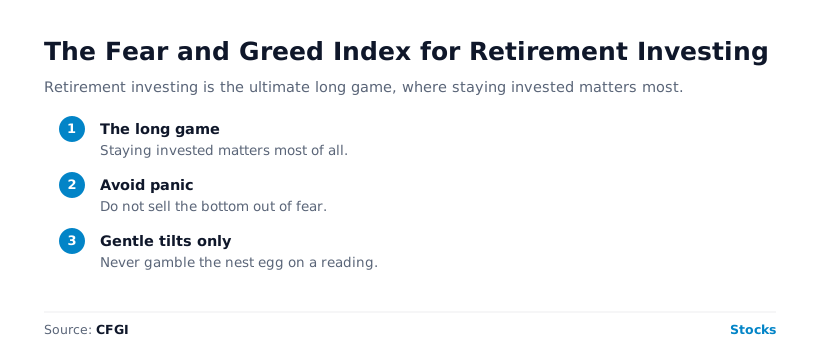
Quick answer
Retirement investing is the longest game most people play, often decades, so the priority is to keep contributing and stay invested through every cycle. The Fear and Greed Index is not a timing tool here. Its value is behavioural: it helps you avoid the two costly retirement mistakes, panic selling in Extreme Fear and over-reaching in Extreme Greed, so compounding can do its work. As retirement nears, it also helps you resist the panic that can do the most damage. This is education, not financial advice.
CFGI data
For retirement, CFGI is a discipline aid, not a signal. Its history since 2021 shows every Extreme Fear, like the equity 3 on 8 April 2025, eventually passed. Over a multi-decade horizon, the index’s job is to stop emotional decisions that interrupt compounding.
Source: CFGI dataset, 2021 to June 2026.
Key takeaways
- Retirement investing is a decades-long game.
- Staying invested matters more than timing.
- Missing the best days, which cluster near lows, is hugely costly.
- The index helps avoid panic selling and over-reaching.
- Its role is behavioural, not predictive.
Time Is the Real Engine
Over a retirement horizon, the biggest driver of outcomes is not picking the perfect entry, it is staying invested so that compounding can work across decades. The behaviour that destroys retirement returns is reacting emotionally: selling in a crash, or piling in at a top. That is where a Fear and Greed Index helps, not as a market-timing tool, which rarely works over a lifetime, but as a way to recognise and resist those emotional moments.
The Cost of Emotional Mistakes
The single most powerful argument for staying invested is what happens if you do not. A large share of the stock market’s long-run gains comes from a tiny handful of its very best days, and those best days have a cruel habit of clustering right after the worst ones, in the violent rebounds that follow a crash. The retiree who panics and sells during a plunge is therefore most likely to be on the sidelines for exactly the powerful recovery that drives their long-term return, locking in the loss and missing the gain. Studies of investor behaviour consistently show that the average investor underperforms the very funds they own, precisely because they buy and sell at the wrong emotional moments. Over a multi-decade horizon, avoiding these self-inflicted errors matters far more than any clever timing ever could.
How to Use It for the Long Game
- Keep contributing on schedule through every cycle, whatever the reading.
- When a crash tempts you to sell, check the index: Extreme Fear is normal and has always passed.
- When euphoria tempts you to over-reach, treat Extreme Greed as a reason for discipline.
- Let your asset mix follow your age and goals, not the sentiment of the moment.
- Treat the index as a guardrail against emotion, never as a timing signal.
Stay Invested
For retirement, the index is most valuable as a guardrail that keeps you from the two big mistakes, selling the bottom and chasing the top. This is education, not financial advice.
As You Near Retirement
The calculus shifts as the finish line approaches, and this is where sentiment can be most useful. Early in your career, time is on your side and a crash is mostly an opportunity to keep buying cheaply; but in the years just before and after retirement, a deep downturn is more dangerous, because you have less time to recover and may soon be drawing the money down, a problem known as sequence-of-returns risk. The standard response is a "glide path", gradually shifting toward a more conservative mix as you age, set by your plan rather than the market. The Fear and Greed Index does not change that plan, but at this stage it guards against the most damaging mistake of all: panic-selling a large nest egg near a bottom, where the loss is hardest to make back, while equally cautioning against reaching for risk in Extreme Greed when you can least afford a setback.
Sequence Risk Near the Finish
A crash hurts most just before and after you retire, when you have least time to recover. That is exactly when the index’s guardrail against panic-selling is most valuable.
A Guardrail, Not a Signal
The throughline is that, for retirement, the Fear and Greed Index is a behavioural tool, not a predictive one. It will not tell you when to get in or out, and trying to use it that way over a lifetime is a recipe for the very mistakes it should help you avoid. Its real job is quieter and more valuable: to put a number on the emotion you are feeling, so that when the crowd is in Extreme Fear and every instinct screams "sell", you have an objective reminder that this is normal, that it has always passed, and that your decades-long plan was built for exactly these moments. Used as a guardrail rather than a signal, it helps ensure the one thing that matters most for retirement, that you stay invested and let compounding finish the job.
Frequently asked questions
Should retirement investors use the Fear and Greed Index?
Not to time the market. Its value is behavioural: it helps you avoid panic selling in Extreme Fear and over-reaching in Extreme Greed, so compounding can work over decades.
What is the biggest retirement-investing mistake?
Reacting emotionally, selling in a crash or piling in at a top. The market’s best days cluster right after the worst, so the panic-seller usually misses the rebound that drives their long-term return. Staying invested matters far more than timing.
Does sentiment matter more as I near retirement?
Yes. With less time to recover and money soon to be drawn down (sequence-of-returns risk), a crash is more dangerous, so the index’s guardrail against panic-selling a large nest egg near a bottom is especially valuable. Your glide path, not the score, sets the mix.
Can sentiment improve my retirement returns?
Mainly by preventing emotional mistakes that interrupt compounding. It is a guardrail, not a timing signal, and not financial advice. This is education, not financial advice.
CFGI.io, Market sentiment research
The CFGI research team builds and maintains the CFGI Fear and Greed Index: a 0 to 100 sentiment score from 10 sub-indicators across hundreds of crypto assets and the equity market, refreshed every 15 minutes. We have tracked market emotion through multiple full crypto and equity cycles.
Think we missed something?
Spotted a gap, disagree with a take, or think we should cover a new topic? Message us and we'll act on your input.
Message us on TelegramKeep reading
This article is educational and is not financial advice. Crypto and equities are volatile and you can lose money. See our disclaimer.