Stocks
What Is a Stock Buyback?
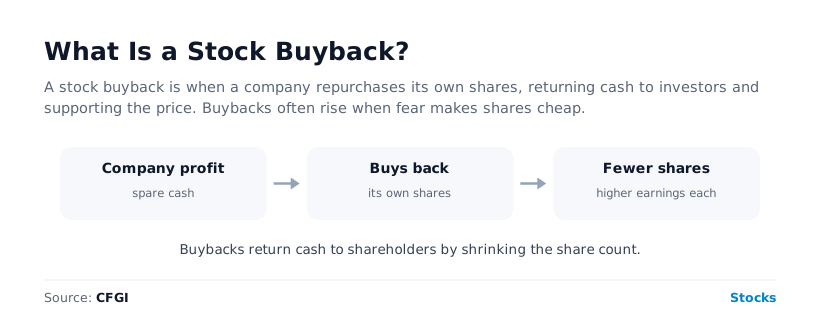
Quick answer
A stock buyback, or share repurchase, is when a company uses its cash to buy back its own shares from the market. This reduces the number of shares outstanding, which lifts earnings per share and returns value to remaining shareholders. Buybacks can also support a price and are more tax-efficient and flexible than dividends, though critics call them financial engineering. Companies often step up repurchases when fear has pushed their shares down to attractive levels, though many do the opposite. This is education, not financial advice.
CFGI data
Buybacks can lean against fear. When sentiment is depressed and shares are cheap, companies repurchasing their own stock add a source of demand. A Fear and Greed Index helps frame whether a buyback is landing into fear, often when it does most for value, or into greed, on its 0 to 100 scale.
Source: CFGI dataset, 2021 to June 2026.
Key takeaways
- A buyback is a company repurchasing its own shares.
- It reduces shares outstanding and lifts earnings per share.
- It is more flexible and tax-efficient than a dividend.
- Critics call it financial engineering, especially when poorly timed.
- The best buybacks happen when fear makes shares cheap.
Returning Cash by Shrinking the Share Count
A company with spare cash has choices: invest it, pay a dividend, or buy back its own shares. A buyback reduces the shares outstanding, so each remaining share represents a slightly larger slice of the company and its profits, which lifts earnings per share even if total profit is unchanged. Buybacks also add demand, which can support or lift the price. Critics argue they can be poorly timed, but well-executed repurchases into weakness can create real value.
How a Buyback Works
In a buyback, the company uses its own cash to purchase its shares, usually steadily on the open market, sometimes through a one-off "tender offer" at a set price. The repurchased shares are then cancelled or held as "treasury" stock, so they no longer count as outstanding. The maths is simple but powerful: if a company earns the same total profit but spreads it across fewer shares, earnings per share rises automatically. A firm earning 100 million dollars on 100 million shares makes 1 dollar per share; buy back 10 million shares and the same profit becomes about 1.11 dollars per share, a 11% boost without selling a single extra product.
Why Companies Do It
Companies favour buybacks for several reasons. They are flexible: unlike a dividend, which investors expect to be maintained forever, a buyback can be started, paused or stopped without the same stigma. They boost earnings per share, which can help a company hit analyst targets, and management bonuses are often tied to that figure. A buyback can also signal that the board believes its own shares are undervalued, putting the company’s money where its mouth is. And they quietly offset the dilution created when firms issue new shares to pay employees. Often a single buyback programme serves several of these purposes at once.
The Flexibility Edge
Cutting a dividend is a public embarrassment; pausing a buyback barely registers. That flexibility is a big reason buybacks have become the preferred way to return cash.
Buybacks Versus Dividends
Buybacks and dividends are the two ways to return cash, with different trade-offs. A dividend hands cash to every shareholder and is taxed in the year you receive it; a buyback returns value only to those who choose to sell, lets remaining holders defer tax until they sell, and lifts earnings per share. Over the past decade, buybacks have overtaken dividends as the main method of returning cash in the US, part of why the market’s dividend yield has slipped below 2%, down from a historical range of 3% to 6%. The research suggests neither is strictly better, but companies that do both have tended to outperform those that only pay dividends.
The Criticism: Financial Engineering
Buybacks are controversial. Critics argue that boosting earnings per share by shrinking the share count is "financial engineering", flattering the headline number without improving the actual business, and that money spent on buybacks could have gone to investment, wages or research. The timing critique is the sharpest: in aggregate, companies tend to buy back the most when shares are expensive in good times and the least when shares are cheap in a downturn, the exact opposite of buying low. Concerns also surround debt-funded buybacks and the link to executive pay. Partly in response, the US introduced a 1% excise tax on buybacks in 2023. A buyback creates value only when shares are repurchased below their worth.
Buybacks and Sentiment
The best buybacks tend to happen when fear has driven shares below their worth, exactly when a company can repurchase the most stock per dollar, yet the uncomfortable truth is that many firms do the opposite, buying eagerly in euphoria and going quiet in panic. A Stock Fear and Greed Index helps frame whether buybacks are landing into fear, where they do most for long-term value, or chasing into greed. A company aggressively repurchasing its own stock while the gauge sits in Extreme Fear is showing real conviction; one buying hand over fist at the top of a greedy market deserves more scepticism.
Frequently asked questions
What is a stock buyback?
When a company repurchases its own shares from the market, reducing shares outstanding. This lifts earnings per share and returns value to remaining shareholders, and is more flexible and tax-efficient than a dividend.
How does a buyback lift earnings per share?
By spreading the same total profit across fewer shares. If a firm earns the same amount but has bought back 10% of its shares, earnings per share rises by roughly that proportion, without any change to the underlying business.
Why are buybacks criticised?
Critics call them financial engineering, flattering earnings per share without improving the business, and note that companies tend to buy back most when shares are expensive and least when cheap. The US added a 1% buyback excise tax in 2023.
When do companies buy back the most?
Ideally when fear has pushed shares to attractive levels, when each dollar repurchases more stock, though in practice many buy most in good times. A Fear and Greed Index helps frame the timing. This is education, not financial advice.
CFGI.io, Market sentiment research
The CFGI research team builds and maintains the CFGI Fear and Greed Index: a 0 to 100 sentiment score from 10 sub-indicators across hundreds of crypto assets and the equity market, refreshed every 15 minutes. We have tracked market emotion through multiple full crypto and equity cycles.
Think we missed something?
Spotted a gap, disagree with a take, or think we should cover a new topic? Message us and we'll act on your input.
Message us on TelegramKeep reading
This article is educational and is not financial advice. Crypto and equities are volatile and you can lose money. See our disclaimer.