Stocks
What Is an Earnings Beat?
Quick answer
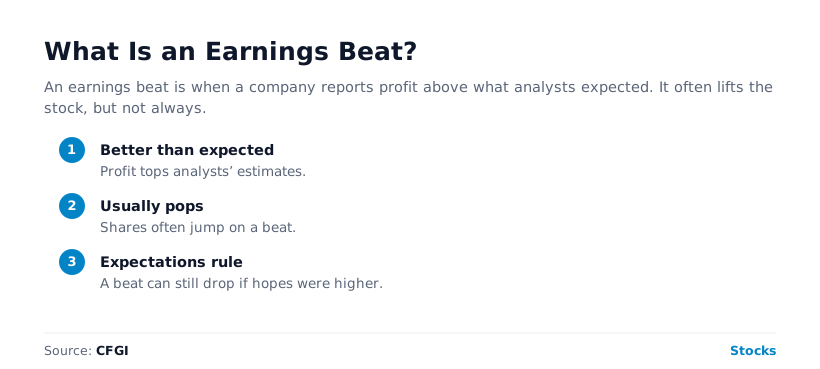
An earnings beat is when a company reports profit, usually earnings per share, higher than analysts expected. Because stock prices already reflect expectations, what moves them is the surprise, beating or missing, rather than the absolute number. A beat often lifts the stock, but not always: most companies beat anyway because estimates are set low, so it is the size and quality of the beat, and the guidance alongside it, that really decide the reaction.
CFGI data
A beat only lifts a stock if expectations were not already euphoric, which is where sentiment comes in. When the Stock Fear and Greed Index sits in Extreme Greed, 80 or above on its 0 to 100 scale, even genuinely good news can underwhelm a crowd that has already priced in perfection, so the same beat can rally one quarter and disappoint the next.
Source: CFGI methodology, 10-input 0 to 100 model.
Key takeaways
- An earnings beat is profit above the analyst consensus estimate.
- Markets react to the surprise, not the raw number.
- Most companies beat: roughly three-quarters of the S&P 500 each quarter.
- The real bar is often a higher "whisper" number or the guidance.
- Misses are punished far harder than beats are rewarded.
Beating the Expectation
Before a company reports, analysts publish forecasts for its earnings per share, and those forecasts are averaged into a "consensus" estimate. When the actual result comes in above that consensus, it is an earnings beat; below it, a miss. The crucial idea is that the market has already priced in the expected number, so it is the gap between expected and actual, the surprise, that tends to move the stock, not the headline figure on its own.
Why Beating Is the Norm, Not the Exception
Here is what surprises most beginners: beating estimates is normal, not impressive. In a typical quarter, roughly three-quarters of S&P 500 companies beat the EPS consensus, around 76 to 78% on a multi-year average, and a similar majority beat on revenue. If almost everyone beats, the beat itself can hardly be remarkable. The reason is a quiet game called "sandbagging": management has every incentive to guide analysts toward modest expectations it knows it can clear, so the company can deliver a "beat" and look good. Investors have grown wise to this, which is why simply nudging past a lowballed estimate often produces little or no reaction.
The Reframe
A beat is the default, not an achievement. The questions that matter are: by how much, how broadly, and against what the market really expected, not the published number.
The Hidden Bar: Whisper Numbers
Because the official consensus is so often beaten, the market quietly trades against a higher, unofficial bar, the "whisper number". This is the figure that circulates among professionals as the real expectation, usually above the published estimate. A stock is frequently priced for the whisper, not the consensus, which is why a company can beat the official estimate and still fall: it cleared the public bar but missed the private one everyone was actually counting on. Understanding this resolves the most confusing part of earnings season, the beat that sinks the stock.
Why a Beat Can Still Disappoint
Beyond the whisper, two more forces can turn a beat sour. The first is euphoric sentiment: if a stock has run up hard and expectations are sky-high, a merely good result lands as a letdown, the classic "buy the rumour, sell the news". The second, and most powerful, is guidance. A company can beat on the quarter just reported and still drop sharply if it cuts its outlook for the quarters ahead, because markets care more about the future than the past. A beat backed by weak guidance is one of the most reliable ways for a stock to fall on apparently good news.
Beats and Misses Are Not Symmetric
The market does not reward beats and punish misses equally. On average, a company that beats might see its stock outperform by less than a percent on the day, while a company that misses can be slammed by several percent or more. That lopsidedness is loss aversion at work: investors fear a miss far more than they celebrate a beat. It also means the quality of a beat matters enormously. A beat driven by a single one-off item, a tax benefit, a sold asset, is treated with suspicion, while a broad-based beat across revenue, margins and cash flow, paired with confident guidance, is what genuinely moves a stock higher.
How to Read an Earnings Beat
- Check the size: a tiny beat over a lowball estimate is barely news.
- Check the breadth: did revenue, margins and cash flow all improve, or just one line?
- Check the guidance: a beat with a cut outlook often outweighs the beat itself.
- Check the expectations: a beat into a euphoric, run-up stock can still disappoint.
Earnings Beats and Market Sentiment
How a beat is received depends heavily on the mood it lands in, which is why sentiment is the missing piece. When the Stock Fear and Greed Index sits in greed and a stock is priced for perfection, the bar to impress is brutally high and good results can fall flat. When fear dominates and expectations are low, the same beat can spark relief and a sharp rally. Reading a company’s result against where investor sentiment already sits, on the 0 to 100 scale, explains far more about the reaction than the beat or miss alone.
Frequently asked questions
What is an earnings beat?
When a company reports profit, usually earnings per share, above the analyst consensus estimate. Markets react to that surprise rather than the absolute number.
Do most companies beat estimates?
Yes. Roughly three-quarters of S&P 500 companies beat the EPS consensus in a typical quarter, largely because estimates are set conservatively. That is why a beat alone is rarely impressive, what matters is the size, breadth and guidance.
Why does a stock sometimes fall after beating estimates?
Because the stock may have been priced for a higher "whisper" number or for strong guidance. Clearing the official consensus by a little, while missing that implicit bar or cutting the outlook, can still sink the stock.
Are beats and misses treated equally?
No. Misses are punished far more harshly than beats are rewarded, a reflection of loss aversion. A broad-based beat with good guidance moves a stock; a thin beat on a one-off item often does not. This is education, not financial advice.
CFGI.io, Market sentiment research
The CFGI research team builds and maintains the CFGI Fear and Greed Index: a 0 to 100 sentiment score from 10 sub-indicators across hundreds of crypto assets and the equity market, refreshed every 15 minutes. We have tracked market emotion through multiple full crypto and equity cycles.
Think we missed something?
Spotted a gap, disagree with a take, or think we should cover a new topic? Message us and we'll act on your input.
Message us on TelegramKeep reading
This article is educational and is not financial advice. Crypto and equities are volatile and you can lose money. See our disclaimer.