Stocks
What Is Earnings Per Share?
Quick answer
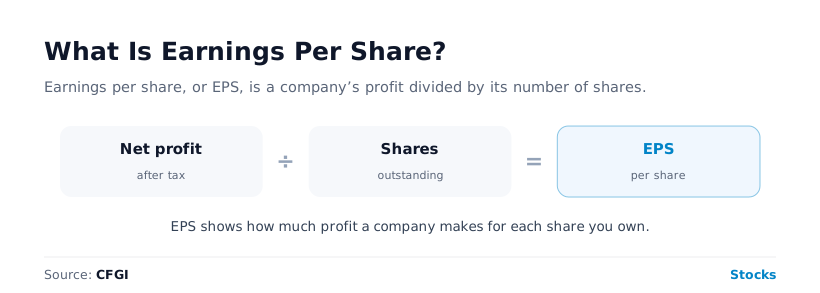
Earnings per share, or EPS, is a company’s profit divided by the number of shares outstanding, so it shows how much profit sits behind each single share. It lets you compare profitability across companies of very different sizes and track it over time, and it forms the bottom half of the price-to-earnings ratio. EPS is one of the most-watched numbers every earnings season, because the gap between the expected figure and the actual one often moves the stock in seconds.
CFGI data
EPS is where expectations meet reality, and the gap between them is pure sentiment. A company can beat its forecast and still fall, because the market was already priced for more. CFGI’s Stock Fear and Greed Index tracks that emotional backdrop on a 0 to 100 scale in real time, the same mood that decides whether a given EPS number is greeted with relief or disappointment.
Key takeaways
- EPS is profit divided by the number of shares, profitability on a per-share basis.
- Diluted EPS counts options and convertibles, so it is the more conservative figure.
- It feeds the price-to-earnings ratio, a core valuation measure.
- Buybacks can lift EPS with no real improvement in the business.
- Beating or missing the expected EPS often moves the stock more than the number itself.
Profit, Per Share
A company’s total profit is hard to compare across firms of different sizes, so investors divide it down. EPS takes company earnings, strictly net income minus any preferred dividends, and divides by the number of shares to give profit on a per-share basis. Think of the company as a pizza: EPS tells you how much profit a single slice produced. A higher EPS means more profit behind each share, and a rising EPS over the years signals a business growing its profitability.
A quick worked example. A company earns 500 million in net profit and has 250 million shares. Its EPS is 500 divided by 250, or 2.00 per share. EPS is also the bottom half of the price-to-earnings ratio: divide the share price by EPS and you see how much investors are paying for each unit of the company’s earnings.
Basic Versus Diluted EPS
You will usually see two versions of the number. Basic EPS uses the shares that exist today. Diluted EPS asks a harder question: what would EPS be if everyone holding something convertible into shares, employee stock options, warrants, convertible bonds, actually claimed them? Because that adds shares to the denominator, diluted EPS is always equal to or lower than basic EPS.
Serious investors lean on the diluted figure, because it is the conservative one. It shows the profit per share in the realistic scenario where the share count grows, rather than flattering today’s smaller count. When a company quotes only its basic EPS, it is worth asking how much dilution is waiting in the wings.
Trailing Versus Forward EPS
| Trailing EPS | Forward EPS | |
|---|---|---|
| Based on | Actual past 12 months | Analyst estimates, next 12 months |
| Nature | Factual, reported | Predictive, can be wrong |
| Feeds | Trailing P/E | Forward P/E |
| Best for | What happened | What the market expects |
Two timeframes, two purposes.
Trailing EPS is history you can rely on; forward EPS is a forecast you should treat with caution. Most valuation arguments hinge on the forward number, which is exactly why a change in analyst estimates can move a stock before a single new result is even reported.
How Buybacks Flatter EPS
Here is the part that catches people out. Because EPS is profit divided by share count, a company can raise EPS without earning a cent more, simply by shrinking the denominator. Share buybacks do exactly that.
Take a company earning 1 million on 1 million shares: EPS is 1.00. It buys back 100,000 shares, leaving 900,000. Now EPS is 1 million divided by 900,000, or 1.11, an 11% jump, with no improvement in the business at all. As McKinsey has noted, buybacks can boost reported earnings per share without improving the underlying returns of the company. EPS went up; the pizza did not get bigger.
Read EPS Growth Carefully
Rising EPS is only good news if it comes from rising profit. If it comes from a shrinking share count, the business may be flat while the headline number climbs. Always check whether earnings grew, not just EPS.
Why EPS Moves Stocks: Beats, Misses and Guidance
Markets do not trade on the EPS number, they trade on the surprise. Analysts publish a consensus EPS estimate, and the stock reacts to whether the actual figure beats or misses it. But a beat is no guarantee of a rally. A company can beat consensus and still fall hard, because the market had already priced in something better, or because management cut its guidance for the next quarter. The market cares more about where earnings are going than where they have been.
There is also a slower effect worth knowing. Post-earnings announcement drift, documented since 1968, is the tendency for a stock to keep drifting in the direction of its surprise, up after a beat, down after a miss, for weeks afterwards. The initial pop is rarely the end of the story.
EPS, Expectations and Sentiment
Strip EPS down and it is a story about expectations versus reality, which is the same fuel that drives investor sentiment. The number itself is cold arithmetic; the reaction to it is emotional, shaped by what the crowd already believed. That backdrop is what the Stock Fear and Greed Index measures on a 0 to 100 scale. In a greedy market, expectations run high and even good results can disappoint; in a fearful one, a modest beat can spark relief. Reading EPS alongside the market’s mood tells you far more than the figure alone.
Frequently asked questions
What is earnings per share?
A company’s profit (net income minus preferred dividends) divided by its number of shares outstanding. It shows how much profit sits behind each share, making profitability easy to compare across companies.
What is the difference between basic and diluted EPS?
Basic EPS uses the shares that exist now. Diluted EPS also counts shares that could be created from options, warrants and convertibles, so it is always equal to or lower than basic EPS. Diluted is the more conservative, widely watched figure.
Can a company increase EPS without earning more?
Yes. Because EPS divides profit by share count, buying back shares lifts EPS even if profit is flat. A buyback of 10% of shares can raise EPS by over 10% with no improvement in the business, so it pays to check whether earnings actually grew.
Why do stocks sometimes fall after beating EPS estimates?
Because the market trades on expectations and guidance, not just the headline number. If a beat was already priced in, or management lowers its outlook, the stock can drop even on good results. This is education, not financial advice.
CFGI.io, Market sentiment research
The CFGI research team builds and maintains the CFGI Fear and Greed Index: a 0 to 100 sentiment score from 10 sub-indicators across hundreds of crypto assets and the equity market, refreshed every 15 minutes. We have tracked market emotion through multiple full crypto and equity cycles.
Think we missed something?
Spotted a gap, disagree with a take, or think we should cover a new topic? Message us and we'll act on your input.
Message us on TelegramKeep reading
This article is educational and is not financial advice. Crypto and equities are volatile and you can lose money. See our disclaimer.