Markets
What Is an Asset Class?
Quick answer
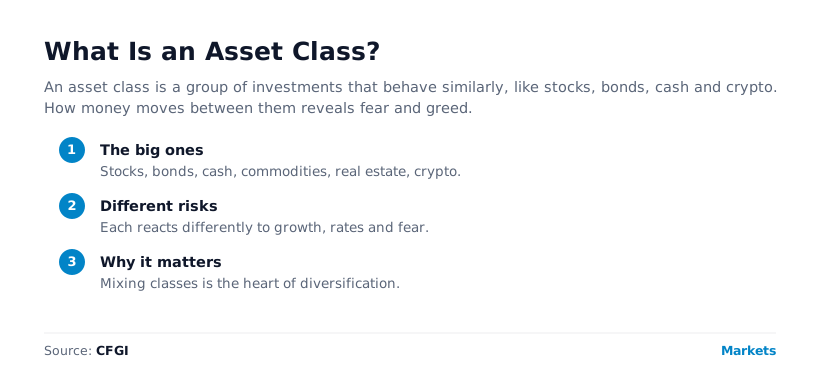
An asset class is a group of investments that share similar characteristics and tend to behave alike, such as stocks, bonds, cash, commodities and cryptocurrencies. Spreading money across asset classes is the foundation of diversification, because they often respond differently to the same events: when one falls, another may hold up. How money rotates between them, toward risk in greed and toward safety in fear, is itself one of the clearest reads on market sentiment. This is education, not financial advice.
CFGI data
Money rotates between asset classes with the mood. Greed pulls capital toward riskier classes like stocks and crypto; fear pushes it toward safer ones like bonds and cash. A Fear and Greed Index reads that rotation as a single number on a 0 to 100 scale, the same risk appetite playing out across every class at once.
Source: CFGI dataset, 2021 to June 2026.
Key takeaways
- An asset class groups investments that behave similarly.
- The main ones are stocks, bonds, cash, commodities, property and crypto.
- Each has a distinct profile of risk and return.
- Low correlation between classes is what makes diversification work.
- Rotation between classes is a clear read on fear and greed.
The Main Building Blocks
Investments are grouped into classes because members of a class tend to share risks and respond similarly to conditions. The classic classes are stocks, bonds and cash, with commodities, property and cryptocurrencies often added. Each has a different profile of risk and return, and the reason the grouping matters is diversification: because different classes often react differently to the same event, holding several can smooth a portfolio’s ride compared with holding just one.
The Main Classes, One by One
| Class | Risk and return | Role |
|---|---|---|
| Stocks | High return, high volatility | Long-term growth |
| Bonds | Lower return, steadier | Stability and income |
| Cash | Lowest risk and return | Safety, dry powder |
| Commodities | Volatile, inflation-linked | Inflation hedge |
| Crypto | Very high risk and volatility | Speculative growth |
The major asset classes and their character.
Property, via real estate or listed funds, is often added too, prized for income and a relatively low correlation to stocks and bonds. No class is "best"; each plays a different role.
How They Behave Differently
The value of having several classes comes from the fact that they march to different drums. Stocks tend to rise during economic growth and fall in recessions. Bonds are steadier and often do well precisely when stocks struggle, especially when interest rates fall. Cash earns little but never falls, making it a safe place to wait. Commodities like gold can hold or gain value during inflation and currency stress, when paper assets wobble. Crypto, the newest class, is the most volatile of all. Because these reactions differ, a shock that hammers one class may leave another untouched, or even lift it.
Correlation: Why Mixing Classes Works
The technical reason diversification across classes works is low correlation, the degree to which two things move together. Stocks and bonds have historically had low or even negative correlation, so a portfolio holding both is steadier than one holding either alone: when stocks fall, bonds or gold may hold their value and cushion the blow. That is the mechanism behind the classic stock-and-bond mix. The one caveat, familiar from any systemic crisis, is that in a true panic correlations can spike toward one and almost everything falls together, so spreading across classes tames everyday risk far more reliably than it shields against a once-in-a-generation shock.
The Key Test
Adding more of the same class is not diversification. Real diversification comes from combining classes that do not move in lockstep, which is what lowers risk without sacrificing return.
Crypto: The New Asset Class
For most of history the list of asset classes was settled. Cryptocurrencies are the first genuinely new entrant in a long time, and whether they deserve the title is still debated. The case in favour is that they have grown into a large, distinct market with their own drivers, and that adding a small amount has at times improved a traditional portfolio’s risk-return profile. The case against points to extreme volatility and a correlation to stocks that has risen as institutions moved in via products like Bitcoin ETFs. Either way, crypto now sits on most maps of the investment landscape, the clearest sign that the set of asset classes is not fixed forever.
Allocation Across Classes
Deciding how to split your money across asset classes, your "asset allocation", is the single most consequential investment decision you make, more important over time than the specific stocks or coins you pick within each class. A young investor with a long horizon might tilt heavily toward stocks and a little crypto for growth; someone near retirement might hold more bonds and cash for stability. The right mix flows from your goals, your time horizon and your risk tolerance, and the asset classes are simply the ingredients you combine to build it.
Asset Classes and Sentiment
The flow of money between asset classes is one of the clearest expressions of risk-on, risk-off behaviour. In greed, capital rotates into riskier classes like stocks and crypto, chasing return; in fear, it retreats to safer ones like bonds, cash and gold, chasing safety. A Fear and Greed Index captures that shift in risk appetite as one number on a 0 to 100 scale. Watching both the gauge and where money is actually rotating gives you the mood and the movement, the feeling and the flow behind it.
Frequently asked questions
What is an asset class?
A group of investments that share similar characteristics and behave alike, such as stocks, bonds, cash, commodities and cryptocurrencies. Spreading across them is the basis of diversification.
What are the main asset classes?
Traditionally stocks, bonds and cash, with commodities, property and cryptocurrencies often added. Each has a different profile of risk and return and plays a different role in a portfolio.
Why does correlation between asset classes matter?
Because diversification only works if classes do not move in lockstep. Stocks and bonds have often had low or negative correlation, so holding both smooths the ride, when one falls, the other may hold up.
How do asset classes relate to fear and greed?
Money rotates between them with the mood: toward riskier classes like stocks and crypto in greed, toward safer ones like bonds and cash in fear. A Fear and Greed Index reads that rotation. This is education, not financial advice.
CFGI.io, Market sentiment research
The CFGI research team builds and maintains the CFGI Fear and Greed Index: a 0 to 100 sentiment score from 10 sub-indicators across hundreds of crypto assets and the equity market, refreshed every 15 minutes. We have tracked market emotion through multiple full crypto and equity cycles.
Think we missed something?
Spotted a gap, disagree with a take, or think we should cover a new topic? Message us and we'll act on your input.
Message us on TelegramKeep reading
This article is educational and is not financial advice. Crypto and equities are volatile and you can lose money. See our disclaimer.