Markets
What Is Systemic Risk?
Quick answer
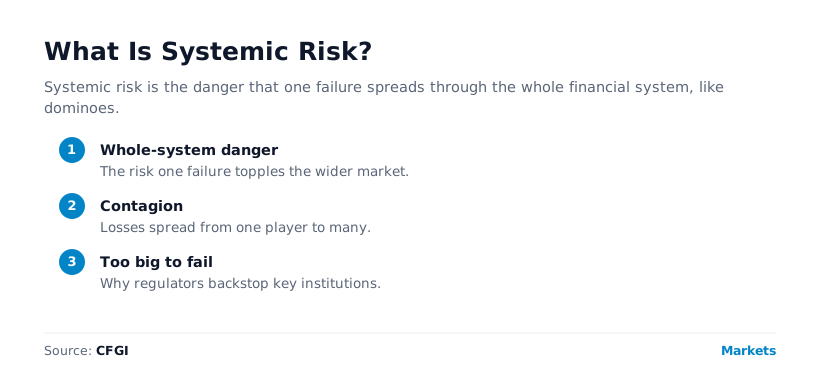
Systemic risk is the danger that the failure of one part of the financial system, a bank, a market, a large institution, cascades through the rest and threatens the whole. Unlike the risk of a single stock falling, which you can diversify away, systemic risk hits everything at once, so spreading your money across assets offers little protection. It is the kind of risk behind full-blown financial crises and market crashes, and it is why regulators watch the biggest institutions so closely.
CFGI data
Systemic events are when CFGI reads its deepest, broadest fear. The crypto low of 17 on 12 May 2022, during the Terra collapse, is exactly this: one failure dragging the whole market down together. CFGI scores that mood on a 0 to 100 scale, and genuine systemic shocks are what push it toward the floor below 20.
Source: CFGI dataset, March 2022 to June 2026.
Key takeaways
- Systemic risk is the danger of a system-wide collapse, not an isolated loss.
- One failure can cascade through everything, like dominoes.
- Unlike idiosyncratic risk, it cannot be diversified away.
- Lehman Brothers in 2008 was the largest bankruptcy in US history.
- Crypto had its own systemic cascade in 2022, from Terra to FTX.
When One Failure Spreads
The financial system is deeply interconnected. Banks lend to one another, institutions hold each other’s debt, and markets rely on shared plumbing. Systemic risk is the danger that one big failure pulls others down with it, a chain reaction rather than a contained loss. A single large bank collapsing can freeze lending across the entire system, because no institution operates in isolation: they are bound together by loans, derivatives and obligations, and the biggest players are usually the most tightly connected of all.
Systemic Versus Idiosyncratic Risk
The cleanest way to understand systemic risk is by its opposite. Idiosyncratic risk, also called specific or unsystematic risk, is the risk tied to one company or sector: a bad product, a fraud, a failed drug trial. It hurts one holding and stops there, which is why spreading money across many holdings tames it.
| Idiosyncratic risk | Systemic risk | |
|---|---|---|
| Affects | One company or sector | The whole system |
| Example | A single firm’s scandal | A banking crisis |
| Diversifiable? | Yes | No |
| Felt as | A bad day for one stock | A crash across everything |
Two very different kinds of risk.
Systemic risk is the one that keeps regulators awake, precisely because the usual defence, owning lots of different things, does not work against it.
Why It Cannot Be Diversified Away
Diversification works by mixing assets that do not all move together, so a fall in one is offset by steadiness in another. The cruel feature of a systemic event is that it breaks this. In a true crisis, correlations rush toward one, almost everything falls at the same time, and the safe-haven assets people scramble into are few and crowded. A market crash driven by systemic risk drags the good down with the bad, which is exactly why "I was diversified" is cold comfort in the depths of a crisis.
2008: The Textbook Case
The defining modern example is the collapse of Lehman Brothers in September 2008. With around 639 billion dollars in assets, it was the largest bankruptcy in US history, roughly six times bigger than any before it. Lehman did not fail quietly. Its web of cross-border obligations and derivative contracts meant the shock spread within hours, freezing credit markets, toppling confidence in other institutions, and forcing emergency rescues across the globe. It was the clearest demonstration of why some firms are called "too big to fail": not because they deserve saving, but because their failure threatens everyone else.
Crypto’s Own Systemic Moment
Crypto learned the same lesson in 2022. The collapse of the Terra ecosystem in May 2022 erased around 45 billion dollars of value in a matter of days and proved to be the first domino. Lenders and funds that were over-leveraged and entangled with one another, Celsius, Three Arrows Capital, Voyager, then BlockFi, fell in sequence, and the cascade culminated in the failure of the exchange FTX that November. The episode, which tipped the market into a long "crypto winter", showed that a young, lightly regulated market can carry exactly the same interconnection and contagion risk as the traditional system, sometimes amplified by even heavier leverage.
How Regulators Try to Contain It
Because systemic failures spill into the real economy, jobs, mortgages, savings, governments treat them as a public problem. The tools are familiar from 2008 and after: capital requirements that force big banks to hold larger buffers, regular stress tests, and central banks acting as lenders of last resort. The uncomfortable trade-off is "moral hazard", the worry that knowing a rescue may come encourages the very risk-taking that creates systemic danger in the first place. Containing systemic risk is therefore a permanent balancing act, never a solved problem.
Systemic Risk and Sentiment
Systemic events produce the most extreme readings on a Fear and Greed Index, because they are the moments when fear is both deepest and broadest, every asset falling, every investor reaching for the exit at once. That is the signature of a crisis as opposed to an ordinary sell-off: not just a low reading, but a low reading across the entire market. Watching how widely fear has spread, through financial contagion, is part of telling a contained scare apart from a systemic one.
Frequently asked questions
What is systemic risk?
The danger that the failure of one part of the financial system cascades through the rest and threatens the whole. Unlike single-asset risk, it hits everything at once and can spill into the wider economy.
What is the difference between systemic and idiosyncratic risk?
Idiosyncratic risk affects one company or sector and can be diversified away. Systemic risk affects the entire system and cannot, because in a crisis almost all assets fall together.
What is an example of systemic risk?
The 2008 collapse of Lehman Brothers, the largest US bankruptcy ever, which froze global credit markets, and crypto’s 2022 contagion from the Terra collapse through to the failure of FTX.
Why can’t systemic risk be diversified away?
Because diversification relies on assets not all moving together, but in a systemic crisis correlations spike and nearly everything falls at once. Spreading out offers little protection. This is education, not financial advice.
CFGI.io, Market sentiment research
The CFGI research team builds and maintains the CFGI Fear and Greed Index: a 0 to 100 sentiment score from 10 sub-indicators across hundreds of crypto assets and the equity market, refreshed every 15 minutes. We have tracked market emotion through multiple full crypto and equity cycles.
Think we missed something?
Spotted a gap, disagree with a take, or think we should cover a new topic? Message us and we'll act on your input.
Message us on TelegramKeep reading
This article is educational and is not financial advice. Crypto and equities are volatile and you can lose money. See our disclaimer.