Markets
What Is Risk Tolerance?
Quick answer
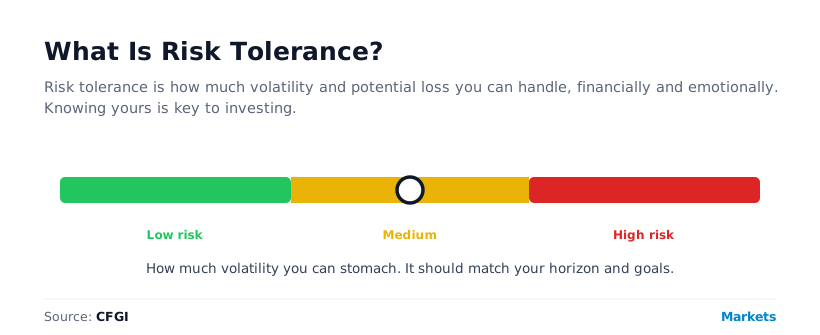
Risk tolerance is how much risk, in terms of volatility and potential loss, you are able and willing to take with your money. It has two sides: your financial capacity to absorb losses without derailing your goals, and your emotional ability to stay calm when investments fall. Knowing your true risk tolerance, before a downturn rather than during one, is what stops fear and greed from making your decisions for you and selling you out at the bottom.
CFGI data
Risk tolerance is tested at the extremes a Fear and Greed Index marks. Many people overestimate theirs in calm markets, then discover the truth when Extreme Fear, below 20 on CFGI’s 0 to 100 scale, finally arrives and they sell at the bottom. Knowing your real tolerance in advance is the single best defence against that mistake.
Source: CFGI dataset, behavioural-finance framing.
Key takeaways
- Risk tolerance is how much risk you are able and willing to take.
- It has a financial side (capacity) and an emotional side (willingness).
- A full risk profile also weighs how much risk your goals require.
- Time horizon is the biggest lever on how much risk you can take.
- People overestimate their tolerance in a bull market and panic-sell in a bear one.
Two Sides of Risk Tolerance
Risk tolerance combines two distinct things. Capacity is financial: how much loss your situation can absorb without derailing your goals. Willingness is emotional: how much volatility you can stomach without losing sleep or panic-selling. Both matter, and they can disagree. A portfolio your finances could survive but your nerves cannot is still the wrong portfolio for you, because the best investment plan in the world is useless if you abandon it at the worst possible moment.
The Three Questions of a Risk Profile
A complete risk profile actually asks three separate questions, and confusing them is a common mistake.
- Willingness. How much risk do you emotionally want to take? This is risk tolerance in the narrow sense.
- Capacity. How much risk can you financially afford to take, given your time horizon, income and obligations?
- Need. How much risk must you take to reach your goals at all?
These often pull in different directions. Someone may be willing to take big risks but unable to afford them, or need high returns yet be unable to stomach the swings required. A sound plan reconciles all three rather than fixating on any one.
Time Horizon: The Biggest Lever
Of all the factors, time horizon moves capacity the most. The longer you plan to stay invested, the more short-term risk you can take, because you have time to recover from declines before you need the money. Saving for retirement 30 years away, you can ride out crashes that would be disastrous for money you need in two years for a house deposit. This is why the same person can sensibly hold an aggressive, stock-heavy mix for a distant goal and a cautious, cash-heavy one for a near-term need at the same time. Risk tolerance is not a single setting; it is goal-specific.
Stated Versus Revealed: The Bull-Market Trap
Here is the most important and least comfortable truth. The risk tolerance you describe in a questionnaire is not the risk tolerance you reveal in a crash. Studies show that when people answer during a calm bull market, their scores are significantly inflated; when they answer after a crash, they are deflated. In other words, almost everyone overestimates how much risk they can handle until they have actually watched real money evaporate. This is why experienced advisers urge new investors to stay conservative until they have lived through their first bear market, because that is the only honest test of what they can truly bear.
The Honest Question
Do not ask "how do I feel about risk?" in a calm market. Ask "how would I feel, and act, if this fell 40% next month?" Your answer to that is your real risk tolerance.
Why Overestimating Costs You
Getting this wrong is expensive in a specific, avoidable way. An investor who overestimates their tolerance takes on too aggressive a portfolio, feels fine while markets rise, and then sells in a panic when the inevitable downturn arrives, locking in losses and missing the recovery that follows. That is the behaviour gap in action, and it usually does more damage to long-term returns than picking the "wrong" investments ever could. A slightly too cautious portfolio you can hold through a storm beats a perfectly optimised one you bail out of at the bottom.
From Tolerance to Allocation
Risk tolerance is not just a feeling; it is meant to drive a decision, your asset allocation, the split of your money between stocks, bonds and cash. A higher tolerance and a longer horizon point toward a larger share of stocks for their higher long-run returns and bigger swings; a lower tolerance or a nearer goal points toward more bonds and cash for stability. The point of measuring tolerance honestly is to land on a mix you can actually stick with. And because tolerance shifts with age, wealth and life events, it is worth revisiting every few years rather than setting once and forgetting.
Risk Tolerance and Sentiment
Your true risk tolerance is revealed precisely at the extremes a Fear and Greed Index is built to flag. When the gauge hits Extreme Fear and everyone around you is selling, that is the moment your real tolerance, not the one you wrote on a form, takes over. Knowing your honest limit in advance, and watching the gauge for when the test is coming, is what lets you hold steady while others capitulate. The index does not set your tolerance; it warns you when it is about to be measured for real.
Frequently asked questions
What is risk tolerance?
How much risk, in volatility and potential loss, you are able and willing to take with your money. It combines your financial capacity to absorb losses and your emotional ability to stay calm when investments fall.
What is the difference between risk tolerance and risk capacity?
Tolerance is your emotional comfort with risk; capacity is your financial ability to take it, driven by factors like time horizon, income and obligations. A good plan also weighs how much risk your goals actually require.
Why do people overestimate their risk tolerance?
Because it is usually measured in calm bull markets, which inflates the answer. The true test only comes in a crash, when real losses trigger an emotional response most people did not predict. Many then panic-sell at the bottom.
How do I find my risk tolerance?
Weigh your financial capacity for loss, your time horizon, and how you would honestly act if your portfolio fell 40%. Then translate that into an asset allocation you can hold through a downturn, and revisit it as life changes. This is education, not financial advice.
CFGI.io, Market sentiment research
The CFGI research team builds and maintains the CFGI Fear and Greed Index: a 0 to 100 sentiment score from 10 sub-indicators across hundreds of crypto assets and the equity market, refreshed every 15 minutes. We have tracked market emotion through multiple full crypto and equity cycles.
Think we missed something?
Spotted a gap, disagree with a take, or think we should cover a new topic? Message us and we'll act on your input.
Message us on TelegramKeep reading
This article is educational and is not financial advice. Crypto and equities are volatile and you can lose money. See our disclaimer.