Crypto
What Is Cryptocurrency?
Quick answer
Cryptocurrency is digital money secured by cryptography and recorded on a blockchain, a shared ledger that no single company or government controls. Bitcoin launched the idea in 2009, and thousands of coins and tokens now trade 24/7. Because crypto markets are young, liquid and retail-heavy, they swing hard on emotion, which is why a Fear and Greed reading is such useful context.
CFGI data
Crypto is the most sentiment-driven asset class there is, and CFGI scores hundreds of coins individually from 0 to 100. The synchronicity is the tell: on 5 February 2026 the major coins bottomed together within days of each other, the most unified fear reading on CFGI record since it began tracking in March 2022.
Source: CFGI dataset, March 2022 to June 2026.
Key takeaways
- Cryptocurrency is digital money recorded on a blockchain, traded 24/7 with no central gatekeeper.
- The market is young, liquid and retail-driven, so price moves hard on crowd emotion.
- A 0 to 100 Fear and Greed score turns that emotion into a signal you can actually read.
- CFGI scores Fear and Greed for hundreds of individual assets, not just the market as a whole.
What Is Cryptocurrency, In Plain Terms?
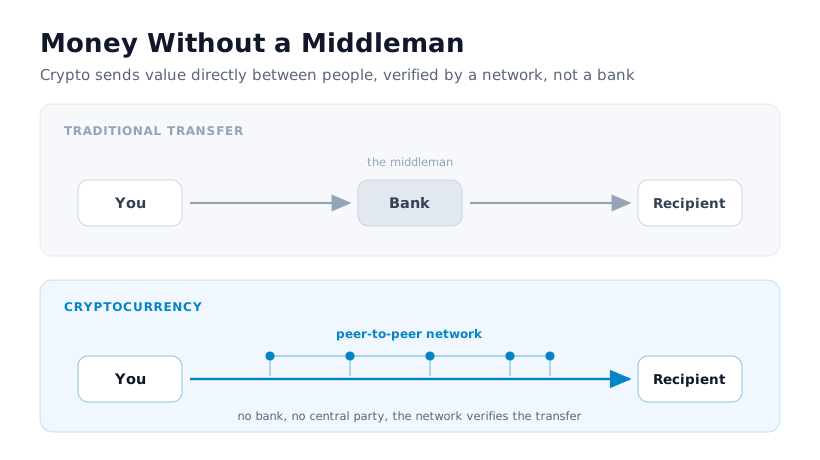
A cryptocurrency is a form of money that exists only as data. Instead of a bank keeping the record of who owns what, the record lives on a [blockchain](/learn/crypto/what-is-a-blockchain/): a shared database copied across thousands of computers, where every transaction is verified by the network rather than a single authority.
Bitcoin was the first, launched in 2009. It showed that two strangers could send value directly to each other online without a middleman. Since then the idea has expanded into thousands of assets, from Ethereum to stablecoins to meme tokens.
How Does Cryptocurrency Actually Work?
Three pieces make it work:
- Blockchain: an append-only ledger of every transaction, grouped into blocks and chained together so the history cannot be quietly rewritten.
- Consensus: the network agrees on the valid history through mining (proof of work, as in Bitcoin) or staking (proof of stake, as in modern Ethereum).
- Wallets and keys: you hold a private key that proves ownership and lets you spend. Lose the key and you lose access, because there is no support line that can reset it.
No Central Off Switch
Because the ledger is decentralised, there is no head office that can freeze the network or reverse a confirmed transaction. That openness is the point, and it is also why responsibility sits with the holder.
What Are the Main Types of Crypto?
- Store-of-value coins like Bitcoin, held mainly as a long-term asset.
- Smart-contract platforms like Ethereum and Solana, which run applications and other tokens on top.
- Stablecoins such as USDT and USDC, pegged to a currency like the US dollar to hold a steady price.
- Tokens and meme coins, which range from real utility to pure speculation and sentiment.
Why Is Crypto So Volatile?
Crypto is far more volatile than most traditional assets, and the reasons are structural. The market is young and relatively small, so large orders move price. It trades 24/7 with no closing bell to cool things off. Leverage is widely available, which amplifies both directions. And ownership skews retail, so narratives and emotion spread fast.
The result is a market that regularly overshoots in both directions: euphoria near the top, despair near the bottom. That is not a flaw to ignore, it is a signal to measure.
How Does Sentiment Move Crypto Prices?
Most short-term price action is a story about how the crowd feels. When prices rise, greed and fear of missing out pull more buyers in, often right as the move is getting tired. When prices fall, fear and capitulation push holders to sell, often right as the worst is already priced in.
This is why the investor Warren Buffett is so often quoted: be fearful when others are greedy, and greedy when others are fearful. The hard part is knowing where the crowd actually is. That is what a sentiment index is for.
How Do You Read the Mood of the Crypto Market?
The Crypto Fear and Greed Index compresses the market mood into a single number from 0 (extreme fear) to 100 (extreme greed). CFGI builds that score from 10 underlying signals, including volatility, momentum, volume, social activity and dominance, and refreshes it every 15 minutes.
Unlike a single market-wide gauge, CFGI also scores Fear and Greed for hundreds of individual assets, so you can see whether the fear in Bitcoin is shared by the rest of the market or not. To learn the wider context, read what financial markets are and how sentiment indicators fit alongside your other tools.
Frequently asked questions
Is cryptocurrency a good investment?
Crypto is high-risk and highly volatile: it can rise or fall sharply in a short time, and you can lose money. This guide is education, not financial advice. Sentiment tools like the Fear and Greed Index help you see when the crowd is euphoric or fearful, but they are context, not a recommendation to buy or sell.
What is the difference between a coin and a token?
A coin runs on its own blockchain (Bitcoin on Bitcoin, ETH on Ethereum). A token is built on top of an existing blockchain, often for a specific app or project. The distinction matters less for sentiment: both swing on crowd emotion.
How many cryptocurrencies are there?
There are thousands, though only a few hundred have meaningful liquidity. CFGI tracks Fear and Greed for the hundreds of assets where sentiment is liquid enough to measure reliably.
Why does crypto trade 24/7?
Crypto markets are global and run on open networks with no central exchange hours, so they never close. That removes the overnight pause that traditional markets use to reset, which is one reason sentiment can swing so quickly.
What is the Crypto Fear and Greed Index?
It is a 0 to 100 score of how fearful or greedy the crypto market is right now, built from multiple sentiment signals. See the live Crypto Fear and Greed Index and read how it is calculated.
CFGI.io, Market sentiment research
The CFGI research team builds and maintains the CFGI Fear and Greed Index: a 0 to 100 sentiment score from 10 sub-indicators across hundreds of crypto assets and the equity market, refreshed every 15 minutes. We have tracked market emotion through multiple full crypto and equity cycles.
Think we missed something?
Spotted a gap, disagree with a take, or think we should cover a new topic? Message us and we'll act on your input.
Message us on TelegramKeep reading
This article is educational and is not financial advice. Crypto and equities are volatile and you can lose money. See our disclaimer.