Markets
What Is the Fear and Greed Index?
Quick answer
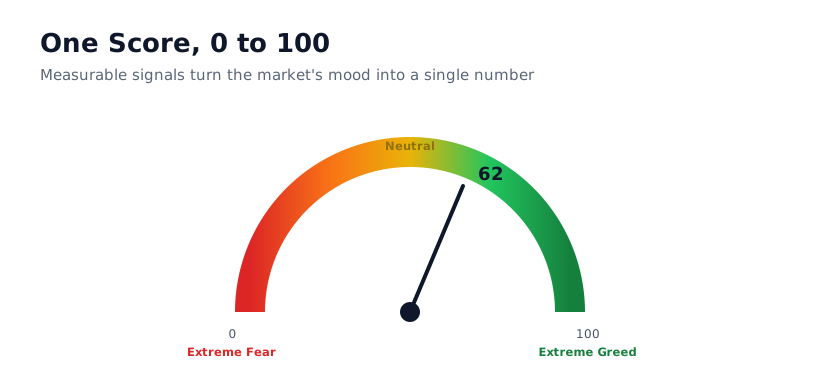
The Fear and Greed Index is a single score from 0 to 100 that measures how fearful or greedy a market is right now. 0 is extreme fear, 100 is extreme greed. It reads measurable signals such as volatility, momentum and volume rather than opinion, so you can track the mood of the crowd over time instead of guessing it. It reads the present well but barely forecasts the next day, so it is best used as context at the extremes. This is education, not financial advice.
CFGI data
CFGI scores Fear and Greed from 0 to 100 for hundreds of assets individually, not one blended market number, across 4 timeframes and refreshed every 15 minutes since March 2022. Scoring each asset on its own is what lets the index show one coin in fear while another runs greedy, the real picture behind a single headline.
Source: CFGI dataset, March 2022 to June 2026.
Key takeaways
- A 0 to 100 score: 0 is extreme fear, 100 is extreme greed.
- It reads measurable signals, not opinion, and updates continuously.
- CFGI scores hundreds of assets individually, so it can show one market splitting in two.
- It mirrors the present well but barely forecasts the next day.
- The signal lives at the extremes; the middle is noise.
What Is the Fear and Greed Index?
The Fear and Greed Index compresses the mood of a market into one number. Instead of reading dozens of charts, you get a single reading from 0 to 100 that says, in plain terms, whether the crowd is fearful, greedy or somewhere in between. The idea rests on a timeless truth of markets: prices are driven not only by fundamentals but by the two great emotions of the crowd, fear and greed, and at the extremes, those emotions tend to push prices too far in both directions. A Fear and Greed Index exists to measure that emotion objectively, turning a vague feeling into a number you can actually track.
CNN made the format familiar for stocks. CFGI runs the same idea across crypto and equities, scoring crypto and stocks separately and updating crypto every 15 minutes.
How Does the 0 to 100 Scale Work?
The score maps to five zones. The bands are asymmetric at the edges: a reading under 20 is Extreme Fear, and 80 or above is Extreme Greed.
| Score | Zone | What it means |
|---|---|---|
| 0 to 19 | Extreme Fear | The crowd is fearful and risk-off |
| 20 to 39 | Fear | Caution dominates |
| 40 to 59 | Neutral | No strong emotion either way |
| 60 to 79 | Greed | Optimism and risk appetite build |
| 80 to 100 | Extreme Greed | The crowd is euphoric and stretched |
The five Fear and Greed zones.
The single most important habit in reading the index is to weight the extremes and largely ignore the middle. A reading near 50 is mostly noise, the market is simply going about its business, but a reading deep in Extreme Fear or Extreme Greed is genuine signal, because it means the crowd has become dangerously one-sided. The index is at its most informative precisely when it is at its most extreme.
What Does It Actually Measure?
CFGI builds each score from 10 underlying indicators, so no single signal dominates. They include price momentum, volatility, trading volume, social activity, market dominance, search interest and on-chain signals like whale movements and order-book pressure. The crucial design choice is that all of these read behaviour rather than opinion, what the crowd is actually doing with its money, not what it says in a survey, which is a far more honest and reliable signal. Because the inputs are measurable, the score is repeatable: the same market conditions produce the same reading, which is what makes it useful to track over time rather than to argue about. Blending many inputs also makes the score robust, since a misleading reading in any one signal is diluted by the other nine.
Why Does Scoring Each Asset Separately Matter?
A single market-wide number hides a lot. CFGI scores hundreds of assets individually, so it can show the market splitting: on 23 May 2024 the gap between the most fearful and most greedy major coins reached 61 points. One asset can sit in Extreme Fear while another runs hot, and only per-asset scoring reveals it. A market average, by its nature, blends those divergences away, telling you the "average" mood while hiding the rotations and outliers that are often the real story. This is the difference between a single thermometer for the whole sky and a detailed weather map, the map shows you where the storms actually are. See it live across the market in the by-coin directory.
Can the Fear and Greed Index Predict the Market?
No indicator predicts the market reliably, and the Fear and Greed Index is no exception. CFGI data mirrors same-day market direction 79% of the time, but its agreement with the next day falls to 49%, close to a coin flip. This is the honest, essential truth about the tool: it is a thermometer, not a crystal ball. It tells you the temperature of the crowd’s emotion right now, accurately, but it cannot tell you what tomorrow holds.
The Honest Read
Sentiment tells you where the crowd is standing now, not where price goes tomorrow. That is still valuable: extremes of fear and greed cluster near turning points, because the crowd is most one-sided exactly when it is most stretched.
How to Use It
Given all that, the right way to use a Fear and Greed Index is as a contrarian context tool, not a signal generator. The guiding philosophy is Warren Buffett’s famous advice to "be fearful when others are greedy, and greedy when others are fearful": Extreme Greed is a reason for caution and risk management, while Extreme Fear is a reason to look for opportunity rather than to join the panic. In practice, that means weighting the extremes and ignoring the noisy middle, reading the direction the score is travelling as well as its level, confirming any action with the price trend and your own plan, and treating the index as a check on your own emotions, since you are part of the very crowd it measures. Used this way, as one input that frames the crowd’s mood, rather than a button that tells you when to buy or sell, the Fear and Greed Index is one of the more useful tools an investor can keep an eye on.
Frequently asked questions
What is the Fear and Greed Index?
A single score from 0 to 100 that measures how fearful or greedy a market is right now, where 0 is extreme fear and 100 is extreme greed. It reads measurable signals like volatility, momentum and volume rather than opinion, so you can track the crowd’s mood over time.
What is a good Fear and Greed Index score?
There is no good or bad score, only context. Extreme Fear (under 20) means the crowd is very risk-off; Extreme Greed (80 or above) means it is euphoric. Both extremes signal that sentiment is one-sided, which is the information the index exists to give you. The middle is mostly noise.
How is the Fear and Greed Index calculated?
CFGI builds each score from 10 measurable indicators, including price momentum, volatility, volume, social activity, market dominance, search interest and on-chain signals, so no single signal dominates and the score is repeatable.
Is the Fear and Greed Index accurate?
It accurately reads current sentiment from measurable signals. As a forecast it is weak: CFGI data matches same-day direction 79% of the time and the next day only 49%. Treat it as context at the extremes, not a prediction. This is education, not financial advice.
CFGI.io, Market sentiment research
The CFGI research team builds and maintains the CFGI Fear and Greed Index: a 0 to 100 sentiment score from 10 sub-indicators across hundreds of crypto assets and the equity market, refreshed every 15 minutes. We have tracked market emotion through multiple full crypto and equity cycles.
Think we missed something?
Spotted a gap, disagree with a take, or think we should cover a new topic? Message us and we'll act on your input.
Message us on TelegramKeep reading
This article is educational and is not financial advice. Crypto and equities are volatile and you can lose money. See our disclaimer.