Markets
What Is a Bond?
Quick answer
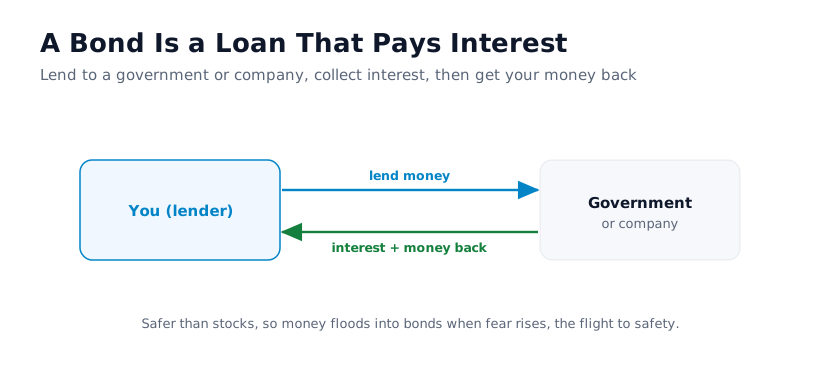
A bond is a loan you make to a government or company in return for regular interest and your money back at the end. It is generally safer and steadier than stocks because the income and repayment are contractual. That safety is why bonds matter for sentiment: when fear rises, money rushes out of risky assets and into bonds, a move known as the flight to safety. Bonds are not risk-free, though, and their prices fall when interest rates rise. This is education, not financial advice.
CFGI data
Money rushing into bonds is one of the clearest fear signals in markets, and CFGI reads it. Safe-haven demand is one of the signals behind its 0 to 100 Fear and Greed score, tracked across crypto and equities since March 2022, so the flight to safety shows up in the reading rather than passing unnoticed.
Source: CFGI methodology and dataset, March 2022 to June 2026.
Key takeaways
- A bond is a loan to a government or company that pays interest.
- Key terms: principal, coupon, maturity and yield.
- It is generally safer and steadier than stocks.
- Bond prices fall when interest rates rise.
- Money flooding into bonds is a flight-to-safety signal.
What Is a Bond?
When you buy a bond, you are lending money. A government or company borrows from you, promises to pay regular interest (the coupon), and returns the original amount at a set date. In exchange for that predictability, bonds usually offer lower returns than stocks. Government bonds from stable countries are among the safest assets there are. If a stock makes you a part-owner of a business, a bond makes you a lender to it, a fundamentally different and more conservative relationship.
How a Bond Works
A few key terms describe every bond. The "principal" (or face value) is the amount you lend and get back at the end. The "coupon" is the interest rate the borrower pays you, usually periodically, for the life of the loan. The "maturity" is the date the principal is repaid, which can range from months to decades. And the "yield" is the bond’s effective return given its current price, which matters because bonds can be bought and sold before maturity. Bonds come in two broad families: government bonds (like US Treasuries), seen as the safest, and corporate bonds issued by companies, which pay more interest to compensate for higher risk. You can simply hold a bond to maturity and collect the income, or trade it in the meantime as its price moves.
Why Are Bonds Considered Safe?
Because the income and the repayment are contractual, not dependent on a company’s growth or a coin’s hype. As long as the borrower does not default, you know exactly what you will get and when, a level of certainty stocks simply cannot offer. That predictability makes bonds the place money hides when the crowd turns fearful, alongside other safe-haven assets. There is a spectrum of safety, though: government bonds from stable countries sit at the safe end, investment-grade corporate bonds a step out, and high-yield "junk" bonds, issued by riskier borrowers, further still. The general rule holds across the ladder: the safer the bond, the lower the interest it pays, because investors accept less return in exchange for more certainty.
Bonds, Interest Rates and Risk
Bonds are safer than stocks, but they are not risk-free, and the most important risk is one many people find counterintuitive: interest-rate risk. Bond prices move opposite to interest rates. When prevailing rates rise, existing bonds, locked into their older, lower coupons, become less attractive, so their market price falls; when rates fall, existing bonds become more valuable and their prices rise. This inverse relationship means even a "safe" government bond can lose value if you need to sell it after rates have climbed. On top of that sits default risk, the chance the borrower fails to pay, which is tiny for stable governments but real for shakier companies. Understanding that bond prices are largely a story about interest rates is the key to understanding how the bond market really behaves.
Prices Move Opposite to Rates
When interest rates rise, existing bond prices fall, and vice versa. This inverse relationship is the single most important thing to grasp about how bonds behave, and why even "safe" bonds carry risk.
Why Are Bonds a Sentiment Signal?
Watch the flow. When the crowd is greedy, money leaves bonds for higher-returning risk like stocks and crypto. When fear rises, money floods back into bonds, the flight to safety. So a surge of bond buying, which pushes bond prices up and their yields down, is one of the clearest signs that fear is taking over the market. This rotation between risky assets and safe bonds is, in effect, the risk-on/risk-off swing seen from the safe-haven side. CFGI treats safe-haven demand as one of the signals behind the Fear and Greed Index, so the rotation between risk and safety feeds the score, and a rush into bonds shows up as a lean toward fear rather than passing unnoticed.
Frequently asked questions
What is a bond?
A loan you make to a government or company in return for regular interest (the coupon) and your money back (the principal) at a set date (maturity). It is generally safer and steadier than stocks because the income and repayment are contractual.
How does a bond make money?
Through interest payments (the coupon) over its life, plus the return of the principal at maturity. Bond prices can also rise or fall if you sell before maturity, so you can earn or lose from price moves too.
Why do bond prices fall when interest rates rise?
Because existing bonds are locked into their older, lower coupons, so when new bonds pay more, the old ones become less attractive and their market price falls. This inverse relationship between prices and rates is the key risk in bonds.
Why do bonds signal fear?
Because money rotates into them when the crowd turns cautious. A surge of bond buying, the flight to safety, pushes prices up and yields down, and is one of the clearest fear signals, which CFGI reads as safe-haven demand. This is education, not financial advice.
CFGI.io, Market sentiment research
The CFGI research team builds and maintains the CFGI Fear and Greed Index: a 0 to 100 sentiment score from 10 sub-indicators across hundreds of crypto assets and the equity market, refreshed every 15 minutes. We have tracked market emotion through multiple full crypto and equity cycles.
Think we missed something?
Spotted a gap, disagree with a take, or think we should cover a new topic? Message us and we'll act on your input.
Message us on TelegramKeep reading
This article is educational and is not financial advice. Crypto and equities are volatile and you can lose money. See our disclaimer.