Stocks
What Is Diversification?
Quick answer
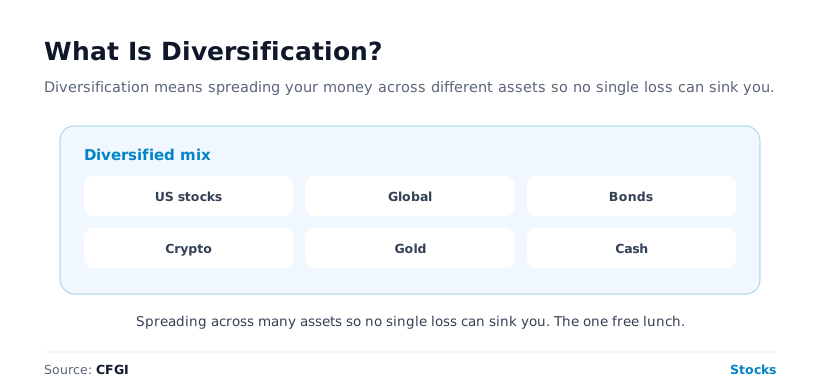
Diversification means spreading your money across different assets, sectors and regions so that no single holding can do too much damage. The idea is that different things rarely all fall at once, so a loss in one can be offset by others. It removes the risk specific to any one asset, often called the "only free lunch" in finance because it lowers risk without lowering expected return, though it cannot remove the risk of the whole market falling together. This is education, not financial advice.
CFGI data
Diversification softens single-asset risk but not a market-wide panic, and CFGI shows when that matters. In the broad sell-offs that drive the score to Extreme Fear, under 20 on its 0 to 100 scale, most assets fall together and diversification gives least cover.
Source: CFGI methodology, 10-indicator 0 to 100 model.
Key takeaways
- Diversification spreads money across many assets, not one.
- It removes "unsystematic" risk, the risk specific to one holding.
- It is called the "only free lunch" in finance.
- Too much of it becomes "diworsification".
- It cannot remove market-wide risk, when everything falls at once.
Why Spreading Out Reduces Risk
If all your money is in one stock and that company stumbles, you feel the full loss. Spread the same money across many companies, sectors and regions, and a problem at one is cushioned by the others. That is diversification: not putting all your eggs in one basket, so a single crack does not break everything. The deeper reason it works is that different assets do not move in lockstep. When one zigs, another may zag, so the ups and downs partly cancel out and the overall ride is smoother. An ETF is a common way to get diversification in a single holding.
Two Kinds of Risk
To understand what diversification does, you have to split risk in two. "Unsystematic" or specific risk is the danger attached to a single company or asset, a fraud, a failed product, a bad quarter, and it is precisely what diversification eliminates: spread across hundreds of holdings, one company’s disaster barely dents the whole. "Systematic" or market risk is the danger that affects everything at once, a recession, a rate shock, a crisis, and this kind cannot be diversified away, because it hits the whole market together. Diversification is therefore a tool for one specific job: removing the risk of any single bet going wrong, while leaving the risk of the market itself untouched.
What It Removes, and What It Does Not
Diversification erases the risk of one holding sinking you. It cannot erase the risk of the entire market falling at once. Know which risk you are actually protected against.
The "Only Free Lunch"
Diversification is often called "the only free lunch in finance", a phrase tied to the Nobel-winning work of economist Harry Markowitz. The insight is genuinely remarkable: because assets are not perfectly correlated, combining them can reduce a portfolio’s overall risk without reducing its expected return. Almost everywhere else in investing, lower risk means lower expected reward, you pay for safety in giving up upside. Diversification is the rare exception, an improvement you get essentially for free, just by spreading out. That is why it sits at the heart of modern portfolio theory and is the one piece of advice nearly every investing expert agrees on, from beginners to professionals.
How to Diversify Well
Good diversification is about combining things that do not move together, not just owning a lot of things. That means spreading across asset classes (stocks, bonds, cash, perhaps property or commodities), across sectors (so a slump in tech is offset by, say, healthcare), across geographies (so one country’s troubles are cushioned by others), and even across time, by investing steadily rather than all at once. The simplest route for most people is a broad index fund or ETF, which packages hundreds or thousands of holdings into a single, automatically diversified share. The goal throughout is low correlation: ten tech stocks are far less diversified than they look, because they tend to rise and fall together.
Over-Diversification: "Diworsification"
You can have too much of a good thing. The legendary investor Peter Lynch coined "diworsification" for the point at which adding more holdings stops reducing risk and starts diluting results. Beyond roughly 20 to 30 well-chosen, uncorrelated stocks, the risk-reduction benefit of adding another is tiny, and a portfolio so spread out that it owns a little of everything simply becomes the market, with no chance of beating it and plenty of mediocre positions watering down your best ideas. So diversification has a sweet spot: enough to protect you from any single failure, but not so much that you own hundreds of names you barely understand. Quality and genuine low correlation matter more than sheer quantity.
What Diversification Cannot Do
Diversification reduces the risk specific to one asset, but it cannot remove the risk of the whole market falling at once. In a broad sell-off, a market crash or a contagion, most things drop together, "all correlations go to one", and that is exactly when a Fear and Greed Index tends to read Extreme Fear. So diversification softens the everyday bumps but offers least cover on the rare days when everything moves as one. That is why truly defensive investors also hold genuine safe havens like cash and high-quality bonds, the few things that can hold up when diversification alone is not enough.
Frequently asked questions
What is diversification?
Spreading your money across different assets, sectors and regions so no single loss can sink you. Because different assets rarely all fall at once, a loss in one can be offset by others.
Why is diversification called a "free lunch"?
Because, thanks to Harry Markowitz’s Nobel-winning work, combining imperfectly correlated assets can lower a portfolio’s overall risk without lowering its expected return, a rare improvement you get essentially for free, unlike most safety which costs upside.
Can you over-diversify?
Yes. Peter Lynch called it "diworsification": beyond roughly 20 to 30 uncorrelated holdings, adding more barely reduces risk and just dilutes your best ideas until the portfolio simply becomes the market. Quality and low correlation beat sheer quantity.
Does diversification remove all risk?
No. It removes the risk tied to any single holding, but not market-wide systematic risk: in a crash or contagion, most assets fall together, which is when a Fear and Greed Index reads Extreme Fear. This is education, not financial advice.
CFGI.io, Market sentiment research
The CFGI research team builds and maintains the CFGI Fear and Greed Index: a 0 to 100 sentiment score from 10 sub-indicators across hundreds of crypto assets and the equity market, refreshed every 15 minutes. We have tracked market emotion through multiple full crypto and equity cycles.
Think we missed something?
Spotted a gap, disagree with a take, or think we should cover a new topic? Message us and we'll act on your input.
Message us on TelegramKeep reading
This article is educational and is not financial advice. Crypto and equities are volatile and you can lose money. See our disclaimer.