Markets
What Is a Risk-On Or Risk-Off Market?
Quick answer
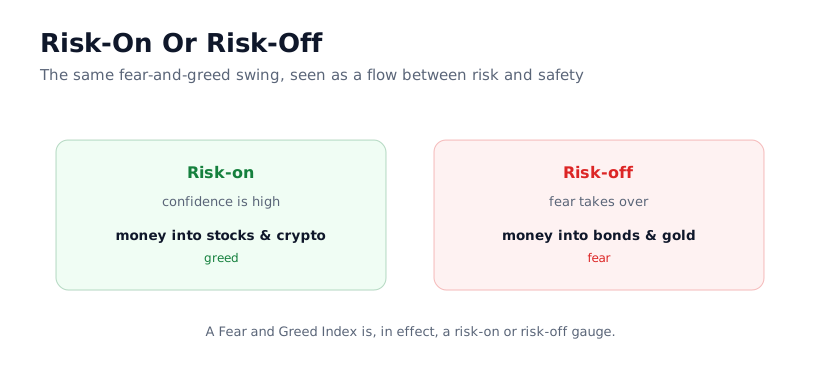
Risk-on and risk-off describe the market’s mood toward risk. In a risk-on market, confidence is high and money flows into riskier assets like stocks and crypto. In a risk-off market, fear takes over and money rotates into safe havens like bonds, gold and the US dollar. It is a cross-market mood that moves stocks, crypto and currencies together, and it is the same fear-and-greed swing, seen as the flow between risk and safety. This is education, not financial advice.
CFGI data
Risk-on and risk-off is fear and greed by another name, and it is exactly what CFGI scores. Its 0 to 100 Fear and Greed reading, from 10 indicators across crypto and equities since March 2022, is in effect a risk-on or risk-off gauge: high is risk-on greed, low is risk-off fear.
Source: CFGI dataset, March 2022 to June 2026.
Key takeaways
- Risk-on means confidence is high and money chases risk.
- Risk-off means fear rules and money flees to safety.
- It is driven by shocks, central banks, data and valuations.
- It is a cross-market mood spanning stocks, crypto and currencies.
- A Fear and Greed Index is, in effect, a risk-on or risk-off gauge.
What Do Risk-On and Risk-Off Mean?
They are shorthand for the crowd’s appetite for risk at a given moment. "Risk-on" is the confident mood: investors reach for higher returns, so money flows into stocks, crypto and other risky assets. "Risk-off" is the fearful mood: investors prioritise safety, so money rotates into safe havens like bonds, gold and the US dollar. It is one of the most useful lenses in markets, because it cuts through the detail to a single question: is the crowd reaching for reward, or reaching for safety?
How the Rotation Works
The two moods show up as a rotation between asset classes. On a risk-on day, risky assets rise together while safe havens drift or fall; on a risk-off day, risky assets fall together while bonds, gold and the dollar climb. Watching what rises and what falls in tandem tells you which mood is in charge, often across crypto, stocks and currencies at once. This is why traders talk about "the risk-on trade" or "the risk-off trade" as if it were a single position, because in a strongly risk-driven market, dozens of seemingly unrelated assets effectively become one bet on the crowd’s appetite for risk, rising and falling together as the mood swings. The clearest tell is when good news for one asset coincides with gains across completely unrelated risky assets at once: that synchronised move is the signature of a market trading on risk appetite rather than on the specifics of each individual asset.
What Drives the Switch
The mood flips on anything that changes the crowd’s sense of safety. Risk-off is triggered by fear-inducing events: a financial shock or crisis, a hawkish central bank signalling higher rates, weak economic data, geopolitical tension, or simply stretched valuations that leave the market nervous. Risk-on returns when those fears ease: dovish central banks, strong data, falling inflation, or a sense that the danger has passed. Often a single event, a Federal Reserve decision, a surprise inflation report, can flip the whole market from one mode to the other in an afternoon, which is why scheduled macro events are watched so closely: they are the switches that toggle the risk-on or risk-off setting for everything at once.
One Switch, Every Market
A single macro event can flip the whole market from risk-on to risk-off in hours, because it changes the crowd’s appetite for risk across stocks, crypto, bonds and currencies simultaneously.
A Mood Across Every Market
What makes risk-on/risk-off so powerful is that it is not confined to one market, it is a global mood that ripples through all of them at once. In a risk-off wave, stocks fall, crypto sells off, high-yielding and emerging-market currencies weaken while the dollar, yen and Swiss franc strengthen, and money pours into government bonds and gold. In risk-on, the flows reverse. This is why, in a strong risk-off move, the famous "diversification breaks down" effect appears: assets that normally seem unrelated all fall together, because they are all, at that moment, simply "risk". Recognising a market that is trading purely on risk appetite, rather than on the merits of individual assets, is one of the more valuable skills an investor can develop.
Why It Is the Same As Fear and Greed
Because risk appetite and emotion are the same thing. Risk-on is greed expressed as a flow into risk; risk-off is fear expressed as a flight to safety. So a Fear and Greed Index reading is, in effect, a risk-on or risk-off score: a high number means the crowd is risk-on and greedy, a low one means it is risk-off and fearful. CFGI reads that swing directly, and because it scores both crypto and equities on the same scale, it can show you whether a risk-off move is confined to one market or sweeping across all of them, the cross-asset breadth that tells you whether you are seeing an isolated wobble or a genuine, market-wide flight from risk.
Frequently asked questions
What does risk-on and risk-off mean?
They describe the crowd’s appetite for risk. Risk-on is a confident mood where money flows into risky assets like stocks and crypto; risk-off is a fearful mood where money rotates into safe havens like bonds, gold and the dollar.
What triggers a risk-off move?
Anything that raises fear: a shock or crisis, a hawkish central bank, weak economic data, geopolitical tension, or simply stretched valuations. A single macro event can flip the whole market from risk-on to risk-off in hours.
Why does it span every market?
Because it is a global mood toward risk, not a single-market move. In risk-off, stocks, crypto and risky currencies fall together while bonds, gold and the dollar rise, which is why diversification can break down in a strong risk-off wave.
Is risk-on or risk-off the same as the Fear and Greed Index?
Effectively yes. Risk-on is greed (a flow into risk), risk-off is fear (a flight to safety). CFGI’s 0 to 100 score reads that swing directly, across both crypto and equities. This is education, not financial advice.
CFGI.io, Market sentiment research
The CFGI research team builds and maintains the CFGI Fear and Greed Index: a 0 to 100 sentiment score from 10 sub-indicators across hundreds of crypto assets and the equity market, refreshed every 15 minutes. We have tracked market emotion through multiple full crypto and equity cycles.
Think we missed something?
Spotted a gap, disagree with a take, or think we should cover a new topic? Message us and we'll act on your input.
Message us on TelegramKeep reading
This article is educational and is not financial advice. Crypto and equities are volatile and you can lose money. See our disclaimer.