Markets
What Is a Central Bank?
Quick answer
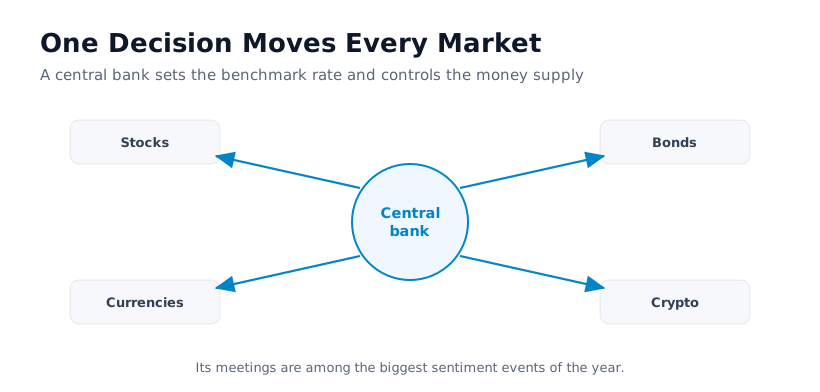
A central bank manages a country’s money and monetary policy. Bodies like the US Federal Reserve set the benchmark interest rate, control the money supply and aim to keep inflation steady and the financial system stable. They are usually independent of politicians so they can make unpopular decisions, and because their choices move every market at once, central-bank meetings are among the largest sentiment events of the year. This is education, not financial advice.
CFGI data
Central-bank decisions move every market at once, and CFGI scores the mood swing they cause. Its 0 to 100 Fear and Greed reading, from 10 indicators across crypto and equities since March 2022, captures the shift toward greed or fear that follows a rate decision or a change in tone.
Source: CFGI dataset, March 2022 to June 2026.
Key takeaways
- A central bank manages a country’s money and monetary policy.
- It sets the benchmark interest rate and controls the money supply.
- Its goals are steady inflation and a stable financial system.
- It is usually independent, so it can make unpopular choices.
- Its decisions are among the biggest sentiment events in markets.
What Is a Central Bank?
A central bank is the institution that oversees a nation’s money. The US Federal Reserve, the European Central Bank and the Bank of England are examples. Unlike a high-street bank, it does not serve the public; it serves the economy, by managing the money supply and setting interest rates. It is best thought of as the economy’s thermostat and its emergency room, the body charged with keeping money stable in normal times and the system from collapsing in a crisis.
What Does a Central Bank Do?
- Sets the benchmark interest rate that ripples through every loan and market.
- Manages the money supply, loosening or tightening how much money flows, including through quantitative easing.
- Targets inflation, usually aiming for a low, steady rate, often around 2%.
- Backstops the system in a crisis, acting as the "lender of last resort".
- Regulates banks and oversees the plumbing of the payment system.
Together these tools let a central bank influence how much it costs to borrow, how much money circulates, and how confident people are that the financial system will hold together.
How It Steers the Economy
A central bank’s core job is balancing two goals: keeping inflation low and steady, and supporting a healthy economy. Its main lever is the interest rate. When the economy overheats and inflation rises, it raises rates to make borrowing dearer, cooling spending and investment. When the economy weakens, it cuts rates to make money cheaper and encourage activity. The catch is timing: rate changes act with long and variable lags, taking many months to fully bite, so a central bank is always steering by looking at where the economy was rather than where it is. That delay is why getting the balance exactly right, the elusive soft landing, is so difficult.
Independence and Credibility
A crucial feature of most modern central banks is independence from day-to-day politics. The logic is that politicians, facing elections, would always be tempted to keep money cheap and rates low for short-term popularity, even when the economy needs the painful medicine of higher rates to curb inflation. By insulating the central bank from that pressure, a country gains an institution that can make unpopular but necessary decisions. Its most precious asset is credibility: when people trust a central bank to control inflation, their expectations stay "anchored", which itself helps keep prices stable. Lose that trust, and inflation can spiral as people stop believing it will be contained. Credibility, in central banking, is half the battle.
Why Independence Matters
Politicians love cheap money; sound policy sometimes needs expensive money. Central-bank independence exists so someone can raise rates when it is necessary but unpopular.
The World’s Central Banks
Every major economy has one. The US Federal Reserve is the most influential by far, because the US dollar is the world’s reserve currency, so the Fed’s decisions ripple through markets everywhere, including crypto. The European Central Bank manages the euro for the eurozone, the Bank of England the pound, the Bank of Japan the yen, and the People’s Bank of China the renminbi. When the Fed moves, the rest of the world feels it: capital flows toward higher US rates, the dollar strengthens, and other central banks often have to respond. This is why investors worldwide, whatever they trade, watch the Fed more closely than almost any other institution on earth.
Why Are Central Banks the Biggest Sentiment Events?
Because one decision reprices everything. A rate change, or even a shift in tone at a press conference, moves stocks, bonds, currencies and crypto together. Traders hang on every word, so the mood can swing hard in minutes from a single sentence, which is why "don’t fight the Fed" is a defining market maxim. Few scheduled events move the crowd as much. CFGI does not predict the decision, but it reads the wave of fear or greed that follows it on the Fear and Greed Index, and its 15-minute refresh is built to capture exactly these rapid, central-bank-driven swings as they unfold.
Frequently asked questions
What is a central bank?
The institution that manages a country’s money and monetary policy, like the US Federal Reserve. It sets the benchmark interest rate, controls the money supply, targets steady inflation and backstops the financial system in a crisis.
How does a central bank control inflation?
Mainly by raising interest rates to cool a hot economy, or cutting them to support a weak one. Higher rates slow borrowing and spending, easing price rises, though the effect works with a long lag.
Why are central banks independent?
So they can make unpopular but necessary decisions, like raising rates to curb inflation, free from the short-term pressures of politics. Their credibility keeps inflation expectations anchored, which itself helps keep prices stable.
Why do markets move so much on central-bank days?
Because one decision reprices every asset at once, and the tone of the message changes expectations for future rates. The mood can swing in minutes, which a Fear and Greed Index captures in real time. This is education, not financial advice.
CFGI.io, Market sentiment research
The CFGI research team builds and maintains the CFGI Fear and Greed Index: a 0 to 100 sentiment score from 10 sub-indicators across hundreds of crypto assets and the equity market, refreshed every 15 minutes. We have tracked market emotion through multiple full crypto and equity cycles.
Think we missed something?
Spotted a gap, disagree with a take, or think we should cover a new topic? Message us and we'll act on your input.
Message us on TelegramKeep reading
This article is educational and is not financial advice. Crypto and equities are volatile and you can lose money. See our disclaimer.