Markets
What Is the Federal Reserve?
Quick answer
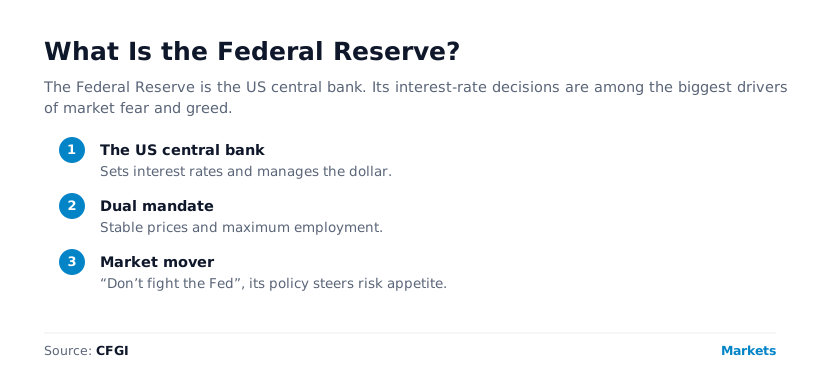
The Federal Reserve is the central bank of the United States. It sets short-term interest rates and manages the money supply to pursue its dual mandate: stable prices and maximum employment. Because its rate decisions ripple through every market, the Fed is one of the most powerful drivers of fear and greed: hints of cheaper money can spark greed, while rate hikes or hawkish surprises can trigger fear. Markets react to what it signals as much as what it does. This is education, not financial advice.
CFGI data
Few events move sentiment like a Fed decision. Rate announcements and the language around them routinely swing CFGI between fear and greed within hours on its 0 to 100 scale, which the 15-minute refresh across four timeframes is built to capture as it happens.
Source: CFGI dataset, 2021 to June 2026.
Key takeaways
- The Federal Reserve is the US central bank.
- Its dual mandate is stable prices and maximum employment.
- It sets short-term interest rates and manages the money supply.
- Markets react to what it signals as much as what it does.
- Its decisions are a master switch for fear and greed.
The Hand On the Rate Lever
The Fed’s most watched tool is the interest rate it sets for banks, which influences the cost of borrowing across the economy. Lower rates make money cheaper and tend to lift asset prices; higher rates make money dearer and tend to weigh on them. The Fed also expands or shrinks the money supply through policies like quantitative easing. Markets hang on not just what the Fed does but what it signals: a single word change in its statement can move trillions of dollars in assets.
What the Fed Actually Does
Congress gives the Fed a "dual mandate": keep prices stable, in practice aiming for inflation around 2%, and foster maximum sustainable employment. These two goals can pull in opposite directions, which is the central tension of its job. Its rate-setting body, the Federal Open Market Committee, meets roughly eight times a year to decide the target for the federal funds rate. Beyond rates, the Fed regulates and supervises banks, runs the plumbing of the payment system, and acts as the "lender of last resort", stepping in to provide emergency liquidity when the financial system seizes up. It is, in short, both the economy’s thermostat and its emergency room.
How a Rate Decision Ripples Out
The federal funds rate is just the rate banks charge each other overnight, but it sets the baseline for nearly all other borrowing. When the Fed raises it, mortgages, credit cards, car loans and business loans all get more expensive, cooling spending and investment, and bond yields rise. There is a second, subtler effect that matters enormously to markets: higher rates raise the "discount rate" used to value future cash flows, which lowers what investors will pay for stocks today, hitting high-growth, long-duration companies hardest. So a Fed decision flows outward in widening circles, from overnight bank lending to the price of nearly every asset on earth.
Words Move Markets Too
One of the most important things to grasp is that the Fed moves markets with words, not just actions. Because investors price in the future, what the Fed signals about coming decisions, its "forward guidance", can matter as much as the decision itself. Traders pore over the wording of its statement, the "dot plot" of officials’ rate projections, and every sentence of the chair’s press conference, hunting for hints of the path ahead. A rate cut that was fully expected may barely move prices, while a surprise shift in tone can trigger a violent reaction. This is why "don’t fight the Fed" is a market maxim, and why Fed-watching is practically its own industry.
Expectations, Not Just Actions
Markets price the future, so a Fed move that was already expected can pass quietly while a single surprising word reprices everything. The signal often matters more than the decision.
Dovish Versus Hawkish
Fed-watchers describe its stance on a spectrum from "dovish" to "hawkish", and the labels are a quick guide to the likely market mood.
| Stance | Means | Tends to fuel |
|---|---|---|
| Dovish | Favours low rates and stimulus | Cheaper money, greed |
| Hawkish | Favours high rates to fight inflation | Dearer money, fear |
The two stances and their market effect.
A dovish Fed prioritises growth and employment with easy money, which tends to lift risk appetite; a hawkish Fed prioritises crushing inflation with tight money, which tends to dampen it. Most decisions sit somewhere between the two poles.
The Fed and Sentiment
Because the Fed sets the price of money, its decisions are a master switch for risk appetite. Dovish signals, hints of cheaper money, tend to feed greed; hawkish surprises tend to spark fear. Watching a Fear and Greed Index around Fed days shows how fast the mood can flip, often within minutes of the statement’s release and again during the press conference. CFGI’s 15-minute refresh is built precisely to capture these rapid swings, turning the market’s real-time reaction to Fed policy into a number you can read as the drama unfolds.
Frequently asked questions
What is the Federal Reserve?
The central bank of the United States. It sets short-term interest rates and manages the money supply to pursue its dual mandate of stable prices and maximum employment, and acts as lender of last resort in a crisis.
Why does the Fed move markets?
Because it sets the price of money. Lower rates lift asset prices and feed greed; higher rates weigh on them and can spark fear. Markets also react to its signals about future policy as much as to its actual decisions.
What do dovish and hawkish mean?
Dovish describes a Fed that favours low rates and stimulus, which tends to fuel greed; hawkish describes one that favours high rates to fight inflation, which tends to fuel fear. Most decisions land between the two.
How does the Fed affect fear and greed?
Dovish signals tend to feed greed, hawkish surprises tend to spark fear, and rate decisions routinely swing sentiment within hours. A Fear and Greed Index captures the reaction in real time. This is education, not financial advice.
CFGI.io, Market sentiment research
The CFGI research team builds and maintains the CFGI Fear and Greed Index: a 0 to 100 sentiment score from 10 sub-indicators across hundreds of crypto assets and the equity market, refreshed every 15 minutes. We have tracked market emotion through multiple full crypto and equity cycles.
Think we missed something?
Spotted a gap, disagree with a take, or think we should cover a new topic? Message us and we'll act on your input.
Message us on TelegramKeep reading
This article is educational and is not financial advice. Crypto and equities are volatile and you can lose money. See our disclaimer.