Markets
What Is an Interest Rate?
Quick answer
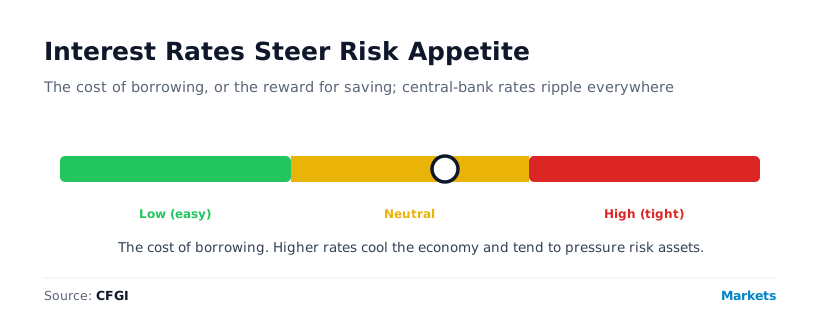
An interest rate is the cost of borrowing money, or the reward for saving it, shown as a percentage. The rate that matters most is the one central banks set, because it ripples through every loan, mortgage and market. When rates rise, safe savings pay more and risky assets look less appealing, and future cash flows are worth less today, so rates steer the crowd between risk and caution. This is education, not financial advice.
CFGI data
Interest rates are the gravity behind risk appetite, and CFGI scores the mood they move. Its 0 to 100 Fear and Greed reading, built from 10 indicators across crypto and equities since March 2022, captures the shift toward greed when rates ease and toward caution when they rise.
Source: CFGI dataset, March 2022 to June 2026.
Key takeaways
- An interest rate is the cost of borrowing or the reward for saving.
- Central banks set the benchmark to manage inflation and growth.
- Higher rates make safe savings more appealing than risky assets.
- Higher rates also lower the present value of future cash flows.
- Rate changes swing the crowd between risk and caution.
What Is an Interest Rate?
An interest rate is the price of money over time. Borrow, and you pay it; save, and you earn it. It is quoted as a yearly percentage. Many rates exist, but the key one is the benchmark set by a central bank, because almost every other rate, on mortgages, loans, bonds and savings, is built on top of it. That single benchmark is, in effect, the base price of money throughout an entire economy, which is why a change to it touches almost everything.
Who Sets Rates and Why
A nation’s central bank, such as the US Federal Reserve, sets the benchmark interest rate as its main tool for steering the economy. The logic is one of balance. When the economy is overheating and inflation is rising, the central bank raises rates to make borrowing more expensive, which cools spending and investment and brings prices back under control. When the economy is weak or shrinking, it cuts rates to make borrowing cheaper, encouraging spending and investment to stimulate growth. Rates are, in this sense, the economy’s thermostat: turned up to cool an overheating economy, turned down to warm a cold one. Getting this balance right is one of the most consequential and closely watched jobs in all of economics, which is why every word from a central bank is dissected.
Why Is It the Most-Watched Number In Markets?
Because it sets the gravity for every asset. When rates are low, holding cash earns little, so money flows into stocks, crypto and other risk to seek a return, a dynamic that fuels risk-taking. When rates rise, safe savings suddenly pay more, the cost of borrowing climbs, and risky assets have to compete with a real, risk-free yield, so money tends to rotate back toward safety. The simple summary is: rates up tends to mean risk-off; rates down tends to mean risk-on. This is why the legendary investor’s warning "don’t fight the Fed" carries such weight, the direction of the central bank’s rate policy is one of the most powerful tides in all of markets, lifting or sinking nearly everything at once.
Rates, Valuations and the Discount Effect
There is a deeper, more mechanical reason rates move asset prices, beyond simple risk appetite. The value of any asset is, in theory, the sum of its future cash flows, a company’s future profits, a bond’s future coupons, discounted back to what they are worth today. The interest rate is the engine of that discounting: the higher the rate, the less those future cash flows are worth in today’s money. This is why rising rates mathematically lower valuations, and why they hit "long-duration" assets hardest, those whose value rests mostly on distant future growth, like high-growth tech stocks and speculative assets such as crypto. A profit expected in ten years is worth far less today at a 5% rate than at a 1% one. This discount effect, working quietly beneath the headlines, is a large part of why growth and crypto are so sensitive to even small shifts in the rate outlook.
Higher Rates, Lower Valuations
An asset is worth its future cash flows discounted to today, and the interest rate is the discount. Higher rates shrink the present value of future growth, hitting long-duration assets like tech and crypto hardest.
How Do Rates Move Sentiment?
A change in rates, or even a hint of one, reprices risk appetite immediately. A surprise hike can flip the crowd from greed to fear in a session; a cut, or the promise of one, can spark relief and risk-on buying. Crucially, because markets are forward-looking, the mood swings on the outlook for rates as much as on the rate itself, a single sentence from a central banker hinting at the future path can move every market at once. This is why scheduled rate decisions and central-bank speeches are among the most watched events in finance: they are the moments that can reset the entire market’s risk appetite. CFGI reads the net effect on the Fear and Greed Index, so you see how the crowd is positioned without tracking every speech, the shift toward greed when rates ease and toward caution when they rise.
Frequently asked questions
What is an interest rate?
The price of money over time: the cost of borrowing or the reward for saving, quoted as a yearly percentage. The most important is the benchmark set by a central bank, on which almost every other rate is built.
Who sets interest rates and why?
A central bank, like the Federal Reserve, sets the benchmark as its main tool to steer the economy: raising rates to cool an overheating, inflationary economy, and cutting them to stimulate a weak one. Rates are the economy’s thermostat.
Why do higher rates hurt risky assets?
Two reasons: safe savings then pay a real return, so risky assets must compete with a risk-free yield and borrowing costs more; and higher rates lower the present value of future cash flows, hitting long-duration assets like growth stocks and crypto hardest.
How do interest rates affect crypto?
Crypto is a risk asset and a long-duration one, so it tends to feel rate moves keenly: pressured when rates rise, supported when they fall. The effect runs through both risk appetite and the discounting of its far-off potential. This is education, not financial advice.
CFGI.io, Market sentiment research
The CFGI research team builds and maintains the CFGI Fear and Greed Index: a 0 to 100 sentiment score from 10 sub-indicators across hundreds of crypto assets and the equity market, refreshed every 15 minutes. We have tracked market emotion through multiple full crypto and equity cycles.
Think we missed something?
Spotted a gap, disagree with a take, or think we should cover a new topic? Message us and we'll act on your input.
Message us on TelegramKeep reading
This article is educational and is not financial advice. Crypto and equities are volatile and you can lose money. See our disclaimer.