Markets
What Is Quantitative Easing?
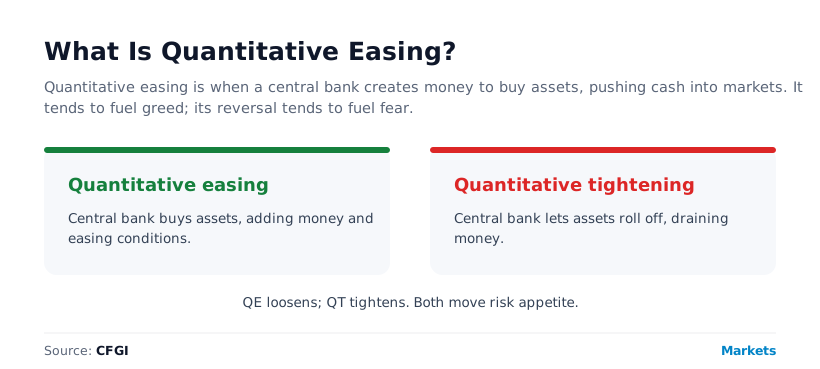
Quick answer
Quantitative easing, or QE, is when a central bank creates new money and uses it to buy assets like government bonds, pushing cash into the financial system and lowering long-term interest rates. The goal is to stimulate the economy when normal rate cuts are not enough, because rates are already near zero. QE tends to lift asset prices and fuel greed; its reversal, quantitative tightening, tends to drain liquidity and fuel fear. This is education, not financial advice.
CFGI data
Liquidity shapes the mood. Eras of QE, when the central bank floods markets with cash, tend to sit alongside greedy sentiment, while tightening tends to coincide with fear. A Fear and Greed Index reads how that backdrop is landing on the crowd day to day on its 0 to 100 scale.
Source: CFGI dataset and standard monetary-policy definitions, June 2026.
Key takeaways
- QE is a central bank creating money to buy assets.
- It pushes cash into markets and lowers long-term rates.
- Banks use it when rates are already near zero.
- It tends to lift asset prices and fuel greed.
- Its reversal, tightening, drains liquidity and tends to fuel fear.
Money Into the System
When the Federal Reserve or another central bank has already cut rates to near zero and wants to stimulate more, it can turn to QE: creating new money to buy bonds and other assets. That raises bond prices, lowers long-term yields, and leaves investors holding cash that often flows into riskier assets like stocks. The reverse is quantitative tightening, where the central bank lets those assets roll off and drains money from the system.
How QE Actually Works
QE is often called "money printing", but no physical notes are printed. The central bank creates new digital reserves and uses them to buy bonds from banks and investors. This does two things. First, by buying bonds in bulk it pushes their prices up and their yields down, lowering long-term borrowing costs across the economy. Second, it floods banks and investors with cash that earns almost nothing sitting still, which nudges them to seek returns elsewhere, in corporate bonds, stocks and other risk assets. Economists call this the "portfolio rebalancing" effect, and it is the main channel through which QE lifts markets: money pushed out of safe bonds has to go somewhere.
Why Central Banks Do It
QE is an emergency tool for when the usual one runs out. A central bank’s main lever is the short-term interest rate, but once that has been cut to roughly zero, the "zero lower bound", it cannot easily go lower. QE is what central banks reach for next: an "unconventional" way to keep loosening when conventional cuts are exhausted. The aims are to stimulate a weak economy, push down long-term borrowing costs, fight the threat of deflation, and calm panic during a financial crisis by showing markets that the central bank will provide effectively unlimited support. It is, in short, the heavy artillery of monetary policy.
The Tool Past Zero
When rates are already near zero and the economy still needs help, QE is how a central bank keeps easing. It works on long-term rates and liquidity, not the short-term rate.
QE In History
QE went from obscure experiment to defining policy in barely a decade. Japan pioneered it in the early 2000s to fight deflation. It became globally famous after the 2008 financial crisis, when the Federal Reserve ran successive rounds, known as QE1, QE2 and QE3, to support the economy, and other major central banks followed. The largest burst came in 2020, when the response to the pandemic saw central banks buy assets on an enormous scale, ballooning the Fed’s balance sheet toward roughly nine trillion dollars. That long era of cheap, abundant money helped power one of history’s great bull markets, and made "don’t fight the Fed" a defining investing maxim.
The Effects and the Criticisms
QE is powerful but controversial. By lifting the prices of stocks, bonds and property, it creates a "wealth effect" that can boost confidence, but critics note it disproportionately benefits those who already own assets, widening inequality. There are fears it can stoke inflation if the money it creates outruns the real economy, and concerns that years of cheap money distort markets, encourage excessive risk-taking, and inflate bubbles that are painful to deflate. It is also hard to unwind: shrinking a vast balance sheet through tightening can unsettle the very markets QE supported. These trade-offs are why QE remains one of the most debated tools in modern central banking.
| QE (easing) | QT (tightening) | |
|---|---|---|
| Action | Buys assets, creates money | Sells or rolls off assets |
| Liquidity | Adds it | Drains it |
| Long-term rates | Pushes down | Pushes up |
| Tends to fuel | Risk appetite, greed | Risk aversion, fear |
Two directions of the liquidity cycle.
QE, Liquidity and Sentiment
Liquidity is fuel for risk appetite. Periods of heavy QE have often coincided with greedy, rising markets, while tightening cycles have coincided with fear and drawdowns, which is the heart of "don’t fight the Fed". A Fear and Greed Index reads the day-to-day mood that this slow-moving backdrop helps shape. QE does not set sentiment by itself, plenty else moves the crowd, but it tilts the playing field: when the liquidity tide is rising, greed comes more easily, and the gauge is where you see that tilt show up in real time.
Frequently asked questions
What is quantitative easing?
When a central bank creates new money to buy assets like government bonds, pushing cash into the system and lowering long-term rates to stimulate the economy, typically when short-term rates are already near zero.
Is QE the same as printing money?
Loosely, but no physical notes are printed. The central bank creates digital reserves to buy bonds, which raises their prices, lowers long-term yields and pushes investors toward riskier assets, the "portfolio rebalancing" effect.
When has QE been used?
Japan pioneered it in the early 2000s; the Federal Reserve ran QE1, QE2 and QE3 after the 2008 crisis; and central banks used it on a massive scale in 2020, swelling the Fed balance sheet toward roughly nine trillion dollars.
Does QE cause greed?
It creates conditions that favour it. More liquidity tends to lift risk appetite, which a Fear and Greed Index often reads as greed, while tightening tends to do the opposite. This is education, not financial advice.
CFGI.io, Market sentiment research
The CFGI research team builds and maintains the CFGI Fear and Greed Index: a 0 to 100 sentiment score from 10 sub-indicators across hundreds of crypto assets and the equity market, refreshed every 15 minutes. We have tracked market emotion through multiple full crypto and equity cycles.
Think we missed something?
Spotted a gap, disagree with a take, or think we should cover a new topic? Message us and we'll act on your input.
Message us on TelegramKeep reading
This article is educational and is not financial advice. Crypto and equities are volatile and you can lose money. See our disclaimer.