Markets
Fear and Greed Index vs Consumer Confidence
Quick answer
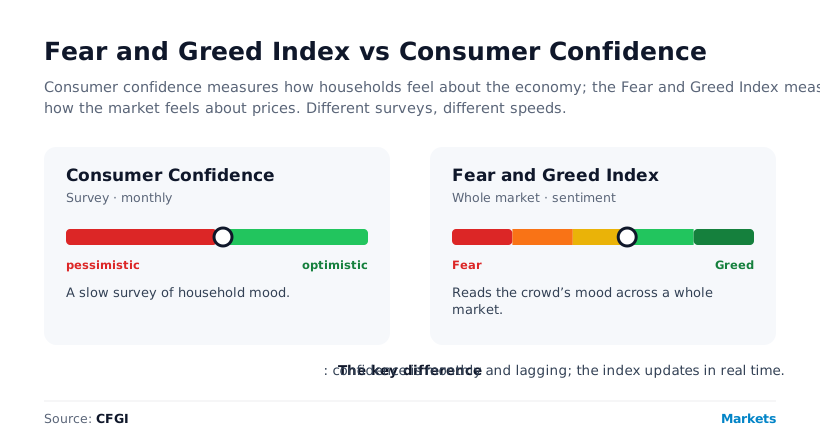
Consumer confidence indexes survey households on how they feel about the economy and their finances, usually monthly. The Fear and Greed Index measures market sentiment from price behaviour, in real time. One is about the economy and moves slowly; the other is about the market and moves fast. Because markets are forward-looking, they often turn before households notice, so the two answer different questions and frequently point opposite ways. This is education, not financial advice.
CFGI data
Consumer confidence is a monthly read on the economy. CFGI Fear and Greed is a market read built from 10 indicators, refreshed every 15 minutes for crypto since March 2022. The two can point opposite ways: markets often turn before households notice, which is why a fast market index and a slow economic survey complement each other.
Source: CFGI dataset, March 2022 to June 2026.
Key takeaways
- Consumer confidence surveys households on the economy, usually monthly.
- The Fear and Greed Index reads market sentiment from price behaviour, in real time.
- One is about the economy; the other is about the market.
- Markets are forward-looking and often move before the data confirms it.
- The gap between them is often the interesting part.
Economy Versus Market
Consumer confidence indexes, such as the Conference Board or University of Michigan measures, poll households on how they feel about jobs, income and the economy. They are released monthly and move slowly, reflecting the real economy more than the market. A Fear and Greed Index reads the market, not the economy: volatility, momentum, breadth and more, turned into a 0 to 100 score in real time. It tracks how the crowd feels about prices, which can shift far faster than household sentiment.
What Consumer Confidence Measures
Two well-known surveys dominate. The Conference Board’s Consumer Confidence Index, published monthly, blends households’ views of current conditions (40% of the index) and their expectations for the next six months (60%), and is especially sensitive to the jobs market. The University of Michigan’s Consumer Sentiment Index, running since 1952, focuses more on household finances and the impact of inflation. What unites them is that they measure optimism about the economy, jobs, income, prices, the cost of living, not about the stock market. That distinction is the whole point of this comparison: a strong economy and a fearful market, or a gloomy public and a soaring market, can and do coexist, because the two surveys are taking the temperature of different things.
Consumer Confidence vs Fear and Greed, Side by Side
| Consumer confidence | Fear and Greed Index | |
|---|---|---|
| Measures | How households feel | How the market feels |
| Domain | The economy | Market prices |
| Cadence | Monthly | Real time |
| Source | Surveys | Market behaviour |
How consumer confidence and a Fear and Greed Index differ.
The cadence gap is large: a once-a-month economic survey simply cannot track the day-to-day, even minute-to-minute, mood swings a market-based index captures. They operate on entirely different clocks.
Different Questions, Different Speeds
The deepest difference is one of timing, and it follows from what each measures. The stock market is forward-looking: it tries to price in the future, so it tends to turn before the economy does, falling in anticipation of a downturn and rising in anticipation of a recovery, often months ahead. Consumer confidence, by contrast, largely reflects the economy people are living in right now, so it tends to lag. This is why a Fear and Greed Index can be deep in fear while consumer confidence is still high, the market is bracing for trouble the public has not yet felt, or why the market can be greedy while households remain gloomy, climbing the proverbial wall of worry. The market is frequently the leading indicator and the survey the confirming one.
The Market Leads, the Survey Confirms
Markets price the future and turn early; consumer confidence reflects the present economy and lags. So the two can point opposite ways, and that gap carries information about what the market sees coming.
Why Watch Both?
Because they frame different parts of the same picture. Consumer confidence sets the economic backdrop, the health of jobs, incomes and spending that ultimately drives company earnings, while a Fear and Greed Index reads the market’s mood about prices right now. Watching them together lets you ask the revealing questions: is the market’s fear justified by a weakening economy, or has it run ahead of the data? Is household gloom a contrarian buy signal, as it has often been historically, or a genuine warning? Neither tool predicts price on its own, but a slow economic survey and a fast market gauge, read side by side, give a richer sense of where sentiment and reality stand relative to each other. Notably, depressed consumer confidence has historically been followed by strong equity returns, with the market often delivering well above its average in the year after sentiment troughs, an echo of the same contrarian logic that makes a Fear and Greed Index useful at its extremes.
Frequently asked questions
Is consumer confidence a market sentiment indicator?
Not really. It measures how households feel about the economy, jobs, income, the cost of living, released monthly. Market sentiment is read by a Fear and Greed Index from price behaviour, in real time. They cover different domains.
What does consumer confidence measure?
Optimism about the economy. The Conference Board index blends current conditions (40%) and six-month expectations (60%) and is jobs-sensitive; the University of Michigan index, running since 1952, focuses on household finances and inflation.
Can they point in opposite directions?
Yes, often. Markets are forward-looking and turn before the economy, so a Fear and Greed Index can be fearful before households notice, or greedy while confidence sags. The market frequently leads and the survey confirms.
Which should investors watch?
Both, for different reasons. Consumer confidence frames the economic backdrop; a Fear and Greed Index reads the market mood now. Neither predicts price alone, but the gap between them is informative. This is education, not financial advice.
CFGI.io, Market sentiment research
The CFGI research team builds and maintains the CFGI Fear and Greed Index: a 0 to 100 sentiment score from 10 sub-indicators across hundreds of crypto assets and the equity market, refreshed every 15 minutes. We have tracked market emotion through multiple full crypto and equity cycles.
Think we missed something?
Spotted a gap, disagree with a take, or think we should cover a new topic? Message us and we'll act on your input.
Message us on TelegramKeep reading
This article is educational and is not financial advice. Crypto and equities are volatile and you can lose money. See our disclaimer.