Markets
What Is Monetary Policy?
Quick answer
Monetary policy is how a central bank manages the supply of money and the cost of borrowing, mainly through interest rates, to steer the economy toward stable prices and healthy employment. Loose policy, low rates and more money, stimulates growth and risk-taking; tight policy, high rates and less money, cools an overheating economy and fights inflation. Because rates set the price of money everywhere, monetary policy is one of the single biggest forces moving markets.
CFGI data
Central-bank decisions drive some of the sharpest swings CFGI captures. Because rates set the price of money for every asset, the score can lurch between greed and fear on its 0 to 100 scale within minutes of an announcement, which is part of why CFGI refreshes its crypto reading every 15 minutes rather than once a day.
Source: CFGI methodology, 0 to 100 sentiment model.
Key takeaways
- Monetary policy manages the money supply and interest rates, run by a central bank.
- The main tools are the policy rate, open market operations, QE and QT.
- Loose policy stimulates growth; tight policy cools inflation.
- The Fed’s dual mandate is maximum employment and stable prices, around 2% inflation.
- "Don’t fight the Fed" reflects how heavily policy steers markets.
Steering the Economy With Money
A central bank uses monetary policy to keep the economy on an even keel, primarily by setting interest rates and managing the money supply. The logic is simple: cheaper money encourages borrowing, spending and investment, while dearer money discourages them. When the economy is weak, the central bank loosens policy to wake it up; when inflation runs too hot, it tightens to cool things down. Unlike fiscal policy, this is run by unelected technocrats and can change far faster than any government budget.
The Toolkit
A central bank has more than one lever, and modern policy uses several at once.
- The policy interest rate. The headline tool, the rate that filters through to loans, mortgages and savings across the economy.
- Open market operations. Buying and selling government bonds to nudge the key short-term rate (in the US, the federal funds rate) toward target.
- Quantitative easing (QE). Creating money to buy long-term bonds, pushing down longer rates and adding liquidity when normal rate cuts run out of room.
- Quantitative tightening (QT). The reverse, shrinking the balance sheet to drain liquidity and tighten conditions.
Loose Versus Tight
| Loose (expansionary) | Tight (contractionary) | |
|---|---|---|
| Rates | Cut | Raise |
| Balance sheet | QE, expand | QT, shrink |
| Goal | Boost growth and jobs | Cool inflation |
| Effect on risk assets | Usually supportive | Usually a headwind |
The two settings of monetary policy.
The 2022 to 2023 period was a textbook tightening cycle: facing the highest inflation in decades, major central banks raised rates rapidly and began QT, deliberately slowing their economies. Markets felt every step, because higher rates lift the discount rate on future profits and make safe cash more attractive than risky stocks.
The Mandate and the 2% Target
A central bank does not set policy on a whim; it works to a mandate. The US Federal Reserve has a "dual mandate", set by law in 1977, to pursue maximum employment and stable prices. It defines stable prices as around 2% annual inflation, low enough to be barely noticed but safely clear of damaging deflation. The hard part is that these goals can conflict: cooling inflation may cost jobs, while protecting jobs may let inflation run. Much of the drama in monetary policy is the central bank trying to balance the two.
Why Markets Hang On Every Word
Because rates reprice every asset, monetary policy ripples through everything, and markets obsess over it. The old trading maxim "don’t fight the Fed" captures the idea that stocks tend to swim with the tide of liquidity the central bank controls, rising when policy is loose and struggling when it is tight. Investors do not just react to decisions, they try to anticipate them, so a single policy meeting, a set of minutes, or even one carefully chosen line in a speech can swing sentiment violently as the entire crowd rethinks where rates are heading next.
Monetary Versus Fiscal Policy
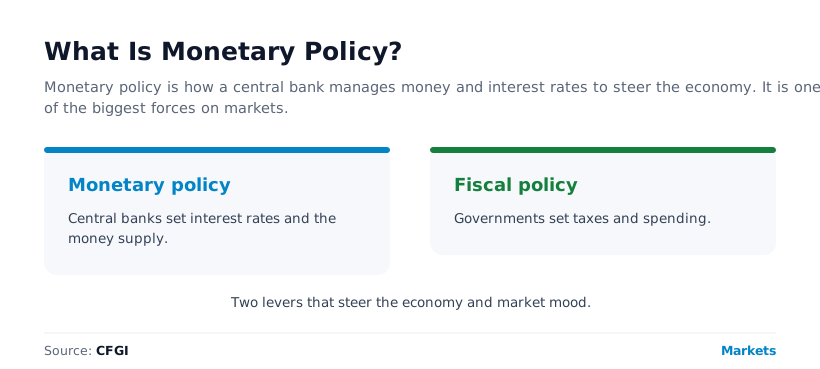
It is worth keeping the two main economic levers straight. Monetary policy is the central bank’s control of money and rates, fast-moving and run by appointed officials. Fiscal policy is the government’s control of spending and taxes, slower and decided by politicians. They can pull together, as in the 2020 crisis when both were thrown wide open, or against each other, with one stimulating while the other restrains. Reading the economy means watching both at once.
Monetary Policy and Market Sentiment
No scheduled events move sentiment quite like central-bank decisions. In the minutes after a rate announcement, risk appetite can flip from greed to fear or back, which is exactly the kind of swing a Fear and Greed Index is built to capture on a 0 to 100 scale. Knowing where policy is heading, and where sentiment already sits, is far more telling together than either on its own, because the market is always trading not just today’s rate but its best guess of the next one.
Frequently asked questions
What is monetary policy?
How a central bank manages the money supply and the cost of borrowing, mainly through interest rates, to steer the economy toward stable prices and healthy employment.
What tools does monetary policy use?
The main ones are the policy interest rate, open market operations (buying and selling government bonds), quantitative easing (creating money to buy bonds), and quantitative tightening (shrinking the balance sheet).
What is the difference between loose and tight monetary policy?
Loose policy means low rates and more money to stimulate growth; tight policy means higher rates and less money to cool an overheating economy or fight inflation.
How is monetary policy different from fiscal policy?
Monetary policy is run by the central bank through money and rates and can move quickly; fiscal policy is run by the government through taxing and spending and tends to be slower and political. This is education, not financial advice.
CFGI.io, Market sentiment research
The CFGI research team builds and maintains the CFGI Fear and Greed Index: a 0 to 100 sentiment score from 10 sub-indicators across hundreds of crypto assets and the equity market, refreshed every 15 minutes. We have tracked market emotion through multiple full crypto and equity cycles.
Think we missed something?
Spotted a gap, disagree with a take, or think we should cover a new topic? Message us and we'll act on your input.
Message us on TelegramKeep reading
This article is educational and is not financial advice. Crypto and equities are volatile and you can lose money. See our disclaimer.