Markets
What Is Quantitative Tightening?
Quick answer
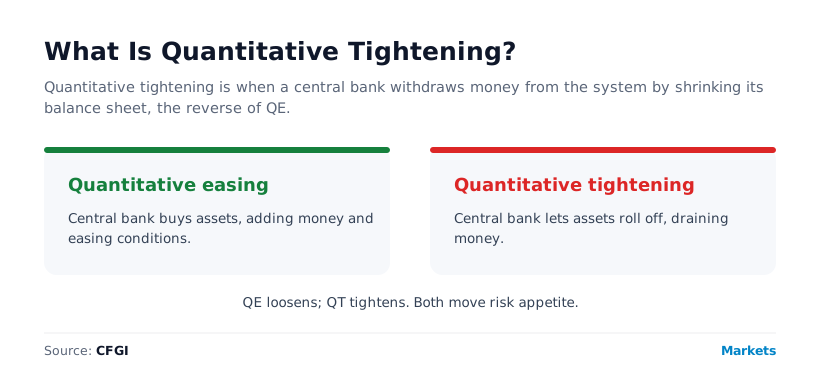
Quantitative tightening, or QT, is when a central bank reduces the amount of money in the financial system by shrinking its balance sheet, letting the bonds it once bought mature without replacing them, or selling them. It is the reverse of quantitative easing. By draining liquidity and leaving more bonds for private investors to absorb, QT tends to push up longer-term interest rates and weigh on risk assets like stocks, which can cool a greedy market into a cautious one.
CFGI data
QT drains liquidity slowly, and CFGI shows it as a grind rather than a spike. Tightening tends to pull the score lower over weeks and months on its 0 to 100 scale, the gradual shift from greed toward caution that a live reading makes visible long before the move is obvious in the headlines.
Source: CFGI methodology, 0 to 100 sentiment model.
Key takeaways
- QT drains money from the system; it is the reverse of QE.
- The central bank shrinks its balance sheet, usually by letting bonds roll off.
- The US ran QT from 2022, cutting holdings by more than 2.2 trillion dollars.
- Pushed too far in 2019, it triggered a spike in short-term funding rates.
- The Fed ended its post-COVID QT in late 2025.
Reversing the Money Printer
Under quantitative easing, a central bank created money to buy bonds and flood the system with liquidity. QT undoes exactly that. The bank lets those bonds mature without buying new ones, or sells them outright, which removes money from the system. The effect is to tighten financial conditions: liquidity falls, and longer-term interest rates tend to rise as more bonds are left for private investors to buy.
How QT Actually Works
The gentler, more common form of QT is "runoff": when bonds the central bank holds mature, it simply does not reinvest the proceeds, so its balance sheet shrinks on its own. To keep it controlled, the bank caps how much it lets roll off each month. The US programme that began in June 2022 is the textbook case, allowing up to around 95 billion dollars of bonds to run off monthly at its peak. Over the following years it shrank the Federal Reserve’s holdings by more than 2.2 trillion dollars, before the pace was slowed in 2024. The alternative, actively selling bonds, is rarer and more aggressive, because it pushes the change through markets faster.
QT Versus Raising Interest Rates
QT is not the same as hiking rates, though they are cousins and often run together. Raising the policy rate lifts the short-term cost of money directly and immediately. QT works in the background on longer-term rates and on the overall quantity of liquidity, by changing the size of the central bank’s balance sheet. Think of rate hikes as the central bank’s loud, visible lever and QT as the quiet one operating underneath. In the 2022 tightening, both were pulled at once, a deliberately powerful combination against high inflation.
Why QT Pressures Markets
Less liquidity and higher safe returns make risk assets less appealing, so QT tends to weigh on stocks and dampen risk appetite, the mirror image of QE’s lift. There is a direct bond-market mechanism too: as the central bank stops absorbing government debt, private investors must buy more of it, and to tempt them the price falls and the yield rises. Higher yields then ripple into the discount rate used to value every other asset. Because all of this works in the background over months, QT is a slow tightening of the screws rather than a single shock.
When QT Goes Too Far: 2019
QT has a hidden danger: nobody knows in advance exactly how much liquidity the system needs, so it is possible to drain too much. That is what happened in September 2019. After an earlier round of QT had pulled roughly 700 billion dollars of reserves out of the system, a sudden squeeze hit the "repo" market where banks borrow overnight, and short-term funding rates briefly spiked toward 10%, from around 2%. The Fed had to step in and reverse course abruptly. It was a vivid reminder that tightening is easier to start than to stop, and that liquidity can vanish faster than expected.
The Lesson
QT looks gentle on paper, a slow drip out of the system, but cross an invisible line on reserves and the calm can turn into a sudden funding scramble.
The 2022 to 2025 Cycle and Its End
The post-pandemic QT programme, designed with the 2019 scare firmly in mind, was run more cautiously, with the pace slowed well before reserves looked scarce. It ran from 2022 until late 2025, when the Fed announced it would stop shrinking its balance sheet. The telling detail is that, unlike in 2019, markets barely flinched this time, a sign the central bank had learned to manage the unwind gently. QT had done its job of removing the extraordinary stimulus of the pandemic era without breaking anything on the way out.
Quantitative Tightening and Sentiment
Because QT works slowly, its effect on mood is a grind rather than a jolt. It steadily tightens financial conditions in the background, gradually nudging sentiment from greed toward caution as liquidity thins. That is exactly the kind of slow drift a live Fear and Greed Index can surface on its 0 to 100 scale, often before the change is obvious in prices. Reading QT alongside the prevailing mood helps explain why a market can feel heavy for months without any single dramatic headline to blame.
Frequently asked questions
What is quantitative tightening?
When a central bank reduces the money in the system by shrinking its balance sheet, letting bonds mature without replacing them or selling them. It is the reverse of quantitative easing.
How is QT different from raising interest rates?
Raising rates lifts the short-term policy rate directly and immediately; QT works on longer-term rates and the overall quantity of liquidity by shrinking the central bank’s bond holdings. They are often used together.
Can quantitative tightening cause problems?
Yes. Drain too much liquidity and funding markets can seize up, as in September 2019 when overnight repo rates briefly spiked toward 10% and forced the Fed to reverse course. The pace has to be managed carefully.
How does QT affect the stock market?
By draining liquidity and lifting yields, QT tends to pressure stocks and reduce risk appetite, gradually shifting sentiment toward caution over months rather than all at once. This is education, not financial advice.
CFGI.io, Market sentiment research
The CFGI research team builds and maintains the CFGI Fear and Greed Index: a 0 to 100 sentiment score from 10 sub-indicators across hundreds of crypto assets and the equity market, refreshed every 15 minutes. We have tracked market emotion through multiple full crypto and equity cycles.
Think we missed something?
Spotted a gap, disagree with a take, or think we should cover a new topic? Message us and we'll act on your input.
Message us on TelegramKeep reading
This article is educational and is not financial advice. Crypto and equities are volatile and you can lose money. See our disclaimer.