Markets
What Is Risk In Investing?
Quick answer
Risk in investing is the chance that an outcome differs from what you expect, including the chance of losing money. Every asset carries some, and higher potential return usually means higher risk. Risk cannot be removed, only understood and managed through diversification, sizing and time. What changes constantly is the crowd’s appetite for risk, and that appetite swinging between fear and greed is what a sentiment index measures. This is education, not financial advice.
CFGI data
Risk appetite is what swings, and CFGI measures it. Its 0 to 100 Fear and Greed score, built from 10 indicators across hundreds of assets since March 2022, is in effect a read on how much risk the crowd wants right now: extreme greed is maximum appetite, extreme fear is the flight to safety.
Source: CFGI dataset, March 2022 to June 2026.
Key takeaways
- Risk is the chance an outcome differs from what you expect.
- Higher potential return usually comes with higher risk.
- There are many types: market, specific, liquidity, inflation and more.
- Risk cannot be removed, only understood and managed.
- The crowd’s appetite for risk swings between fear and greed.
What Is Risk?
Risk is uncertainty about the future, specifically the chance that an investment does worse (or better) than expected. It is not the same as danger; it is the spread of possible outcomes. A government bond has a narrow spread, so low risk. A memecoin has an enormous spread, so high risk. Understanding risk is less about avoiding it, which is impossible, than about knowing how much of it you are taking and whether you are being fairly rewarded for it.
Risk and Return: The Trade-Off
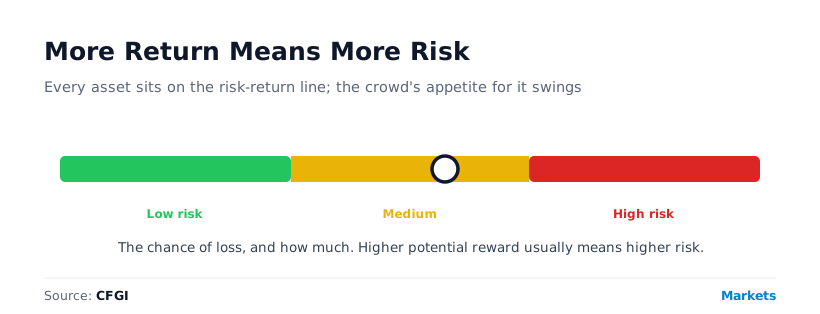
The central rule of investing is that risk and return are linked: to earn a higher return, you generally have to accept a higher risk of loss. This is the "risk premium", the extra reward investors demand for bearing uncertainty. It sorts assets into a rough spectrum, from low-risk, low-return cash and government bonds, through medium-risk stocks, to high-risk, high-reward crypto and speculative bets. Crucially, higher risk only means a higher potential return, not a guaranteed one; it equally means a greater chance of loss. The trade-off cannot be cheated, the only real exception is diversification, which can reduce risk without sacrificing expected return, which is why it is called the one "free lunch" in finance.
The Main Types of Risk
Risk is not one thing but many, and good investors think about each.
- Market risk: the whole market falls and takes you with it, which diversification cannot remove.
- Specific risk: something goes wrong with one company or project; diversification can remove this.
- Volatility risk: the price swings sharply, testing your nerve.
- Liquidity risk: you cannot sell quickly without accepting a worse price.
- Inflation risk: even "safe" cash loses purchasing power over time.
Notice that there is no risk-free choice: holding cash to avoid market risk simply swaps it for inflation risk. Every option carries some flavour of uncertainty.
Risk Versus Volatility
It is worth separating two ideas that often get blurred: risk and volatility. Volatility is how much a price swings around in the short term, the visible turbulence, and it is the most common way people measure risk, because it is easy to see and quantify. But they are not the same. A highly volatile asset can be a sound long-term holding for a patient investor, while a "stable" one can carry hidden dangers, like a slow erosion from inflation or a sudden, catastrophic blow-up. True risk is the chance of a permanent loss of capital, not the day-to-day wobble. Confusing the two leads people to fear short-term volatility they could easily ride out, while ignoring quieter risks that do real, lasting damage.
Volatility Is Not the Whole of Risk
Volatility is the visible bumps; risk is the chance of permanent loss. A volatile asset can be safe to hold for years, and a calm one can hide a real danger.
Managing Risk
Since risk cannot be eliminated, the goal is to manage it so it is sized to what you can both afford and emotionally endure. The core tools are diversification, spreading across uncorrelated assets so no single failure can ruin you; position sizing, never betting more than you can afford to lose on one idea; time horizon, since a longer runway lets you ride out volatility that would sink a short-term trader; and matching the overall risk of your portfolio to your personal risk tolerance. The aim is not to maximise return at any cost, but to take enough risk to be rewarded while keeping the downside survivable. In investing, surviving the bad outcomes matters more than catching every good one.
Why Does Risk Appetite Matter?
The risk in an asset changes slowly, but how much risk the crowd wants changes fast. In greed, investors chase risk and pile into the speculative end; in fear, they flee to safe havens and dump anything risky. That swing in appetite, not the underlying risk, drives most short-term moves, the same memecoin that felt thrilling in a greedy market feels terrifying in a fearful one, though its actual risk barely changed. A Fear and Greed Index is, in effect, a risk-appetite gauge: high means the crowd wants risk, low means it wants safety. Reading it tells you not how risky assets are, but how willing the crowd currently is to bear that risk.
Frequently asked questions
What is risk in investing?
The chance that an outcome differs from what you expect, including the chance of losing money. It is the spread of possible outcomes, not danger itself, and every asset carries some.
Does higher risk mean higher return?
It usually means higher potential return, the "risk premium" paid for bearing uncertainty, but not a guaranteed one. Higher risk equally raises the chance of loss. The trade-off cannot be cheated, except by diversification.
What is the difference between risk and volatility?
Volatility is short-term price swings, the visible turbulence; true risk is the chance of a permanent loss of capital. A volatile asset can be a sound long-term holding, while a calm one can carry hidden dangers like inflation.
What is risk appetite?
How much risk the crowd is willing to take at a given moment. It swings between greed (chasing risk) and fear (fleeing to safety), which is what a Fear and Greed Index measures. This is education, not financial advice.
CFGI.io, Market sentiment research
The CFGI research team builds and maintains the CFGI Fear and Greed Index: a 0 to 100 sentiment score from 10 sub-indicators across hundreds of crypto assets and the equity market, refreshed every 15 minutes. We have tracked market emotion through multiple full crypto and equity cycles.
Think we missed something?
Spotted a gap, disagree with a take, or think we should cover a new topic? Message us and we'll act on your input.
Message us on TelegramKeep reading
This article is educational and is not financial advice. Crypto and equities are volatile and you can lose money. See our disclaimer.