Markets
What Is a Flight to Safety?
Quick answer
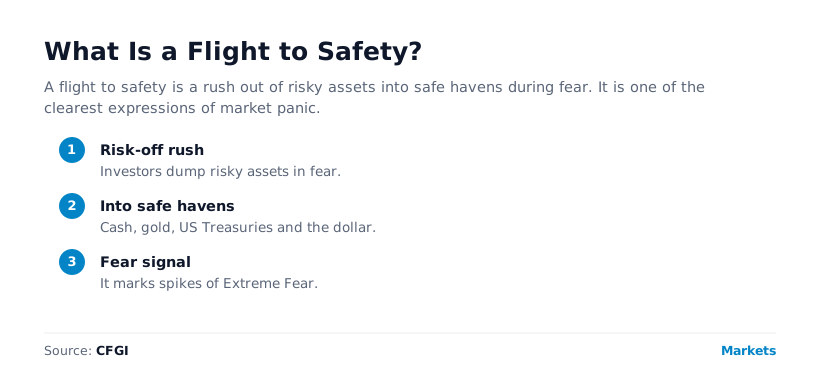
A flight to safety, sometimes called a flight to quality, is a sudden rush by investors out of risky assets and into safe havens like government bonds, gold and the US dollar. It happens when fear spikes and the priority shifts from earning returns to protecting capital. It is usually fast and indiscriminate, even good assets get sold as everyone reaches for the exits at once, and it is one of the clearest expressions of market panic, lining up with the lowest readings on a Fear and Greed Index. This is education, not financial advice.
CFGI data
A flight to safety is fear in motion. When CFGI plunges toward lows like the equity 3 on 8 April 2025, money is fleeing risk for safe havens. The sentiment score and the flight are two views of the same surge of fear.
Source: CFGI dataset, 2021 to June 2026.
Key takeaways
- A flight to safety is a rush from risky assets to safe havens.
- It happens when fear spikes and capital protection takes over.
- Government bonds, gold and the dollar are typical destinations.
- It is fast and indiscriminate, even good assets get sold.
- It coincides with the lowest Fear and Greed readings.
When Protecting Capital Takes Over
Most of the time investors seek returns. In a flight to safety, that flips: the only thing that matters is not losing money. Capital rushes out of stocks, crypto and other risk assets and into safe havens, the assets investors trust to hold value when everything else is falling. It is the most acute form of risk-off behaviour. A flight to safety is usually fast and indiscriminate: even good assets get sold as the crowd reaches for the exits all at once.
Where the Money Goes
A flight to safety has a handful of traditional destinations, the assets the world reaches for when it is scared.
- Government bonds: especially US Treasuries, seen as the closest thing to risk-free, so their prices rise as money pours in.
- Gold: the ancient store of value, prized for holding worth when paper assets wobble.
- The US dollar: the world’s reserve currency, which strengthens as global investors seek safety.
- Cash: the simplest haven of all, sitting out the storm entirely.
Certain currencies like the Japanese yen and Swiss franc often strengthen too. The common thread is trust: in a panic, capital flows toward whatever it believes will still be standing when the dust settles.
What Triggers a Flight to Safety
A flight to safety is set off by a sharp spike in fear, usually from a shock that threatens the system rather than a single company. The classic triggers are financial crises, like 2008, sudden economic shocks, like the onset of the COVID pandemic in 2020, geopolitical events such as wars or conflicts, and black swan surprises that no one was positioned for. The common feature is that the danger feels broad and hard to assess, which flips investors’ priority from "how much can I earn?" to "how do I protect what I have?" almost overnight. The bigger and more systemic the perceived threat, the more violent and widespread the flight.
Why Even Good Assets Get Sold
One of the most counterintuitive features of a flight to safety is that quality is no protection. In a genuine panic, investors often sell what they can, not what they should, dumping their most liquid, highest-quality holdings simply because those are the easiest to turn into cash, while illiquid positions are stuck. Leverage forces the issue, as margin calls compel sales regardless of an asset’s merits. The result is that "all correlations go to one": even fundamentally sound assets fall together, the baby thrown out with the bathwater. This is the same dynamic as financial contagion, and it is exactly why diversification offers least protection at the very moment a flight to safety strikes, leaving only true havens standing.
Sell What You Can, Not What You Should
In a flight to safety, investors raise cash by selling their best, most liquid assets, so quality falls alongside junk. Only genuine safe havens reliably hold up.
A Flight to Safety As Peak Fear
Because it is driven by acute fear, a flight to safety coincides with the lowest readings on a Fear and Greed Index. The index reads the panic directly; the surge into havens confirms it. The two together mark the moments of maximum fear, which, paradoxically, have often sat closer to market lows than to the start of a fall, because by the time everyone has fled to safety, the selling is closest to exhausted. So while a flight to safety is the very picture of fear in motion, a deep Fear and Greed reading during one is exactly the kind of capitulation signature a contrarian watches, not as a guarantee of a bottom, but as a sign that the crowd’s fear has reached an extreme.
Frequently asked questions
What is a flight to safety?
A sudden rush by investors out of risky assets and into safe havens like government bonds, gold and the dollar, driven by spiking fear and the urge to protect capital. It is the most acute form of risk-off behaviour.
Where does the money go in a flight to safety?
Mainly into US government bonds, gold, the US dollar and cash, plus currencies like the Japanese yen and Swiss franc. The common thread is trust: capital flows to whatever investors believe will hold its value through the panic.
Why do even good assets get sold?
Because in a panic investors sell what they can, not what they should, dumping their most liquid, highest-quality holdings to raise cash, while leverage forces more sales. "All correlations go to one", so quality falls with junk, and only true havens hold up.
How does it relate to the Fear and Greed Index?
It coincides with the lowest readings. The index reads the panic directly, while the surge into safe havens confirms it. Together they mark peak fear, which has often sat nearer market lows than the start of a fall. This is education, not financial advice.
CFGI.io, Market sentiment research
The CFGI research team builds and maintains the CFGI Fear and Greed Index: a 0 to 100 sentiment score from 10 sub-indicators across hundreds of crypto assets and the equity market, refreshed every 15 minutes. We have tracked market emotion through multiple full crypto and equity cycles.
Think we missed something?
Spotted a gap, disagree with a take, or think we should cover a new topic? Message us and we'll act on your input.
Message us on TelegramKeep reading
This article is educational and is not financial advice. Crypto and equities are volatile and you can lose money. See our disclaimer.