Stocks
What Is the Stock Market?
Quick answer
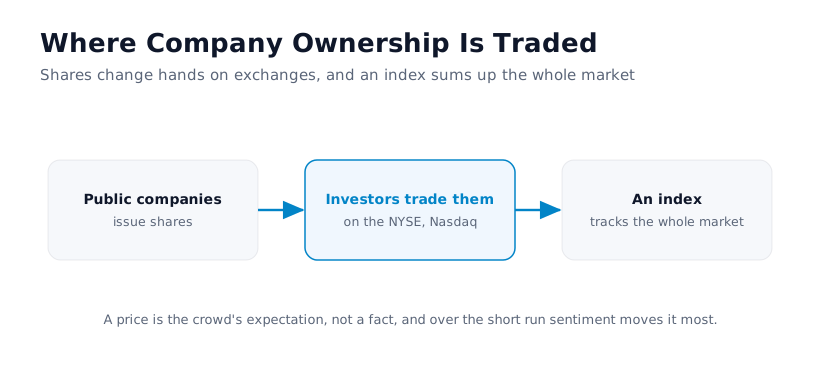
The stock market is where shares of public companies are bought and sold, on exchanges such as the NYSE and Nasdaq. A share is a small piece of ownership, and its price reflects what the crowd expects the company to be worth. It lets companies raise capital and investors own a slice of business growth. Because expectations swing with emotion, equities cycle through fear and greed just like every other market. This is education, not financial advice.
CFGI data
Equity crowds and crypto crowds behave differently, and CFGI scores both. The stock crowd is quick to panic but slow to celebrate: across a 21% S&P 500 year from June 2025 to June 2026 there was not one extreme-greed close. The Stock Fear and Greed Index runs 0 to 100, updated daily since 2021.
Source: CFGI dataset, 2021 to June 2026.
Key takeaways
- The stock market is where ownership in public companies is priced and traded on exchanges.
- Indices like the S&P 500 track the market as a whole; a price is the crowd’s expectation.
- It lets companies raise capital and is a barometer of the economy.
- Over the short run, sentiment moves prices more than fundamentals do.
- Fear and greed show up through volatility, breadth and demand for safe havens.
What Is the Stock Market, In Plain Terms?
The stock market is the network of exchanges where shares of public companies change hands. A "share" (or stock) is a small unit of ownership in a company. Buy one and you own a sliver of the business, including a claim on its future profits. When people say the market is up or down, they usually mean an "index": a basket that tracks many companies at once, like the S&P 500 (the 500 largest US companies) or the Nasdaq 100 (large tech-heavy names).
How Does the Stock Market Work?
Companies raise money by selling shares to the public in an IPO, the "primary market", where the company itself receives the cash. After that, those shares trade between investors on exchanges such as the NYSE and Nasdaq, the "secondary market", where the company is no longer directly involved; investors are simply trading ownership among themselves. A price is simply the point where a buyer and a seller agree, updated continuously through the trading day as orders meet in the exchange’s order book. Unlike crypto, equity markets keep set hours and close overnight and on weekends. That pause matters: it gives the crowd time to cool off, which is one reason equity sentiment usually swings less violently than crypto sentiment.
Who Trades, and Why It Matters
Two broad groups make up the market. "Retail" investors are individuals trading their own money, while "institutional" investors, pension funds, asset managers, hedge banks and the like, trade vast sums on behalf of others, and it is this large institutional presence that gives equities their steadier, more deliberate character compared with retail-driven crypto. Beyond who participates, the stock market plays several roles that reach far beyond traders. It is the engine of "capital formation", channelling savings into the companies that build, hire and innovate, funding economic growth. It lets ordinary people share in that growth and build long-term wealth, which is why it underpins so many pensions and retirement accounts. And it acts as a real-time barometer of the economy, with its rises and falls treated as a signal about the collective outlook for business and confidence. The stock market, in short, is not just a place to trade; it is one of the central institutions of a modern economy.
What Actually Moves Stock Prices?
Over years, prices track fundamentals: earnings, growth and interest rates. Over days and weeks, they track something messier, which is how the crowd feels about those fundamentals. The investor Benjamin Graham put it best: in the short run the market is a voting machine, in the long run it is a weighing machine. The votes are emotional, which is why a roaring company can still see its stock fall, and a struggling one can rally. This is the single most important idea for understanding market mood: a price is not an objective fact about a company, it is the crowd’s ever-shifting opinion of it, and opinions move on feeling as much as on fact.
How Do Fear and Greed Show Up In Stocks?
Equity fear and greed are measurable. The classic signals include:
- Volatility: when fear spikes, options pricing and the VIX (the market’s fear gauge) rise.
- Market breadth: in greed, most stocks rise together; in fear, gains narrow to a few names.
- Safe-haven demand: money rotates into bonds and gold when the crowd is fearful.
- Momentum and strength: how far price sits above or below recent ranges.
Why It Matters
Sentiment extremes tend to cluster near turning points. Peak greed has marked many tops, and peak fear has marked many bottoms, which is why contrarian investors watch the gauge closely.
How Do You Read Stock Market Sentiment?
A Stock Fear and Greed Index folds those signals into a single 0 to 100 score, where 0 is extreme fear and 100 is extreme greed. It will not tell you what happens next, but it tells you where the crowd is standing right now, which is exactly the information emotion tends to hide. To see the same idea applied to a faster, 24/7 market, compare it with the Crypto Fear and Greed Index, or read what financial markets are for the bigger picture.
Frequently asked questions
What is the stock market?
The network of exchanges, like the NYSE and Nasdaq, where shares of public companies are bought and sold. A share is a small unit of ownership, and its price reflects what the crowd expects the company to be worth. It lets companies raise capital and investors own a slice of business.
How does the stock market work?
Companies first sell shares in an IPO (the primary market), where they receive the cash. After that, investors trade those shares among themselves on exchanges (the secondary market). A price is where a buyer and seller agree, updated continuously through set trading hours.
What moves stock prices?
Over years, fundamentals like earnings, growth and interest rates. Over days and weeks, sentiment, how the crowd feels about those fundamentals. As Benjamin Graham said, the market is a voting machine short term and a weighing machine long term.
Can sentiment predict the stock market?
No indicator predicts the market reliably. Sentiment is best used as context: extreme fear and extreme greed flag when the crowd is crowded on one side, which historically clusters near turning points. This is education, not financial advice.
CFGI.io, Market sentiment research
The CFGI research team builds and maintains the CFGI Fear and Greed Index: a 0 to 100 sentiment score from 10 sub-indicators across hundreds of crypto assets and the equity market, refreshed every 15 minutes. We have tracked market emotion through multiple full crypto and equity cycles.
Think we missed something?
Spotted a gap, disagree with a take, or think we should cover a new topic? Message us and we'll act on your input.
Message us on TelegramKeep reading
This article is educational and is not financial advice. Crypto and equities are volatile and you can lose money. See our disclaimer.