Markets
What Is Trading?
Quick answer
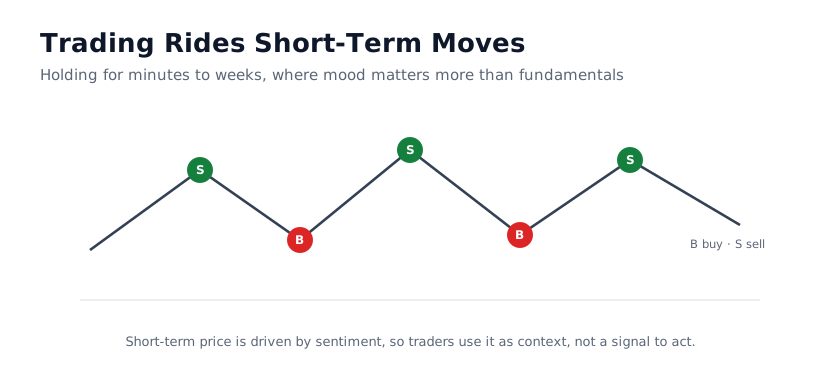
Trading is buying and selling assets to profit from price moves, usually over short periods. Where an investor holds for years, a trader may hold for seconds to weeks, using styles from scalping to position trading and relying mostly on technical analysis. Because short-term price is driven by mood more than fundamentals, traders pay close attention to sentiment, but as context, never as a guarantee of what comes next. Trading is high-risk, and most who attempt it underperform a simple long-term approach. This is education, not financial advice.
CFGI data
A Fear and Greed Index is context for a trade, not a signal. CFGI scores the crowd mood from 0 to 100, but mood tells you where sentiment stands now, not where price goes next, which is why traders use it to frame risk rather than to time entries.
Source: CFGI methodology, 0 to 100 sentiment model.
Key takeaways
- Trading aims to profit from price moves over shorter periods.
- Styles range from scalping (seconds) to position trading (months).
- Traders lean on technical analysis; investors on fundamentals.
- Risk management, not prediction, is what keeps traders in the game.
- Sentiment is context for traders, not a signal to act.
What Is Trading?
Trading is buying and selling assets to profit from changes in price. The defining feature is time: traders work over short horizons, from seconds to weeks, rather than the years an investor might hold. The shorter the horizon, the more the crowd’s mood, rather than fundamentals, drives the outcome. See trading vs investing for the full contrast, the core difference is that a trader is betting on price movement while an investor is buying a piece of a business to hold.
The Main Trading Styles
| Style | Typical hold | Relies on |
|---|---|---|
| Scalping | Seconds to minutes | Tiny moves, many trades |
| Day trading | Within a single day | Intraday moves, no overnight risk |
| Swing trading | Days to weeks | Technicals plus some fundamentals |
| Position trading | Weeks to months | Longer trends, more fundamentals |
Trading styles by holding period.
The styles form a spectrum from frantic to patient. A scalper may make dozens of trades a day for a few cents each; a position trader holds a trend for months and looks almost like an investor. Shorter styles demand more time, more discipline and lower costs per trade, and they leave less room for error.
Technical Versus Fundamental Analysis
Traders and investors tend to use different toolkits. Investors lean on fundamental analysis, the study of earnings, valuation and the economy, to decide what is worth owning. Traders lean on technical analysis, the study of price charts, volume, patterns and momentum, to decide when to buy and sell. A neat summary is that fundamental analysis tells you what to buy, while technical analysis tells you when. Over short horizons, where mood and momentum dominate and fundamentals barely move, technical and sentiment signals carry more weight, which is why they sit at the centre of most traders’ decision-making.
How Traders Manage Risk
For serious traders, survival depends far more on managing risk than on predicting prices. The essential tools are stop-losses that cap how much any single trade can lose, position sizing that limits how much capital is risked at once, and a favourable risk-reward ratio so that winners outweigh losers over time. A common rule is never to risk more than a small percentage of your account on one trade, so that no single loss, or even a string of them, can be fatal. The hard truth is that you cannot control whether a trade wins, only how much you lose when it goes wrong, which is why disciplined risk management, not a magic indicator, separates traders who last from those who blow up.
Cut Losses, Let Winners Run
You cannot control whether a trade works, only how much it costs when it does not. Sizing positions and respecting stops is what keeps a losing streak from ending your trading.
The Hard Truth About Trading
Trading is glamorised, but the odds are sobering. Study after study finds that the large majority of active traders lose money over time and underperform a simple buy-and-hold approach, with success rates falling the longer people persist. The culprits are transaction costs, taxes on frequent gains, and the sheer difficulty of consistently beating a near-random short-term market while battling your own emotions. None of this means trading is impossible, some do it well, but it means it should be approached as a demanding skill with a high failure rate, not a shortcut to wealth. For most people, patient long-term investing is the better path, and that is not a knock on trading so much as an honest reading of the base rates.
Why Traders Watch Sentiment
Because over short windows, price is largely a story about how the crowd feels. Knowing whether the market is fearful or greedy tells a trader whether the crowd has become crowded on one side, which is valuable in a world where short-term moves are driven by mood. But it is context, not a crystal ball: CFGI data mirrors the same day 79% of the time and the next day only 49%. Used well, the Fear and Greed Index is one input among many, helping a trader frame risk and spot stretched positioning, never an instruction to act on its own.
Frequently asked questions
What is trading?
Buying and selling assets to profit from short-term price moves, over horizons from seconds to weeks. It differs from investing mainly in time horizon and in relying on technical rather than fundamental analysis.
What are the main trading styles?
Scalping (seconds to minutes), day trading (within a single day), swing trading (days to weeks) and position trading (weeks to months). They form a spectrum from frantic and short-term to patient and almost investor-like.
Is trading risky?
Yes, very. Short-term trading is high-risk, and the majority who attempt it lose money and underperform a simple long-term approach, eaten by costs, taxes and emotion. Risk management is what keeps the survivors in the game. This is education, not financial advice.
Can sentiment tell a trader what to do?
No. Sentiment reads the present, not the future. CFGI data matches same-day direction 79% of the time but only 49% the next day, so it is context for framing risk, not a signal to act on alone.
CFGI.io, Market sentiment research
The CFGI research team builds and maintains the CFGI Fear and Greed Index: a 0 to 100 sentiment score from 10 sub-indicators across hundreds of crypto assets and the equity market, refreshed every 15 minutes. We have tracked market emotion through multiple full crypto and equity cycles.
Think we missed something?
Spotted a gap, disagree with a take, or think we should cover a new topic? Message us and we'll act on your input.
Message us on TelegramKeep reading
This article is educational and is not financial advice. Crypto and equities are volatile and you can lose money. See our disclaimer.