Stocks
What Is the S&P 500?
Quick answer
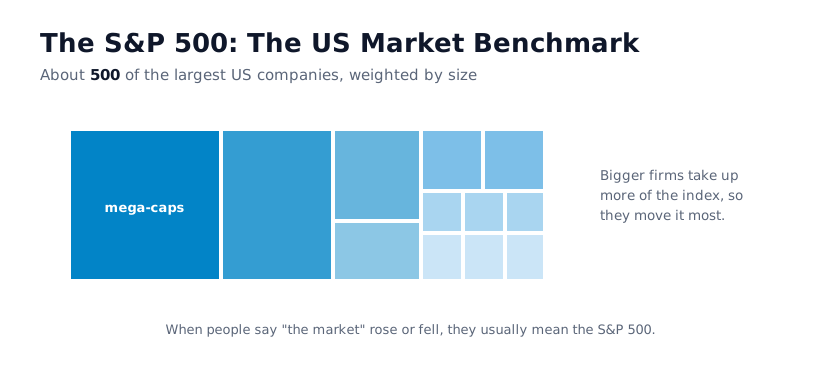
The S&P 500 is an index that tracks about 500 of the largest US public companies, weighted by size. It is the most widely used stand-in for "the US stock market", so when people say the market rose or fell, they usually mean the S&P 500. Because it is weighted by company value, a handful of mega-cap tech firms carry much of its weight, and its overall mood is a read on how the whole US market feels. This is education, not financial advice.
CFGI data
The S&P 500 is the benchmark CFGI reads for stock sentiment, and it has spanned the full scale: from an extreme-fear 3 on 8 April 2025 to a high of 83 on 19 December 2023. The Stock Fear and Greed Index scores that mood from 0 to 100, updated daily since 2021.
Source: CFGI dataset, 2021 to June 2026.
Key takeaways
- The S&P 500 tracks around 500 of the largest US companies.
- It is the standard stand-in for the US stock market.
- It is weighted by company size, so big firms move it most.
- A few mega-cap firms carry much of its weight.
- Its mood reads the feeling of the whole US market.
What Is the S&P 500?
The S&P 500 is a stock market index: a single number that tracks a basket of stocks. This basket holds roughly 500 of the largest companies listed in the US, weighted by their market value, so giants like Apple and Microsoft move it more than smaller members. Because it is so broad, covering around 80% of the total value of the US stock market, it is treated as the benchmark for the entire market, the single number that best answers "how are US stocks doing?"
How the S&P 500 Is Built
The "500" is not simply the 500 biggest companies by a mechanical rule. Membership is decided by a committee at S&P Dow Jones Indices, which selects large, established US companies that meet criteria for size, liquidity and profitability, and adds or removes members as the corporate landscape shifts. Crucially, the index is weighted by market capitalisation, so each company’s influence is proportional to its total value: a trillion-dollar firm moves the index far more than a company a fraction of its size, even though both are "members". This is why the S&P 500 is considered a high-quality gauge of the large-cap US market specifically, it is a curated, weighted snapshot of corporate America’s giants, not a simple headcount of big names.
Why Does the S&P 500 Matter So Much?
It is the reference point for almost everything in equities. Fund managers measure themselves against it, "did you beat the S&P?" is the question that defines a career, trillions of dollars track it through index funds and ETFs, and the news quotes it as "the market". It is arguably the single most important and most-watched financial index in the world. If you want one number for how US stocks are doing, this is it, and its movements ripple outward into pensions, retirement accounts and global markets alike. The tech-heavy Nasdaq and the older Dow Jones are the other common benchmarks, but neither carries quite the same weight as the default measure of "the market".
The Mega-Cap Question
Because the index is weighted by size, a subtle and important risk has grown within it: concentration. In recent years a small group of giant technology companies has come to make up a remarkably large share of the entire S&P 500, which means the index’s performance increasingly depends on the fortunes of just a handful of names. This has two consequences worth understanding. First, the headline index can look healthy while the average stock struggles, if the mega-caps are rising but most other members are flat or falling, a condition of weak "breadth". Second, it makes the index less diversified than its 500 members suggest, since so much of its movement rides on a few stocks. Watching whether a rally is broad or narrow, many stocks participating versus a few giants carrying the load, is one of the more important things the headline number alone will not tell you.
The Index Is Not Always the Average Stock
Because a few mega-caps carry so much weight, the S&P 500 can rise while most of its members lag. A healthy headline can hide weak breadth beneath the surface.
What Does Its Mood Reveal?
Because the S&P 500 represents the whole market, its sentiment is the market’s sentiment. And the equity crowd has a distinct character: it panics quickly but is slow to celebrate. CFGI data captured this in a 21% S&P 500 year that produced not a single euphoric close, fear arriving fast while euphoria stayed rare, and over its record the equity score has ranged from a deeply fearful 3 to a high of 83. Reading the S&P 500’s mood, rather than just its level, adds a dimension the price alone misses: it tells you not only where the market is, but how confident or fearful the crowd behind it feels, including whether a rise is backed by broad conviction or carried nervously by a narrow few. Read where the market mood sits now on the Stock Fear and Greed Index.
Frequently asked questions
What is the S&P 500?
An index that tracks about 500 of the largest US public companies, weighted by size, covering around 80% of the US stock market’s value. It is the most widely used stand-in for "the US stock market".
How many companies are in the S&P 500, and how is it built?
About 500 large US companies, selected by a committee at S&P Dow Jones Indices for size, liquidity and profitability. It is weighted by market value, so the biggest companies have the most influence, it is not simply the 500 biggest by a mechanical rule.
Why does concentration in the S&P 500 matter?
Because it is size-weighted, a handful of mega-cap tech firms carry much of its weight, so the index can rise while most members lag (weak breadth), and it is less diversified than 500 members suggest. Whether a rally is broad or narrow matters.
What does the S&P 500 tell you about sentiment?
As the market benchmark, its mood is the market’s mood. CFGI scores it daily, and its data shows the equity crowd panics fast while rarely turning euphoric, with the score ranging from 3 to 83. This is education, not financial advice.
CFGI.io, Market sentiment research
The CFGI research team builds and maintains the CFGI Fear and Greed Index: a 0 to 100 sentiment score from 10 sub-indicators across hundreds of crypto assets and the equity market, refreshed every 15 minutes. We have tracked market emotion through multiple full crypto and equity cycles.
Think we missed something?
Spotted a gap, disagree with a take, or think we should cover a new topic? Message us and we'll act on your input.
Message us on TelegramKeep reading
This article is educational and is not financial advice. Crypto and equities are volatile and you can lose money. See our disclaimer.