Stocks
What Is the Nasdaq?
Quick answer
Nasdaq is two things: a major US stock exchange, the world’s first fully electronic one, and a set of indices that track its companies. The most quoted is the Nasdaq 100, which is heavy on large technology names. Because tech is more growth-focused and sensitive to interest rates than the wider market, the Nasdaq is a kind of high-beta version of the market that tends to swing harder on shifts in risk appetite, which makes its mood a sharp read on fear and greed. This is education, not financial advice.
CFGI data
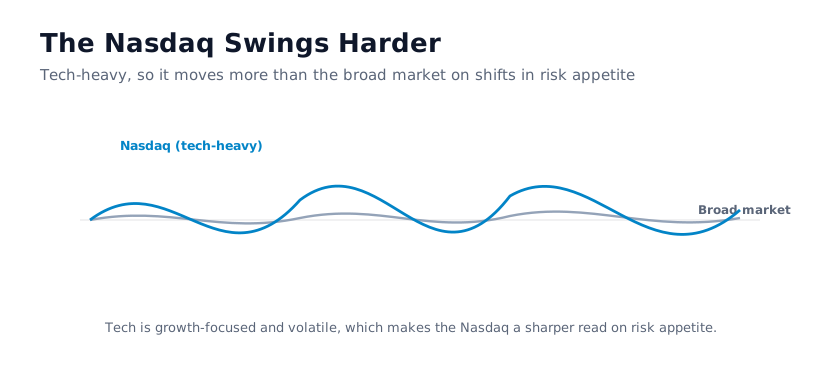
The tech-heavy Nasdaq tends to swing harder than the broad market, which makes its mood a sharper read on risk appetite. CFGI scores stock sentiment from 0 to 100, updated daily since 2021 across major indices and leading stocks, so those swings show up as a number.
Source: CFGI dataset, 2021 to June 2026.
Key takeaways
- Nasdaq is both a US exchange and a family of indices.
- The exchange was the world’s first fully electronic market.
- The Nasdaq 100 is heavy on large technology companies.
- Tech is growth-focused and rate-sensitive, so it is more volatile.
- It is a high-beta barometer that swings hard on risk appetite.
What Is the Nasdaq?
The name covers two things. First, the Nasdaq is a stock exchange, fully electronic and home to many technology companies. Second, it is a set of indices, the most famous being the Nasdaq 100, which tracks 100 of the largest non-financial companies listed there. People slip between the two meanings constantly, so it is worth keeping them straight.
The Exchange Versus the Index
The Nasdaq the exchange is a marketplace where shares are bought and sold. Launched in 1971, it was the world’s first electronic stock exchange, a "dealer" market run through market makers rather than a physical trading floor, and it grew into the second-largest exchange in the world by the value of its listings. The Nasdaq the index is different: it is a number that tracks the performance of companies listed there. The broad Nasdaq Composite covers thousands of them, while the Nasdaq 100 follows the hundred largest non-financial names. When commentators say "the Nasdaq was up today", they almost always mean the index, not the exchange, even though the same word does both jobs.
Why Is the Nasdaq So Tech-Heavy?
From early on, the Nasdaq became the natural home for technology and growth companies, so its biggest members are names like Apple, Microsoft, Nvidia and Amazon. That concentration makes the Nasdaq a kind of high-beta version of the market: it tends to rise more in good times and fall more in bad ones than the broader S&P 500. It also carries real concentration risk, since a handful of mega-cap technology stocks make up a large share of the index, so the Nasdaq’s fortunes are tied unusually tightly to how those few giants perform. When you watch the Nasdaq, you are watching big tech more than the economy as a whole.
This is why the Nasdaq and the S&P 500 can tell different stories on the same day. Because the S&P spreads across sectors like energy, healthcare, finance and consumer staples, it tends to move more gently, while the Nasdaq, dominated by a few rate-sensitive tech titans, lurches further in whichever direction the mood is heading. Comparing the two is itself informative: when the Nasdaq is falling much harder than the S&P, it is usually a sign that the market is specifically shunning risk and growth, not just drifting lower.
The Nasdaq As a Risk Barometer
The Nasdaq’s tech tilt makes it an unusually sensitive gauge of risk appetite, for a specific reason. Technology and growth stocks derive most of their value from earnings expected far in the future, which makes them "long duration": their worth is acutely sensitive to interest rates and to the mood about the future. When rates fall and optimism reigns, those distant earnings are worth more today and the Nasdaq soars; when rates rise or fear takes hold, the same earnings are discounted hard and the Nasdaq falls fastest. This is why the Nasdaq often leads the market both up and down, and why a sharp move in it is frequently the first sign that risk appetite itself is shifting.
A Magnifier of the Mood
Because its big tech names are long-duration and rate-sensitive, the Nasdaq amplifies whatever the market feels about the future, rallying hardest in greed and falling hardest in fear.
What Does the Nasdaq’s Mood Signal?
Because growth stocks are more sensitive to risk appetite and interest rates, the Nasdaq often leads the market’s mood swings. When risk appetite is high, tech runs; when fear and rising rates bite, tech falls hardest. So the Nasdaq is a sharper, more emotional gauge than the broad market, and watching it can give an early read on whether the crowd is leaning risk-on or risk-off. CFGI reads stock sentiment into the Stock Fear and Greed Index, updated daily, and because it also scores leading stocks individually, you can drill from the overall equity mood down to the tech giants that drive the Nasdaq.
Frequently asked questions
Is the Nasdaq an exchange or an index?
Both. The Nasdaq is a US stock exchange, the world’s first fully electronic one, launched in 1971, and it also lends its name to indices like the Nasdaq Composite and Nasdaq 100, which track companies listed on it. "The Nasdaq was up" usually refers to the index.
Why is the Nasdaq more volatile than the S&P 500?
Because it is concentrated in growth-focused technology companies, which are long-duration and more sensitive to risk appetite and interest rates, so they swing harder in both directions, a high-beta version of the market.
What is the Nasdaq 100?
An index tracking the 100 largest non-financial companies listed on the Nasdaq exchange, dominated by mega-cap technology names like Apple, Microsoft, Nvidia and Amazon. The broader Nasdaq Composite covers thousands of listed companies.
What does the Nasdaq say about sentiment?
It often leads the market’s mood swings. When risk appetite is high, tech runs; when fear and rising rates bite, it falls hardest, making the Nasdaq a sharp, early gauge of risk-on versus risk-off. This is education, not financial advice.
CFGI.io, Market sentiment research
The CFGI research team builds and maintains the CFGI Fear and Greed Index: a 0 to 100 sentiment score from 10 sub-indicators across hundreds of crypto assets and the equity market, refreshed every 15 minutes. We have tracked market emotion through multiple full crypto and equity cycles.
Think we missed something?
Spotted a gap, disagree with a take, or think we should cover a new topic? Message us and we'll act on your input.
Message us on TelegramKeep reading
This article is educational and is not financial advice. Crypto and equities are volatile and you can lose money. See our disclaimer.