Stocks
What Is a Stock Market Index?
Quick answer
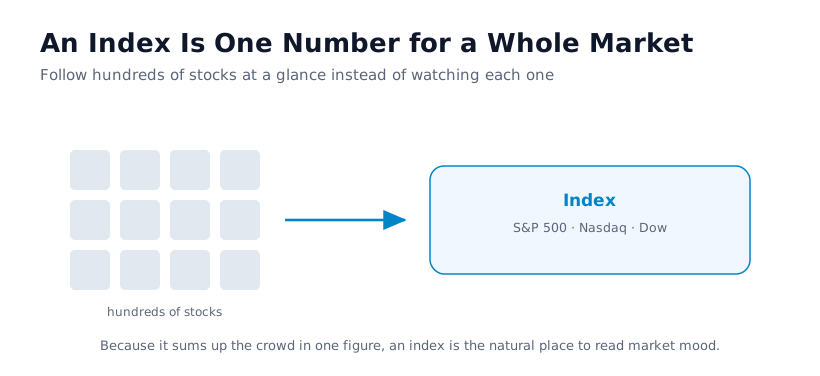
A stock market index is a single number that tracks a basket of stocks, so you can follow a whole market at a glance instead of watching hundreds of shares. The S&P 500, Nasdaq 100 and Dow Jones are the best-known. Indices are built from selection rules and a weighting method, and they are the basis for index funds that let people own a whole market at once. Because an index sums up the crowd in one figure, it is the natural place to read the market’s overall mood. This is education, not financial advice.
CFGI data
An index sums up the market in one number, which is exactly where mood is easiest to read. CFGI scores stock sentiment across major indices and leading stocks into a 0 to 100 Fear and Greed reading, updated daily since 2021, so the index mood becomes a single figure too.
Source: CFGI dataset, 2021 to June 2026.
Key takeaways
- An index tracks a basket of stocks in one number.
- The S&P 500, Nasdaq and Dow are the major examples.
- Most are weighted by company value; the Dow by share price.
- Indices are the basis for index funds and passive investing.
- An index is the natural place to read overall market mood.
What Is a Market Index?
An index bundles many stocks into a single, trackable number. Rather than follow 500 companies one by one, you watch the S&P 500 and get the gist in one figure. Indices are how we talk about "the market" being up or down, and they are the basis for index funds that let people invest in a whole market at once. When you hear that "the market rose 1% today", it is almost always an index that is being quoted.
The Major Indices
A handful of indices dominate the conversation, each representing a different slice of the market.
| Index | Tracks | Known for |
|---|---|---|
| S&P 500 | ~500 large US companies | The main market benchmark |
| Nasdaq 100 | 100 large non-financial firms | Tech-heavy |
| Dow Jones | 30 large established firms | The oldest, price-weighted |
| Russell 2000 | ~2,000 small companies | Small-cap health |
The best-known US stock indices.
The S&P 500 is the one most professionals mean by "the market", while the tech-heavy Nasdaq and the venerable Dow Jones tell their own stories.
How Are Indices Built?
Each index has rules: which companies it includes and how much weight each one carries. The weighting method matters enormously. Most modern indices, like the S&P 500 and Nasdaq 100, are weighted by company value (market capitalisation), so the biggest firms move them most, a handful of giant tech companies can swing the whole S&P. The older Dow Jones is unusual: it is weighted by share price, so a company with a high stock price counts for more regardless of its actual size, a quirk of its 19th-century origins. Some indices are equal-weighted, giving every member the same say. Indices are also periodically rebalanced, adding and removing companies as they grow or shrink, so the basket stays representative of the market it is meant to track.
Why an Index Is More Than a Number
Indices do far more than report a level. They serve as benchmarks, the yardstick against which investors and funds measure their performance, "did I beat the S&P 500?" is the question that haunts every active manager. They are the foundation of passive investing: index funds and ETFs simply hold the same basket an index tracks, letting ordinary people own a whole market cheaply, which has become one of the most popular ways to invest. And they act as a barometer of the broader economy, since the fortunes of hundreds of major companies, rolled into one line, say a great deal about the health of business and the confidence of investors. An index, in short, is both a measuring stick and a mirror. This is also why indices feature so heavily in the news and in policy: a sharp move in a major index is treated as a signal about the economy itself, capable of shaping confidence, headlines and even central-bank thinking, far beyond the fortunes of any single company within it.
A Benchmark and a Barometer
An index is the yardstick funds are measured against, the basket index funds track, and a barometer of the economy, all at once. That is why one number can carry so much weight.
Why Read Mood Through an Index?
Because an index already does the summing-up. It captures the collective behaviour of many companies, so its rises, falls and volatility reflect the mood of the whole market, not one company’s news. That makes an index the cleanest canvas for a sentiment reading, an individual stock can soar or crash on a single earnings report, but a broad index moves on the mood of the crowd. CFGI scores the major indices and leading stocks on the Stock Fear and Greed Index, turning the market’s mood into one number, so you get not just where the index is, but how the crowd behind it feels.
Frequently asked questions
What is a stock market index?
A single number that tracks a basket of stocks, so you can follow a whole market at a glance instead of watching hundreds of shares. The S&P 500, Nasdaq 100 and Dow Jones are the best-known.
What are the main US stock indices?
The S&P 500 (around 500 large companies, the main benchmark), the Nasdaq 100 (tech-heavy), the Dow Jones (30 large established firms, price-weighted) and the Russell 2000 (small-caps).
How are indices weighted?
Most modern indices, like the S&P 500 and Nasdaq 100, are weighted by company value, so the biggest firms move them most. The Dow Jones is unusually weighted by share price, and some indices are equal-weighted.
Why are indices used to measure sentiment?
Because an index already sums up many companies into one number, its moves reflect the whole market’s mood rather than a single firm’s news, which makes it the cleanest canvas for a sentiment reading. This is education, not financial advice.
CFGI.io, Market sentiment research
The CFGI research team builds and maintains the CFGI Fear and Greed Index: a 0 to 100 sentiment score from 10 sub-indicators across hundreds of crypto assets and the equity market, refreshed every 15 minutes. We have tracked market emotion through multiple full crypto and equity cycles.
Think we missed something?
Spotted a gap, disagree with a take, or think we should cover a new topic? Message us and we'll act on your input.
Message us on TelegramKeep reading
This article is educational and is not financial advice. Crypto and equities are volatile and you can lose money. See our disclaimer.