Markets
What Are Financial Markets?
Quick answer
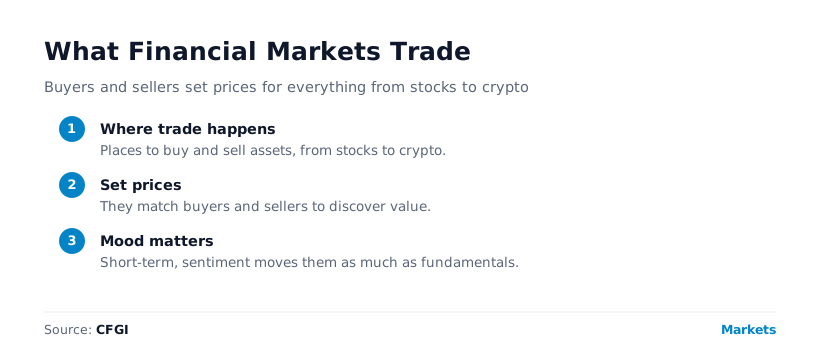
Financial markets are where people buy and sell assets such as stocks, bonds, currencies, commodities and crypto. Prices are set by supply, demand and expectations about the future. They channel money from savers to the projects that need it and let everyone price risk in real time. Over the long run prices track fundamentals, but over days and weeks they track emotion, which is why every market cycles through measurable fear and greed. This is education, not financial advice.
CFGI data
Financial markets run on the same fear and greed in every asset, and CFGI is the only score that reads both crypto and equities on one 0 to 100 scale. That shared yardstick, tracked since March 2022, is what lets you compare a crypto crowd with a stock crowd directly rather than guessing at the difference.
Source: CFGI dataset, March 2022 to June 2026.
Key takeaways
- Financial markets are where assets are priced and traded between buyers and sellers.
- The main types are equities, bonds, currencies (forex), commodities and crypto.
- They channel capital to where it is needed and let everyone price risk.
- A price is the crowd’s collective expectation, not a fixed truth.
- In the short run emotion drives price, so sentiment is a measurable edge.
What Are Financial Markets, In Plain Terms?
A financial market is any place, physical or digital, where buyers and sellers trade assets and discover a price. That price is the single number on which the whole crowd currently agrees, and it updates every time a trade happens. Markets exist to do two big jobs: move money from people who have it to projects that need it, and let everyone price risk and opportunity in real time. From a centuries-old stock exchange to a 24/7 crypto market, they are all variations on the same simple idea, a meeting place where the price of something is settled by what people are willing to pay.
What Are the Main Types of Financial Market?
- Equities (stocks): ownership in public companies. See what the stock market is.
- Bonds: loans to governments or companies that pay interest.
- Currencies (forex): the largest market in the world, where one currency is traded for another.
- Commodities: physical goods like oil, gold and wheat.
- Crypto: digital assets on a blockchain that trade 24/7. See what cryptocurrency is.
These markets differ in what they trade and when they are open, but they are deeply interconnected: a shock in one, a spike in bond yields or a crash in crypto, ripples through the others, because the same investors and the same risk appetite move between them.
Why Do Financial Markets Matter?
Financial markets are easy to dismiss as a casino for the wealthy, but they perform jobs that are genuinely vital to a functioning economy. The first is "capital allocation": markets channel savings toward the companies, governments and projects that can put them to productive use, funding the businesses that build, hire and innovate, this is why companies issue shares and bonds in the first place. The second is "liquidity": because there is almost always someone willing to buy or sell, markets let people convert assets into cash and back again, which makes saving and investing practical for everyone. The third is "price discovery": the constant tug of buyers and sellers continuously settles on a fair, up-to-the-minute price for everything, embedding information and expectations into a single number. And the fourth is acting as a barometer of confidence in the economy. In short, financial markets are the circulatory system of modern capitalism, moving capital to where it is most useful and pricing risk for the whole economy in real time.
The Economy’s Circulatory System
Markets allocate capital to productive uses, provide liquidity, discover fair prices and gauge confidence. They are not just a place to trade, but core machinery of a functioning economy.
How Are Prices Set In a Market?
Price is set by supply and demand. When more money wants to buy than to sell, price rises until enough sellers appear, and the reverse when fear takes over. Every buyer and seller is acting on their own read of the news, the data and, crucially, what they think everyone else will do next. That last part is why markets are reflexive: expectations move price, and price then changes expectations. A rising market makes people feel optimistic, which fuels more buying, until it does not. This feedback loop between price and emotion is what gives markets their characteristic boom-and-bust rhythm, and it is the reason the same simple supply-and-demand mechanism can produce both calm, orderly trading and wild bubbles and crashes.
Why Does Emotion Drive Markets?
Behind every price is a person, and people are not coldly rational about money. The same two emotions show up in every market and every era: "greed" when prices rise and nobody wants to miss out, and "fear" when prices fall and everyone wants out at once. Those emotions move in cycles, from optimism to euphoria to anxiety to panic and back. The cycle is why markets overshoot in both directions, and why the crowd is so often most confident at the top and most despairing at the bottom.
The Contrarian Idea
If the crowd is usually wrong at the extremes, then measuring the crowd is useful. That is the entire premise behind a Fear and Greed Index.
What Is the Fear and Greed Index?
The Fear and Greed Index turns market emotion into a single score from 0 (extreme fear) to 100 (extreme greed). Rather than guess the mood, it reads measurable signals, such as volatility, momentum, volume and demand for safer assets, and rolls them into one number you can track over time. CFGI runs the idea across both major markets: a Crypto Fear and Greed Index covering hundreds of assets, and a Stock Fear and Greed Index for equities. Both update continuously, so you can see how the crowd is positioned before you decide how you want to position, and, because they share one scale, compare a crypto crowd with a stock crowd directly.
Frequently asked questions
What are financial markets?
Any place, physical or digital, where buyers and sellers trade assets and discover a price. They channel money from savers to the projects that need it and let everyone price risk and opportunity in real time.
What are the main financial markets?
The big five are equities (stocks), bonds, currencies (forex), commodities and crypto. They differ in what they trade and when they are open, but all are priced by supply, demand and crowd sentiment, and they are deeply interconnected.
Why do financial markets matter?
They allocate capital to productive uses (funding companies and governments), provide liquidity (letting people convert assets to cash and back), discover fair prices, and gauge economic confidence. They are the circulatory system of a modern economy.
What moves financial markets?
Over the long run, fundamentals like earnings, growth and interest rates. Over the short run, sentiment: how fearful or greedy the crowd feels about those fundamentals. That short-run mood is what a Fear and Greed Index measures. This is education, not financial advice.
CFGI.io, Market sentiment research
The CFGI research team builds and maintains the CFGI Fear and Greed Index: a 0 to 100 sentiment score from 10 sub-indicators across hundreds of crypto assets and the equity market, refreshed every 15 minutes. We have tracked market emotion through multiple full crypto and equity cycles.
Think we missed something?
Spotted a gap, disagree with a take, or think we should cover a new topic? Message us and we'll act on your input.
Message us on TelegramKeep reading
This article is educational and is not financial advice. Crypto and equities are volatile and you can lose money. See our disclaimer.