Stocks
What Is a Stock Bear Market?
Quick answer
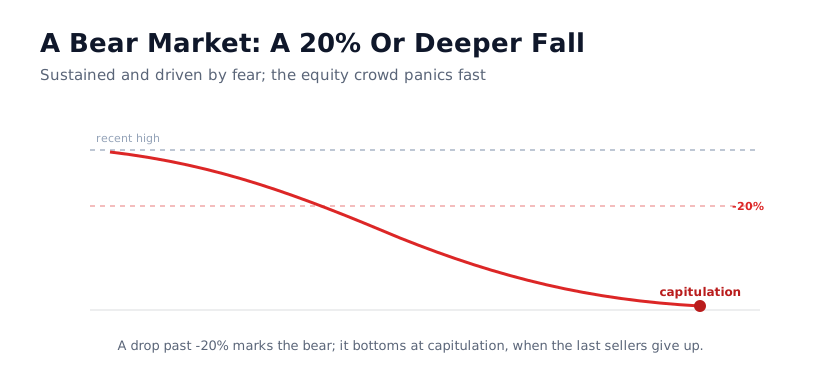
A stock bear market is commonly defined as a fall of 20% or more from a recent high, sustained over time and driven by fear. The equity crowd is quick to panic, so fear arrives fast even if it stops short of crypto-style extremes. Bear markets move through emotional stages, from denial to capitulation, and they bottom at capitulation, when the last sellers finally give up. This is education, not financial advice.
CFGI data
The equity crowd panics fast, but with more restraint than crypto. On 5 February 2026 CFGI scored the stock market at 35, ordinary fear, while crypto sat at an all-time low of 12. The Stock Fear and Greed Index reads that mood from 0 to 100, updated daily since 2021.
Source: CFGI dataset, 2021 to June 2026.
Key takeaways
- A bear market is commonly a fall of 20% or more from a high.
- It is sustained and driven by fear.
- The equity crowd panics fast.
- It moves through emotional stages, denial to capitulation.
- Bottoms form at capitulation, when sellers give up.
What Is a Stock Bear Market?
A bear market is an extended decline, the mirror of a bull market. A common rule of thumb is a drop of 20% or more from a recent peak. The name comes from a bear swiping its paws downward. It is driven by fear: weakening confidence, falling earnings expectations, or a shock like a recession. Where a bull market is a slow climb on confidence, a bear market is a faster, more violent affair, because fear is a sharper and more urgent emotion than greed.
What Defines a Bear Market
The 20% threshold is the headline definition, but the character matters as much as the number. A fall of 10% to 20% is usually called a correction, a normal and frequent event; a bear market is the deeper, more sustained decline beyond that. Analysts often distinguish three kinds. A cyclical bear market is tied to the economic cycle, typically a recession, and is the most common. A secular bear market is a longer, structural downturn that can grind on for years. And an event-driven bear market is triggered by a sudden shock, a pandemic, a war, a financial crisis, and can be sharp but shorter-lived. Bear markets are also, historically, shorter than bull markets, reflecting the long-run upward drift of the economy, but they can be far more intense while they last.
How Does Fear Drive a Bear Market?
The equity crowd is quick to panic. Selling spreads, money rotates to safe havens like bonds and gold, and the mood feeds on itself: falling prices breed more fear, which brings more selling, a vicious cycle that can feed on its own momentum. Stocks fall faster than they rise, because fear is faster than greed, the market takes the stairs up and the elevator down. Yet equities rarely reach crypto-style extremes. On 5 February 2026, CFGI scored stocks at 35, ordinary Fear, while crypto hit an all-time low of 12: same day, two very different depths of fear, a reminder that the steadier, more institutional equity crowd panics with more restraint than crypto’s.
The Stages of a Bear Market
A bear market tends to move through a recognisable emotional arc, the mirror image of a bull market’s climb. It often begins in denial, as investors dismiss the early falls as a passing dip and "buy the dip" out of habit. As losses deepen, denial gives way to genuine fear, then to outright panic as the selling accelerates. Finally comes capitulation, the moment of maximum despair when even the most stubborn holders give up and sell, often followed by a period of gloomy disinterest before hope slowly returns. The path down is rarely a straight line: it is punctuated by sharp bear market rallies, violent bounces that tempt buyers back in before fading to new lows. Recognising which stage the market is in, especially the difference between early denial and final capitulation, is one of the harder and more valuable skills in investing.
Denial, Fear, Panic, Capitulation
Bear markets move through emotional stages and are punctuated by false-dawn rallies. The deepest despair, capitulation, tends to come near the end, not the beginning.
Why Does Capitulation Mark the Bottom?
A bear market ends when the selling exhausts itself. Once the determined sellers have sold and fear is widespread, there is simply no one left to sell, so even modest buying can turn the market. That is why capitulation, the point of maximum, exhausted fear, so often clusters near bottoms, though it never guarantees one. This is the deep logic behind contrarian thinking: the moment of greatest pessimism, when it feels most foolish to buy, is frequently the point of greatest opportunity, precisely because all the bad news and forced selling are finally spent. An extreme fear reading does not ring a bell at the exact low, nothing does, but it tells you the conditions a bottom forms from are in place. Read the equity mood on the Stock Fear and Greed Index.
Frequently asked questions
What counts as a bear market?
A common definition is a fall of 20% or more from a recent high, sustained over time. A smaller, shorter drop of 10% to 20% is usually called a correction.
What are the types of bear market?
Cyclical (tied to a recession, the most common), secular (a longer structural downturn lasting years), and event-driven (triggered by a sudden shock like a pandemic or crisis, often sharp but shorter).
What are the stages of a bear market?
A recognisable emotional arc: denial (dismissing the dip), then fear, then panic as selling accelerates, and finally capitulation, the moment of maximum despair. The path down is punctuated by sharp bear market rallies that fade to new lows.
Why does capitulation mark the bottom?
Because once the determined sellers have sold and fear is widespread, there is no one left to sell, so even modest buying can turn the market. Extreme fear clusters near bottoms, though it never guarantees one. This is education, not financial advice.
CFGI.io, Market sentiment research
The CFGI research team builds and maintains the CFGI Fear and Greed Index: a 0 to 100 sentiment score from 10 sub-indicators across hundreds of crypto assets and the equity market, refreshed every 15 minutes. We have tracked market emotion through multiple full crypto and equity cycles.
Think we missed something?
Spotted a gap, disagree with a take, or think we should cover a new topic? Message us and we'll act on your input.
Message us on TelegramKeep reading
This article is educational and is not financial advice. Crypto and equities are volatile and you can lose money. See our disclaimer.