Crypto
What Is Capitulation In Crypto?
Quick answer
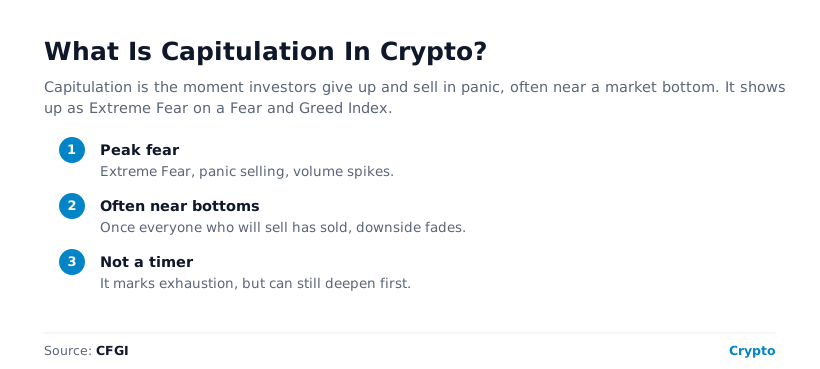
Capitulation is the point where investors give up hope and sell en masse, usually after a long decline. Prices drop sharply on heavy volume as the last holders throw in the towel, often amplified by forced liquidations. Because it marks the moment the crowd is most fearful and selling is most exhausted, capitulation often happens near a market bottom, and it shows up as Extreme Fear on a Fear and Greed Index. This is education, not financial advice.
CFGI data
Capitulation registers as the deepest readings on the scale. In CFGI data since March 2022, Extreme Fear under 20 clusters around these give-up moments, because capitulation is the crowd at its most one-sided, exactly what a sentiment score at the bottom of its range captures.
Source: CFGI dataset, March 2022 to June 2026.
Key takeaways
- Capitulation is mass surrender: investors sell in panic, giving up.
- It usually comes after a long decline, on heavy volume.
- It is often amplified by forced liquidations.
- It often happens near a market bottom, as selling exhausts.
- It shows up as Extreme Fear on a Fear and Greed Index.
The Moment the Crowd Gives Up
Capitulation is an emotional event, not just a price one. After a long decline, the holders who insisted they would never sell finally do, all at once. The result is a sharp drop on heavy volume, a sign that selling pressure is exhausting itself because almost everyone who wanted out is now out. That is why capitulation often marks a bottom: once the last sellers have sold, there is little supply left to push price lower, and the path of least resistance can flip. It is not a guarantee, but it is why deep Extreme Fear draws contrarian attention.
The Signs of Capitulation
Capitulation has a recognisable, violent signature, distinct from an ordinary down day.
- A sharp, accelerating drop: the decline steepens into a near-vertical plunge rather than a gentle slide.
- A spike in volume: a flood of selling as everyone heads for the exit at once.
- A cascade of liquidations: over-leveraged positions are force-sold, pouring fuel on the fire.
- Deep Extreme Fear: sentiment plunges to the bottom of the scale.
- Despair in the mood: the headlines and the crowd turn to "it is over", "crypto is dead".
When several of these appear together, the market is showing the classic marks of a give-up moment, the emotional low point of the decline.
Why Capitulation Marks a Bottom
The reason capitulation so often coincides with a low is simple supply and demand. A market falls as long as there are sellers willing to accept ever-lower prices. Capitulation is the moment that supply runs out: when even the most stubborn, committed holders have finally thrown in the towel, there is almost no one left to sell. With the selling pressure exhausted, it takes only modest buying to turn the tide, and the path of least resistance flips from down to up. This is the grain of truth behind the old saying that "the bottom is made when the last bull capitulates", the worst-feeling moment, when surrender is total, is frequently the point of maximum opportunity, even though it is impossible to recognise with certainty in real time.
Maximum Pain, Minimum Supply
Capitulation feels like the end, and that feeling is the point: once everyone has sold in despair, there is little selling left to do, which is why give-up moments so often sit near the lows.
Capitulation In a Crypto Winter
Capitulation events are landmarks of crypto’s deepest declines and often punctuate a crypto winter. The 2022 downturn offered textbook examples: the collapse of the Terra ecosystem in May, and later the failure of the FTX exchange, each triggered waves of forced selling and despair that sent sentiment to its extremes, with the crypto score falling to a deep 17 during the Terra event. These cascades, where one failure liquidates the next in a chain, are how crypto’s heavy leverage turns a decline into a capitulation. The flush is brutal, but it is also how the excess of the prior boom is finally cleared out, setting the stage, historically, for the long, quiet accumulation that follows.
Capitulation and Extreme Fear
On the Crypto Fear and Greed Index, capitulation reads as Extreme Fear, the bottom of the 0 to 100 scale. The index does not call the exact low, but a deep fear reading on heavy selling is the data signature of a crowd that may be capitulating. For a contrarian, that is a moment to watch closely rather than to join, and its most valuable use is often defensive: when the gauge is pinned at an extreme and every instinct screams to sell, capitulation is precisely the moment history suggests you should slow down. Selling into the give-up flush tends to crystallise losses at the worst price, which is why the deepest Extreme Fear readings, painful as they are, so often appear near the lows that later looked like the best opportunities.
Frequently asked questions
What does capitulation mean in crypto?
The moment investors give up and sell in panic, usually after a long decline and on heavy volume, often amplified by forced liquidations. Because the crowd is most fearful and selling most exhausted then, capitulation often happens near a market bottom.
What are the signs of capitulation?
A sharp, accelerating drop, a spike in selling volume, a cascade of liquidations, sentiment plunging to deep Extreme Fear, and despair in the headlines and crowd. When several appear together, it has the marks of a give-up moment.
Does capitulation mark the bottom?
Often, but not always. Once even the most stubborn holders have sold, there is little supply left to push price lower, so the path of least resistance can flip. It is a contrarian signal, not a guarantee, and impossible to confirm in real time.
How is capitulation shown on the Fear and Greed Index?
As Extreme Fear, a reading under 20, on heavy selling, like the crypto score’s fall to 17 during the Terra collapse. Its most valuable use is often defensive: not selling into the give-up flush. This is education, not financial advice.
CFGI.io, Market sentiment research
The CFGI research team builds and maintains the CFGI Fear and Greed Index: a 0 to 100 sentiment score from 10 sub-indicators across hundreds of crypto assets and the equity market, refreshed every 15 minutes. We have tracked market emotion through multiple full crypto and equity cycles.
Think we missed something?
Spotted a gap, disagree with a take, or think we should cover a new topic? Message us and we'll act on your input.
Message us on TelegramKeep reading
This article is educational and is not financial advice. Crypto and equities are volatile and you can lose money. See our disclaimer.