Stocks
What Is a Stock Market Correction?
Quick answer
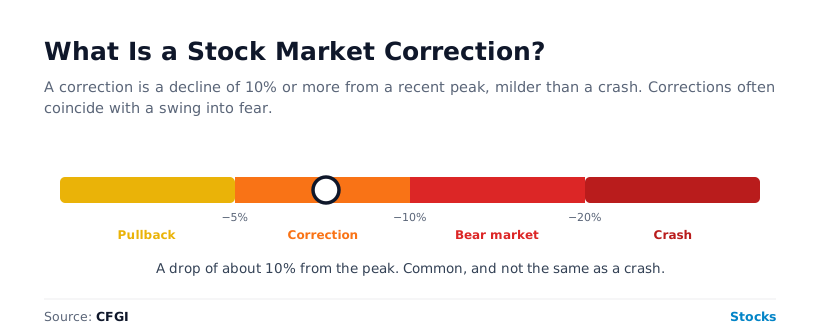
A stock market correction is a decline of 10% or more from a recent peak, but less severe than a 20% bear market. Corrections are a normal, even healthy, part of investing, they happen roughly every year or two, release built-up greed, and reset valuations without ending a bull market. They typically come with a swing in sentiment from greed toward fear, which a Fear and Greed Index captures as it happens. This is education, not financial advice.
CFGI data
Corrections are sentiment resets. A 10% pullback usually drags CFGI from greed toward fear on its 0 to 100 scale, and the sharper the drop, the deeper the reading. Watching the score through a correction shows whether fear is merely cooling greed or tipping toward panic.
Source: CFGI dataset, 2021 to June 2026.
Key takeaways
- A correction is a fall of 10% or more from a recent peak.
- It is milder than a 20% bear market and differs from a crash.
- Corrections of 10% or more happen roughly every year or two.
- They are normal and can be healthy, resetting valuations.
- They usually come with a swing from greed toward fear.
A Normal Part of the Cycle
The convention is simple: a fall of 10% or more from a recent high is a correction; 20% or more is a bear market. Corrections happen regularly, often more than once a year in some markets, and they are not a sign that something is broken. They release excess greed, shake out weak hands and reset stretched valuations. For long-term investors, corrections are usually noise rather than emergency. The danger is reacting to them emotionally, selling into the dip rather than riding it out.
Correction Versus Crash Versus Bear Market
Three terms get muddled, but they describe different things.
| Term | Size | Character |
|---|---|---|
| Correction | 10% to 20% drop | Gradual, common, often healthy |
| Crash | 10%+ in days | Sudden, panic-driven |
| Bear market | 20%+ drop | Prolonged, months to years |
Three kinds of decline.
A correction is defined by depth, 10% to 20%, regardless of speed. A crash is defined by speed, an extreme drop over days. A bear market is the deepest and longest. A correction can deepen into a bear market, but most do not.
How Often, and How Deep
Corrections are far more routine than headlines suggest. Since 1980, the US market has fallen 10% or more in roughly half of all calendar years, and a 10%-plus correction has arrived on average about every year to two years. Smaller dips are even more common: pullbacks of 5% or more happen several times in a typical year. In other words, double-digit declines are not rare disasters but a regular feature of investing, the price of admission for the long-run returns stocks provide. Knowing how ordinary they are is itself a defence, because the investor who expects corrections is far less likely to panic when one arrives.
Why Corrections Are Healthy
Counterintuitively, corrections do the market good. By pulling prices back from frothy highs, they let air out of building bubbles before they grow dangerous, reset stretched valuations to more reasonable levels, and flush out the excess leverage and speculation that accumulate in a long rally. They also hand patient investors a chance to buy quality assets at lower prices. The proof is in the long-run numbers: despite these frequent declines, the US market has still delivered strong average annual returns of well over 10% across the decades. Corrections are not the opposite of a healthy market; they are part of what keeps one healthy.
The Release Valve
A market that never corrected would inflate into an ever-bigger bubble. Regular 10% pullbacks are the pressure-release valve that lets a bull market last.
How to Handle One
The biggest mistake in a correction is letting fear drive the decision. History is clear that corrections recover, often within months, and that selling into the dip tends to lock in losses and risk missing the rebound, which frequently comes fast. For a long-term investor with a sound plan, the usual right answer is to do nothing, to ride it out, because time in the market reliably beats trying to time it. Some investors go further and treat a correction as a buying opportunity, adding gradually to quality holdings at better prices. Either way, the discipline is the same: react to your plan, not to the falling number on the screen.
Corrections and Sentiment
A correction is a sentiment reset in real time. As prices fall 10% or more, a Stock Fear and Greed Index typically swings from greed toward fear, and watching it through the decline helps tell whether the move is a healthy cooling of greed or the start of something deeper. If the gauge slides from Extreme Greed back toward neutral, the correction may simply be releasing froth; if it plunges into Extreme Fear, the crowd is closer to panic, which contrarians watch for signs of an overdone, potentially buyable low. The number turns an anxious, ambiguous slide into something you can actually read.
Frequently asked questions
What is a stock market correction?
A decline of 10% or more from a recent peak, but less than a 20% bear market. Corrections are a normal, often healthy, part of investing that happen roughly every year or two.
What is the difference between a correction, a crash and a bear market?
A correction is a 10% to 20% decline defined by depth; a crash is a sudden extreme drop over days, defined by speed; a bear market is a deeper, prolonged decline of 20% or more. A correction can deepen into a bear market, but most do not.
Are corrections bad?
Not necessarily. They release built-up greed, reset valuations, flush out excess speculation and create buying opportunities, without ending a bull market. Despite frequent corrections, long-run market returns have been strongly positive.
How should I handle a correction?
Usually by not panic-selling. Corrections tend to recover within months, and selling into the dip risks locking in losses and missing the rebound. For long-term investors they are usually noise; some treat them as a chance to buy. This is education, not financial advice.
CFGI.io, Market sentiment research
The CFGI research team builds and maintains the CFGI Fear and Greed Index: a 0 to 100 sentiment score from 10 sub-indicators across hundreds of crypto assets and the equity market, refreshed every 15 minutes. We have tracked market emotion through multiple full crypto and equity cycles.
Think we missed something?
Spotted a gap, disagree with a take, or think we should cover a new topic? Message us and we'll act on your input.
Message us on TelegramKeep reading
This article is educational and is not financial advice. Crypto and equities are volatile and you can lose money. See our disclaimer.